- Fungi Including Lichens
- ›Ascomycete Fungi
- ›Sac Fungi and Lichens
- ›Common Lichens
- ›Shield Lichens, Sunburst Lichens, Rosette Lichens, and Allies
- ›shield lichens, rim lichens, and allies
- ›Pilocarpaceae
- ›Podotara
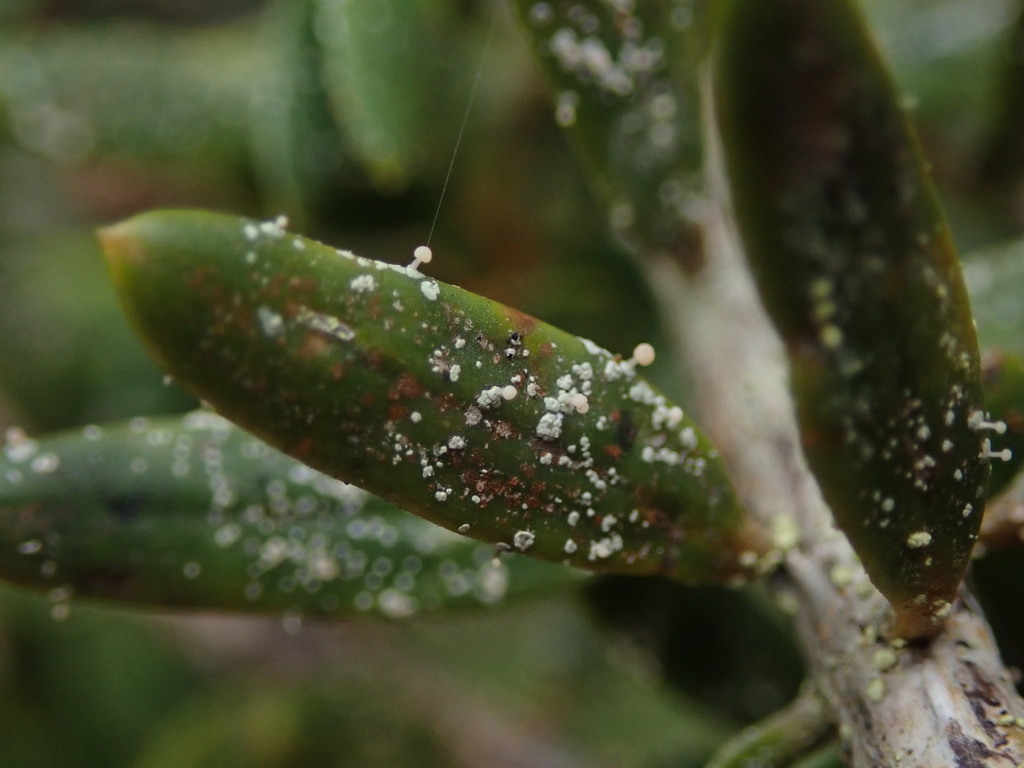
Podotara pilophoriformis
Podotara is a fungal genus in the family Ectolechiaceae. It is a monotypic genus, containing the single species Podotara pilophoriformis, an uncommon foliicolous (leaf-dwelling), crustose lichen that grows on Podocarpus totara, a species of podocarp tree endemic to New Zealand. Both the genus and the species were proposed in 1996.
From the article Podotara on Wikipedia (CC BY-SA), quoted section by section
Description
The thallus of Podotara pilophoriformis is crustose, appearing as isolated patches, with a diameter range of 0.3 to 0.5 mm. The mature thallus displays a cracked-areolate texture, with individual areolae measuring between 0.3 and 0.5 mm in width. Characteristically, the thallus exhibits a white hue, around 0.1 mm in thickness, incorporating green algal cells belonging to the genus Trebouxia. A unique feature of Podotara pilophoriformis is the absence of prothallus. The apothecia, round and sometimes formed by a fusion of two or more tubercles, have a rosy colour and measure between 0.3 and 0.35 mm across. They stand on a white stalk, ranging from 0.2 to 0.4 mm in length and 0.1 mm in width. Inside, the hymenium is clear, around 70 μm tall, with straight paraphyses that partly intertwine and measure 1.5 μm in thickness. The ellipsoid ascospores are four-loculed, ranging in size from 12 to 15 μm by 2.5 to 3 μm. The chemistry of Podotara pilophoriformi is also distinctive. The thallus reacts to a solution of potassium hydroxide (KOH, a standard chemical spot test) by turning red. It contains norstictic acid, connorstictic acid, salazinic acid, and galbinic acid. Additionally, the hymenial jelly surrounding the ascus turns blue when in contact with iodine (I), with a darker blue tube structure also evident. The apothecia, similar to the thallus, react to KOH with a red colour.
Range & habitat
The habitat of Podotara pilophoriformis is highly specialised, with the species growing epiphyllously (i.e., on the upper surface) on the leaves of Podocarpus totara, a native podocarp in New Zealand. The type specimen was collected on Pakawau Creek Road (Golden Bay, South Island). Some other lichens that typically grow in association with P. pilophoriformis include Bactrospora metabola, Bacidia sp., Lecanora sp., Megalaria grossa, and Rinodina malcolmii.
== References ==
Wikipedia: “Habitat and distribution”
Where it lives
Recorded sightings
—
geo-referenced records in GBIF, from museums, herbaria and field observers.
Drag the globe to turn it. Dots are where records exist, not a range map; darker means more records.
In the stacks
Searching the stacks…
Every page naming Podotara pilophoriformis in the Biodiversity Heritage Library →
This page is assembled live from iNaturalist, GBIF, Wikipedia, the Source Library and the Internet Archive. It is not yet part of the hand-edited codex. iNaturalist taxon 405085.