- Fungi Including Lichens
- ›Ascomycete Fungi
- ›Sac Fungi and Lichens
- ›Common Lichens
- ›Shield Lichens, Sunburst Lichens, Rosette Lichens, and Allies
- ›Peltigerales
- ›Lobariaceae
- ›Pseudocyphellaria
Seaweed Lichen
Pseudocyphellaria carpoloma
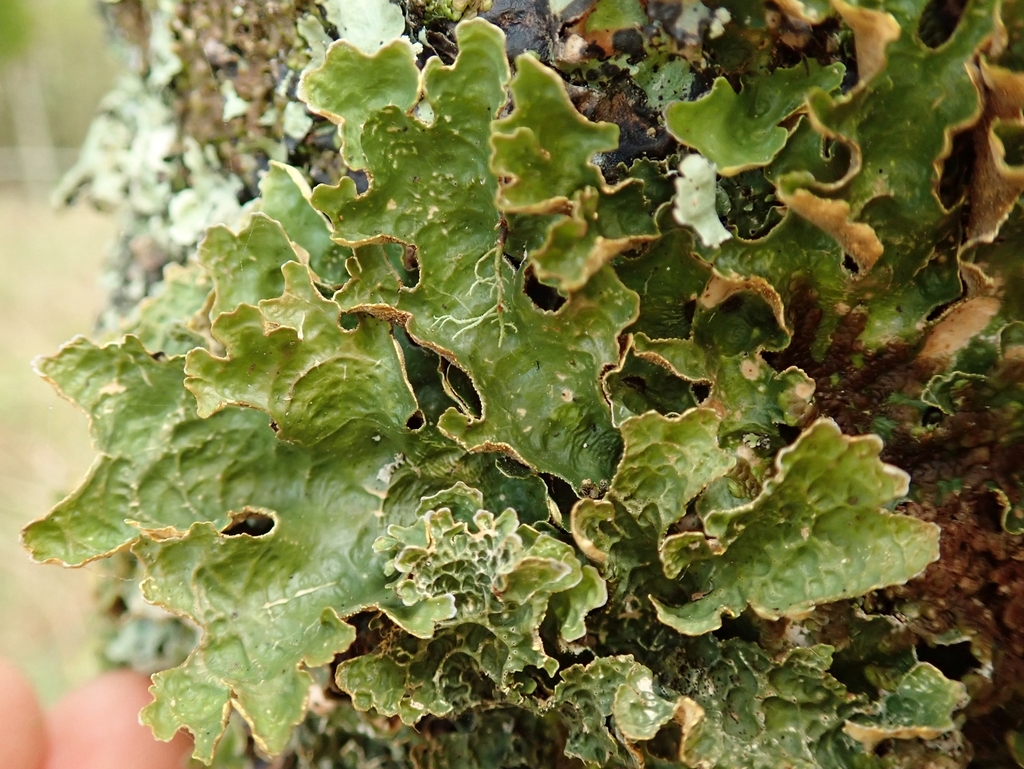
Pseudocyphellaria carpoloma is a species of corticolous (bark-dwelling), foliose lichen in the family Peltigeraceae. It is found in New Zealand, most commonly in northern coastal forest, but also on the west coast of South Island, on Stewart Island, and in the Kermadec Islands. The bright green upper surface, dichotomously branching nature of its lobes, as well as the yellow pseudocyphellae on the lobe margins and lower surface are characteristics that distinguish it from other New Zealand species in genus Pseudocyphellaria, such as P. billardierii, P. faveolata and P. rufovirescens.
From the article Pseudocyphellaria carpoloma on Wikipedia (CC BY-SA), quoted section by section
Description
The thallus of Pseudocyphellaria carpoloma has a diameter ranging between 50 and 500 mm. This lichen presents itself in vast, sprawling arrays that resemble a loosely tangled growth. The lobes of the lichen, measuring between 30–80 mm by 10–70 mm, have a distinct branching pattern – their formation subtly reminiscent of a dichotomy. Their margins are intact and delicately underlined with a yellow, wart-like structure known as pseudocyphellae. The lobes, when observed closely, display an array of colours. From a vivid lettuce-green or olive-green when wet to a pale greyish-green when dry, they often carry brownish undertones, particularly towards their tips. The lobes are strongly faveolate, meaning they have pits or depressions, giving the surface a somewhat dimpled appearance. The lichen does not produce isidia, phyllidia, maculae, or soredia–asexual reproductive propagules present in some other members of the genus. Pseudocyphellaria carpoloma has a white medulla (the inner layer), and it possesses a photobiont (photosynthesising partner), the green algal species Chlorella sphaerica. The lower surface ranges from a pale yellow margin to a buff, brownish or dark red-brown central region. …
Range & habitat
Pseudocyphellaria carpoloma occurs in New Zealand, most commonly in northern coastal forest, but also on the west coast of South Island, on Stewart Island, and in the Kermadec Islands. It has been recorded growing on the trunk of the endemic palm tree Rhopalostylis sapida.
== References ==
Wikipedia: “Habitat and distribution”
Where it lives
Recorded sightings
—
geo-referenced records in GBIF, from museums, herbaria and field observers.
Drag the globe to turn it. Dots are where records exist, not a range map; darker means more records.
In the stacks
Searching the stacks…
Every page naming Pseudocyphellaria carpoloma in the Biodiversity Heritage Library →
This page is assembled live from iNaturalist, GBIF, Wikipedia, the Source Library and the Internet Archive. It is not yet part of the hand-edited codex. iNaturalist taxon 405272.