- Plants
- ›Vascular Plants
- ›flowering plants
- ›monocots
- ›grasses, sedges, cattails, and allies
- ›grasses
- ›Oatgrasses, Pampasgrasses, and allies
- ›Oatgrasses, Pampasgrasses, and allies
- ›Rytidosperma
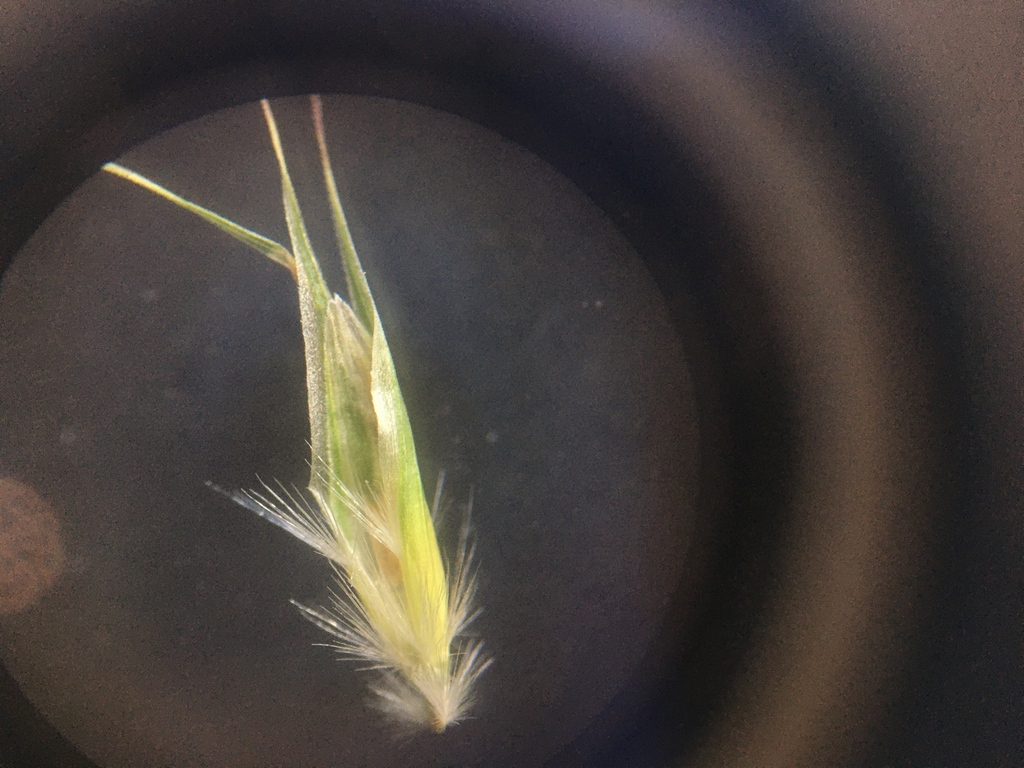
Rytidosperma clavatum
Rytidosperma clavatum is a species of true grass in the subfamily Danthonioideae. It is endemic to New Zealand and was described as Notodanthonia clavata in 1963 by Russian-New Zealand botanist Victor Zotov.
From the article Rytidosperma clavatum on Wikipedia (CC BY-SA), quoted section by section
Description
R. clavatum is a shortly rhizomatous grass forming spreading tufts, with extravaginal branching. Its leaf-sheaths are light grey-brown. Its inflorescences are organised in racemes or racemose panicles, on culms up to 90cm. The spikelets comprise 5-10 fertile florets with awns clearly emerging from glumes. The florets have lobed apexes, and a single awn. The florets contain three rows of hairs, one on the callus, and two often marginal tufts on the lemmas. The upper lemma hairs are marginal tufts longer or equal to the lemma, but well exceeded by the lateral lemma lobes. The lower row is short, barely or not reaching the upper lemma hairs. The lemmas are otherwise glabrous and shining. The callus hairs overlap the lower lemma hairs. The awn is flat at the base of its sinus and concealing top of palea, which is usually longer than it.
Identification. As a Rytidosperma, the easiest way to identify R. clavatum is to select a single floret (which will contain a single awn, two lateral lobes, and usually three rows of hairs - one on the callus and two on the lemma). The arrangement of the hairs, as well as the relative lengths of the awn, lateral lobes, sometimes the callus can help identify to species, using a key such as that found in the New Zealand Flora.
Similar species. R. clavatum is very similar to the exotic R. racemosum. R. …
Range & habitat
R. clavatum is endemic to New Zealand, found in the North Island south of Auckland, throughout the South Island east of the main divide, and on the Chatham Islands. In 2007, a new northernmost record was found at Great Barrier Island, in the Hauraki Gulf. R. clavatum was apparently sown over extensive areas of hill pastures early in the 1900s, under the name Danthonia pilosa. Zotov collected the specimen he listed as a holotype in a railway cutting in Upper Hutt on the 12th December 1952.
Wikipedia: “Distribution”
What it does
R. clavatum is a grass open, dry areas in lowland and montane zones. It is often found on rock outcrops surrounded by pasture.
Associated species. In Tongariro National Park, R. clavatum is described as growing in habitat dominated by dwarf shrubs Dracophyllum recurvum, Gaultheria colensoi and Calluna vulgaris with herbs Anisotome aromatica and Celmisia spectabilis. On the Waimakariri and Rakaia floodplains, R. clavatum is associated with Discaria toumatou, Olearia adenocarpa, Austrostipa nodosa, Anthoxanthum odoratum, Rumex acetosella, and Racomitrium curiosissimum.
Parasites and herbivores. The rust fungus Uromyces danthoniae, a species found that grows parasitically on the leaves of several Rytidosperma species in New Zealand and Australia, infects Rytidosperma viride. It forms dense clusters of orange-brown aecidia on both surfaces of the leaf. The phytopathogenic fungus Colletotrichum graminicola is recorded growing on the senescing leaves of R. clavatum. The smut fungi Sphaerodothis danthoniae and Ustilago agropyri have also been recorded on R. clavatum. R. clavatum is eaten by sheep, cattle, and rabbits.
Wikipedia: “Habitat and ecology”
In human culture
Rytidosperma: 'wrinkled seed' from the Greek 'rhytidos' = wrinkled and 'sperma' = seed clavatum, from the Latin clavatus, meaning ‘club-shaped’.
Wikipedia: “Etymology”
Where it lives
Recorded sightings
—
geo-referenced records in GBIF, from museums, herbaria and field observers.
Drag the globe to turn it. Dots are where records exist, not a range map; darker means more records.
In the stacks
Searching the stacks…
Every page naming Rytidosperma clavatum in the Biodiversity Heritage Library →
This page is assembled live from iNaturalist, GBIF, Wikipedia, the Source Library and the Internet Archive. It is not yet part of the hand-edited codex. iNaturalist taxon 405798.