- Plants
- ›Vascular Plants
- ›flowering plants
- ›Dicots
- ›Sunflowers, Bellflowers, Fanflowers, and Allies
- ›Sunflowers, Daisies, Asters, and Allies
- ›Asteroideae
- ›groundsels and allies
- ›Senecioninae
- ›Senecio
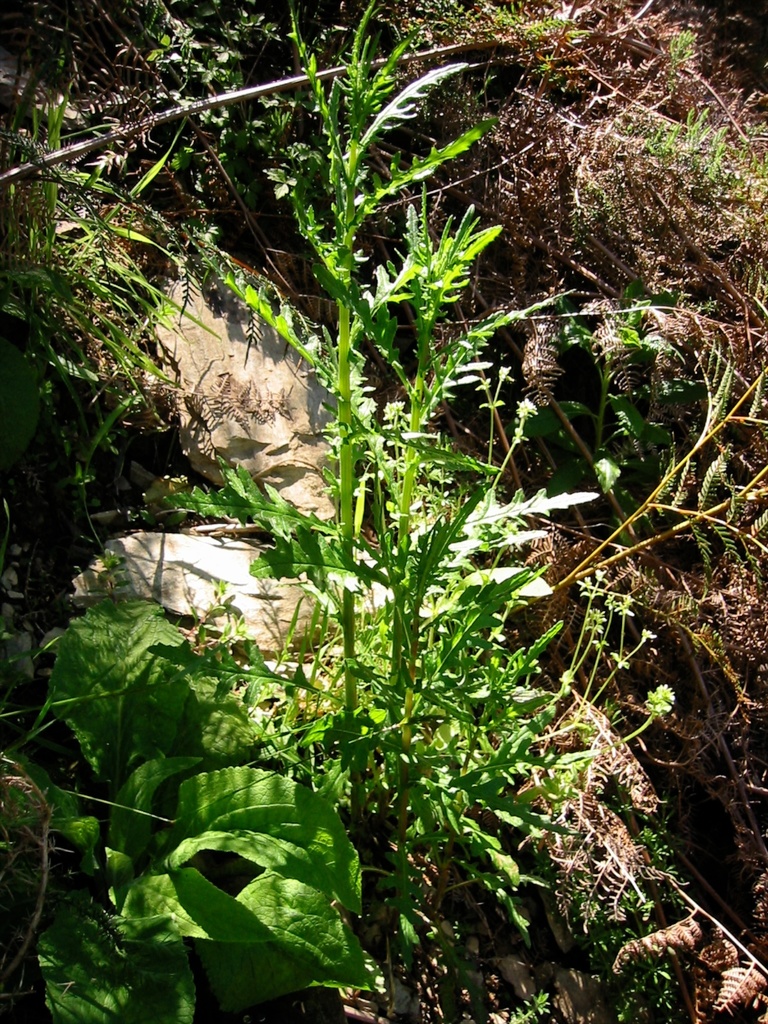
Hill Fireweed
Senecio hispidulus
Senecio hispidulus, the Hill Fireweed or Rough Groundsel, is a species of flowering plant in the daisy family. It is found in many parts of Australia.
From the article Senecio hispidulus on Wikipedia (CC BY-SA), quoted section by section
Description
Senecio hispidulus is an erect herb with an annual or a short lived perennial life cycle and can grow up to 2 metres (6 ft 7 in) tall, but is usually between 30–100 cm (12–39 in) tall. It is a dicotyledonous herb which means the plant is vascular and that it flowers. The plant flowers many small inflorescence of a yellow or pale-yellow color. The herb is sparsely to moderately course-hairy, with shorter hairs on upper leaf surface and longer, denser and jointed hairs on lower surface (A. Rich, 1834). The primary stem is usually simple and is covered in conspicuous soft bristly hairs. S. hispidulus has a woody base which develops into a ribbed mid stem. Mid stem leaves are evenly spaced and sized, usually 70–150 mm (2.8–5.9 in) in length. Its leaf color varying from dark green to yellow green and sometimes shaded with red. Also upper stem can be tinged with purple or red, and is usually triggered by environmental temperatures. The larger and lower leaf margins are sinuately pinnately lobed being usually three to five toothed, having a terminal tooth which is longer than that of the laterals. The uppermost smaller leaves, more in proximity to plant inflorescence are often dentate and not lobed. Plant inflorescence usually of many capitula (flower heads). Overall number of capitula contained usually between 14 and 48 containing 25 florets per capitula. …
Range & habitat
S. hispidulus is indigenous to New Zealand and Australia. In Australia it is predominantly found in the state of New South Wales. Although S. hispidulus is also found in Tasmania, Western Australia, and Queensland.
Wikipedia: “Natural global range”
What it does
S. hispidulus can grow all year round depending on environmental circumstances, which is one of the reasons various specimens can have different heights. Some plants in good growing conditions can grow all year round, whereas other plants in suboptimal conditions will not be able to do this. This fact is one example of the versatility of the herb, which is able to easily adapt to its environment. This versatility is also demonstrated in the flowering period of S. hispidulus which is estimated to be from October to April, but is differently assessed by New Zealand Plant Conservation Network to last from August to May which is a very large time period for flowering to occur. But it is safe to say the plant flowers usually between spring and summer. S. hispidulus is known to be a strongly invasive species which is easily grown from seed. When flowering S. hispidulus produces both polliniferous (pollen bearing) florets and female florets. This is likely to increase the plants' probability to reproduce in a scenario where cross pollination might be hindered. A distinction in the number of polliniferous florets to female florets has been discovered between the two different components of S. hispidulus in New Zealand. The Northern component of S. …
Wikipedia: “Life cycle and phenology”
Toxicity
It is believed to lead to more livestock poisoning and death (Heywood 1978, Lawrence 1981). Senecio species of plants are containing pyrrolizidine alkaloids (PA) which is harmful for human. Because they lead to the damages of liver and lungs, they are related to poisonings and losses. PA may be considered as one kind of carcinogenesis.
Wikipedia: “Poisoning”
Where it lives
Recorded sightings
—
geo-referenced records in GBIF, from museums, herbaria and field observers.
Drag the globe to turn it. Dots are where records exist, not a range map; darker means more records.
In the stacks
Searching the stacks…
Every page naming Senecio hispidulus in the Biodiversity Heritage Library →
This page is assembled live from iNaturalist, GBIF, Wikipedia, the Source Library and the Internet Archive. It is not yet part of the hand-edited codex. iNaturalist taxon 405973.