- Fungi Including Lichens
- ›Basidiomycete Fungi
- ›Higher Basidiomycetes
- ›Mushrooms, Bracket Fungi, Puffballs, and Allies
- ›Agaricomycetidae
- ›Common Gilled Mushrooms and Allies
- ›Agaricineae
- ›Hymenogastraceae
- ›Tympanella
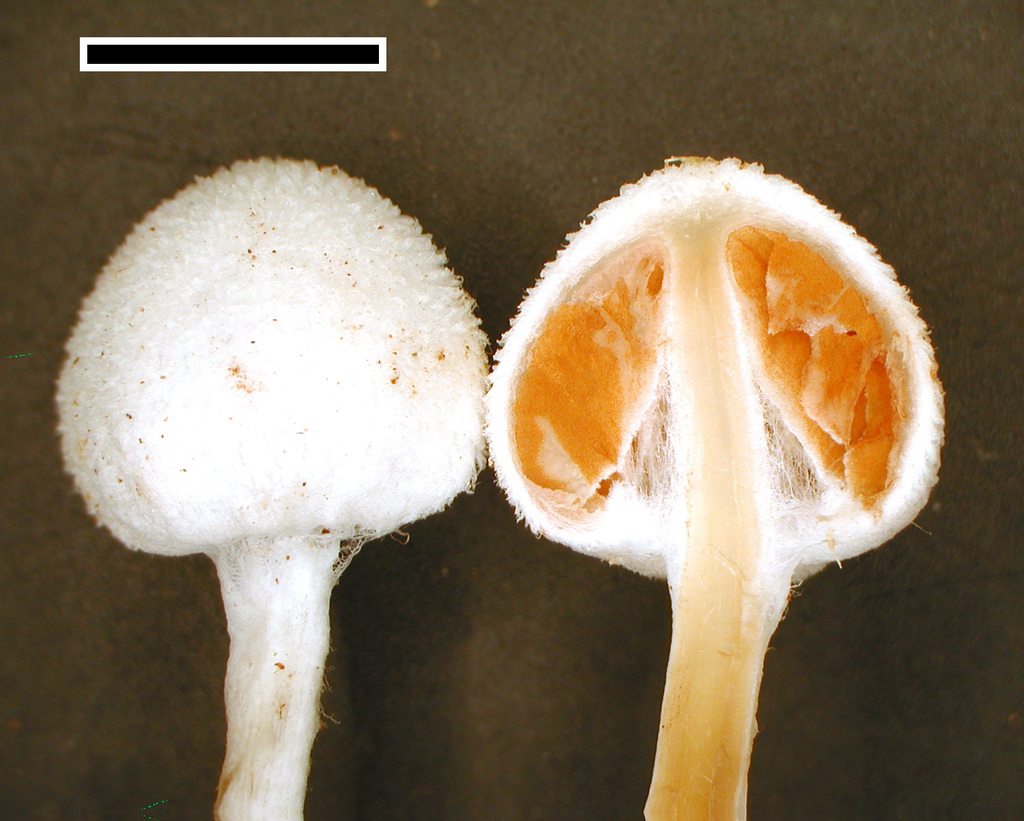
Tympanella galanthina
Tympanella is a fungal genus in the family Bolbitiaceae. A monotypic genus, it contains the single secotioid species Tympanella galanthina, found in New Zealand. Mycologist Egon Horak defined the genus in 1971. T. galathina was originally described as Agaricus galathinus in 1890 by Mordecai Cubitt Cooke and George Edward Massee.
From the article Tympanella galanthina on Wikipedia (CC BY-SA), quoted section by section
Description
The pileus of Tympanella galanthina is dry, and 7–30 mm diameter. It is secotioid and globose when young. Later in development the pileus may become convex or campanulate, however, the margin is still strongly incurved. The colour varies and can be white, cream, clay, or buff. The pileus is densely squamulose, with small hairs or scales. There are fibrillose remnants of the veil near the margin, white and conspicuous particularly on young fruit bodies. The lamellae are a distinct rust to cinnamon brown, not lacunose or anastomosing, adnate or adnexed, sometimes subdecurrent and floccose with a coloured edge. The cylindrical stipe is also dry and is typically 10–40 mm tall and 1.5–5 mm wide. It is light brown, concolourus with the pileus and has white fibrils down from the veil. This species does not have a permanent cortina or ring and columella is absent /not attenuated near the apex. The stipe is singularly fistulose, watery brown context without smell or taste. The spores are smooth, elliptical, and thick-walled, 10.4–13.5 × 6.3–8 μ. The spores have a germ pore and are reddish-brown, but are not amyloid or dextrinoid. The basidia are 27–36 × 8–11 μ with 4 spores. The cheilocystidia are 15–45 × 12–25 μ and are thin-walled, hyaline, clavate or lageniform with a sterile zone at the edge. …
Range & habitat
Tympanella galanthina is found in New Zealand forests among leaf litter or fallen tree fern fronds, and occasionally on rotting wood. It prefers wet forest conditions and is distributed over the North and South Islands. It has been found in association with Beilschmiedia tawa, Sphaeropteris medullaris, Leptospermum scoparium, Nothofagus fusca, N. menziesii, N. solandri, and with Podocarpus.
== References ==
Wikipedia: “Habitat and distribution”
In human culture
Tympanella, derived from the Latin Tympanum meaning little drum or stretched and -ella meaning small.
The specific epithet galanthina is possibly derived from the Greek, Γαλα = milk, ανθοσ = flower, and the adjectival ending, -ιον; possibly referring to similarities to the snowdrop, Galanthus.
Wikipedia: “Etymology”
Where it lives
Recorded sightings
—
geo-referenced records in GBIF, from museums, herbaria and field observers.
Drag the globe to turn it. Dots are where records exist, not a range map; darker means more records.
In the stacks
Searching the stacks…
Every page naming Tympanella galanthina in the Biodiversity Heritage Library →
This page is assembled live from iNaturalist, GBIF, Wikipedia, the Source Library and the Internet Archive. It is not yet part of the hand-edited codex. iNaturalist taxon 408302.