- Animals
- ›Arthropods
- ›Hexapods
- ›Insects
- ›Winged and Once-winged Insects
- ›Beetles
- ›Water, Rove, Scarab, Long-horned, Leaf, and Snout Beetles
- ›Scarabaeiform Beetles
- ›Scarabs, Stag Beetles, and Allies
- ›Stag Beetles
- ›Lucaninae
- ›Lissapterini
- ›Geodorcus
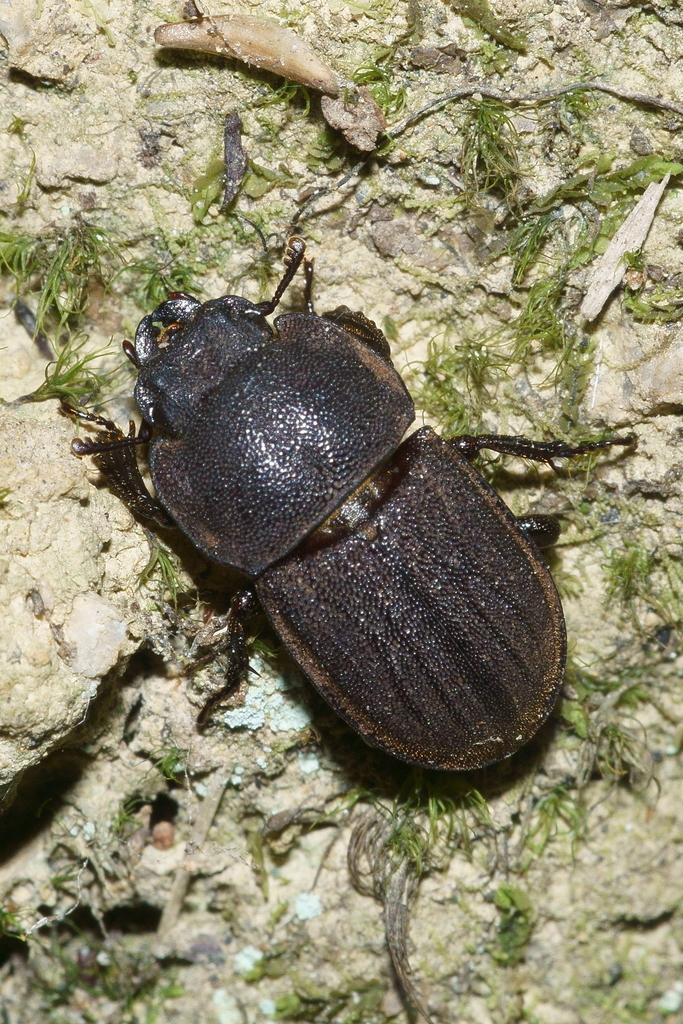
Geodorcus novaezealandiae
Geodorcus novaezealandiae is a large species of stag beetle only found in the Wellington region of New Zealand. It was first described in 1845 by English entomologist Frederick William Hope. It is the smallest member of the genus Geodorcus, all of which are legally protected species. The species displays sexual dimorphism, with the male having distinctly larger and bulkier mandibles than the female. It is often found living under rimu (Dacrydium cupressinum) and southern beech (Nothofagus) trees. Like other Geodorcus species, the larva feeds on rotting wood whereas the adult is presumed to feed on plant sap. It has been speculated that both the male and female work together to create tunnels inside rotting wood to lay eggs in. Under the New Zealand Threat Classification System it is listed as "Naturally Uncommon" with the qualifier of "Range Restricted".
From the article Geodorcus novaezealandiae on Wikipedia (CC BY-SA), quoted section by section
Description
Including their mandibles, the male is 12–21.5 mm in length whereas the female is 11–17.4 mm, which makes them the smallest species of Geodorcus. Like all other Geodorcus, they show sexual dimorphism: the male has a much wider head and larger mandibles whereas the female mandibles are relatively short and are less apparent. In the male, the front of the pronotum (the upper part of the thorax) bulges forwards and slightly hangs over the head whereas in female the pronotum is normal. The body is dull to slightly glossy black, with the upper surface being covered in small punctures. The elytra (hardened plates that cover the abdomen) have a series of slightly raised ribs running down their surface towards the tip of the elytra. The frons and vertex, which make up the front parts of the head, have a distinct depression.
Range & habitat
G. novaezealandiae is only found in New Zealand, where it is found in the south of the North Island. Its range extends from the Akatarawa Valley in the Tararua Range in the north of the region to the Aorangi Range in the south. It has been observed at altitudes from near sea level to 365 m. It has been observed under the bark of live rimu (Dacrydium cupressinum) and southern beech (Nothofagus) trees. It's also been found in old beech stumps and amongst roots. Like other Geodorcus species, it is forest-dwelling and nocturnal. Specimens have also been collected in traps 1.5 m above the ground on māhoe (Melicytus ramiflorus) and hinau (Elaeocarpus dentatus) trees. In one study, pitfall traps were able to collect adults in winter, spring and summer whereas a revision of the species had specimens collected from July to April.
Wikipedia: “Distribution and habitat”
What it does
As adults, it is presumed to feed on plant sap from the trees they hide in. It has been reported feeding on speargrass (Aciphylla) and on pieces of apple (when held in captivity). Like other Geodorcus species, the larvae feed on rotting wood. It has been speculated that both sexes work together to create tunnels in rotting wood to lay eggs in, with the male's large mandibles being well suited for the task. While copulating, the male and female face opposite directions with the tips of their abdomen touching.
Wikipedia: “Ecology and behaviour”
Listen
Looking for field recordings…
Where it lives
Recorded sightings
—
geo-referenced records in GBIF, from museums, herbaria and field observers.
Drag the globe to turn it. Dots are where records exist, not a range map; darker means more records.
In the stacks
Searching the stacks…
Every page naming Geodorcus novaezealandiae in the Biodiversity Heritage Library →
This page is assembled live from iNaturalist, GBIF, Wikipedia, the Source Library and the Internet Archive. It is not yet part of the hand-edited codex. iNaturalist taxon 408646.