- Plants
- ›Vascular Plants
- ›flowering plants
- ›Dicots
- ›carrots, ivies, and allies
- ›Griselinia family
- ›Griselinia
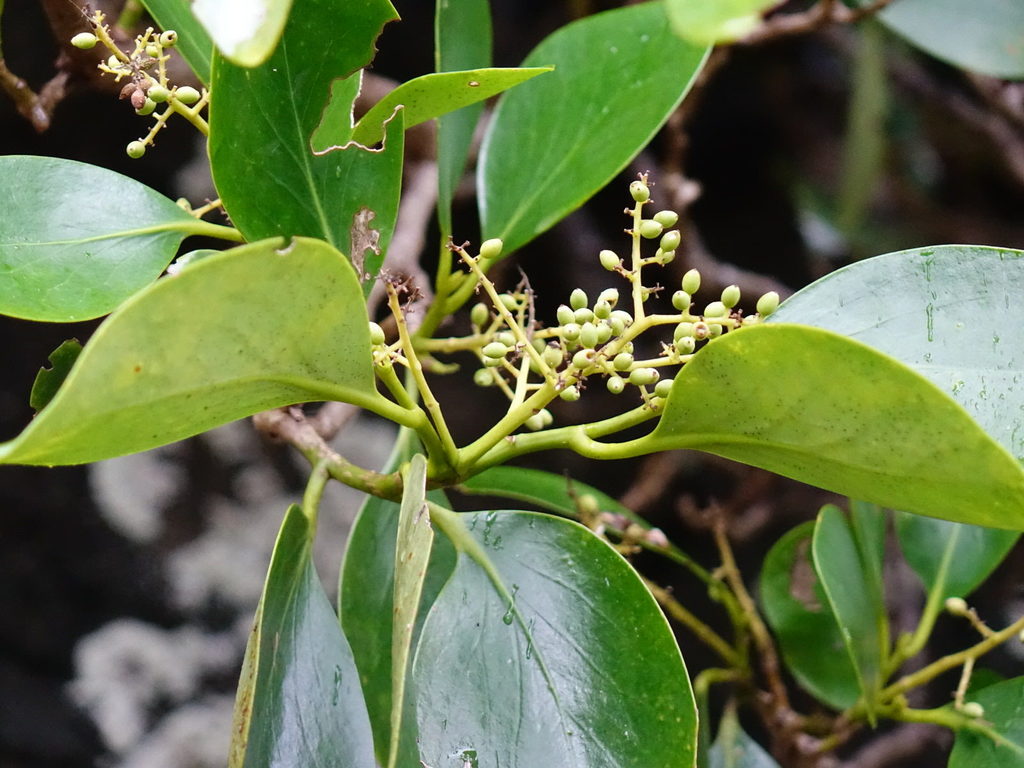
puka
Griselinia lucida
Griselinia lucida, commonly known as puka, akapuka, and shining broadleaf, is a species of shrub in the family Griseliniaceae. It is endemic to New Zealand. Its range mainly covers the North and South Islands. It typically grows epiphytically, meaning it grows on other plants, although it can also be found in coastal and rocky environments. It reaches 10 metres (30 feet) in maximum height. The leaves are large, thick, and glossy, and the roots are grooved and often grow downward until they reach the forest floor.
Griselinia lucida was first described by the German botanist Georg Forster in 1786. It is only one of two Griselinia species found in New Zealand. Pollination is likely achieved by insects or the wind. The fruits are dispersed by fruit-eating animals (frugivores), such as birds. Germination requires light and moist conditions. Its 2023 conservation status in the New Zealand Threat Classification System is "Not Threatened".
From the article Griselinia lucida on Wikipedia (CC BY-SA), quoted section by section
Description
Griselinia lucida is a species of evergreen shrub or small tree in the family Griseliniaceae. It reaches 8 metres (26 feet) in height, and it commonly occurs as an epiphyte (growing on another plant). The crown can reach a width of 8 m (26 ft) or more in a canopy. G. lucida can also be considered as a hemiepiphyte because of its large, brown to grey-coloured grooved roots, which often grow downward to reach the forest floor. Leaves are thick, glabrous, glossy, and leathery in texture. They are found in an alternating pattern and are broadly ovate to oblong in character, with a rounded tip. Leaves are 7–18 cm (2.8–7.1 in) long, 5–9 cm (2.0–3.5 in) wide, and 0.3–0.7 mm thick. Very young leaves can have a reddish-purple coloured margin. The undersides of the leaves can be whitish in colour. The petioles are 2.5–5 cm (0.98–1.97 in) long. The inflorescences (flower clusters) are found on peduncles, which are 10–15 cm (3.9–5.9 in) long. The peduncle can have trichomes at the top. The inflorescences are found at the ends of branchlets. Flowers are small, only about 1–3 mm long, and they are a cream or yellowish colour. Fruiting occurs in infructescences (fruit clusters) with small, oval, berry-like, fruits that are 4–10 mm long and 5 mm in diameter. They are dark purple when they are ripened. Each fruit contains a single seed, which is about 4 mm long and 3 mm wide. G. …
Range & habitat
Griselinia lucida is endemic to New Zealand. Its range mainly covers the North, and South Islands, but the species is most common in the North Island. G. lucida is primarily found on the west coast of New Zealand, with a relatively small presence on the east coasts of both islands. In the North Island, G. lucida is able to extend further inland than the South Island due to there being less mountainous terrain and warmer climates. The species' southern limit is confirmed to be at least Milford Sound in Fiordland. Records further south of Milford Sound are uncertain, as they are not backed by herbarium specimens. G. lucida's 2023 conservation status in the New Zealand Threat Classification System is "Not Threatened".
Habitat. Griselinia lucida can establish itself in different environments. G. lucida primarily grows as a light-demanding epiphyte in the canopy of old-growth forests, but it also occurs on coastal cliffs and rocky sites. In the North Island's Taranaki and Waikato regions, G. lucida is most common in epiphytic relationships with pukatea (Laurelia novae-zelandiae) and tawa (Beilschmiedia tawa). Near the South Island coastal town of Kaikōura, G. lucida is commonly associated with kiekie (Freycinetia banksii), nīkau (Rhopalostylis sapida), among other plants.
Wikipedia: “Distribution”
What it does
Griselinia lucida's seeds are dispersed by fruit-eating animals (frugivores), such as birds. G. lucida's fruits are dispersed by bird species, which includes, but is not limited to: kererū (Hemiphaga novaeseelandiae), New Zealand bellbirds (Anthornis melanura), silvereyes (Zosterops lateralis), and tūī (Prosthemadera novaeseelandiae). The North Island kōkako (Callaeas wilsoni) browse the leaves and buds of the plant, and may also consume the fruits. Pollination is likely achieved by insects or the wind. Bees occasionally visit the flowers to collect nectar. Germination of the seed requires light and moist conditions. Griselinia lucida plays host to numerous insects, including: Aenetus virescens, Glaucias amyoti, Heterocrossa gonosemana, Phyllonorycter messaniella, and Oemona hirta. Deer and goats possibly eat parts of the tree, but this has not been confirmed in published studies.
Wikipedia: “Ecology”
At the table
The indigenous Māori people had few uses of G. lucida, but they did use the wood in the making of cartridge holders. In traditional medicinal practices, the inner bark is said to have soothing characteristics for skin conditions. The inner bark is similar to that found on G. littoralis. European settlers used the wood in constructing fence-posts and in work by millwrights.
Wikipedia: “Uses”
In human culture
Griselinia lucida's genus name, Griselinia, is named is honour of the Italian botanist Francesco Griselini. The specific epithet (second part of the scientific name), lucida, means 'shining'. The species is commonly known as puka, akapuka and shining broadleaf. Other Māori names for the plant include akakōpuka and pukatea. The name puka is also used to describe the unrelated Meryta sinclairii.
Wikipedia: “Etymology”
Where it lives
Recorded sightings
—
geo-referenced records in GBIF, from museums, herbaria and field observers.
Drag the globe to turn it. Dots are where records exist, not a range map; darker means more records.
In the stacks
Searching the stacks…
Every page naming Griselinia lucida in the Biodiversity Heritage Library →
This page is assembled live from iNaturalist, GBIF, Wikipedia, the Source Library and the Internet Archive. It is not yet part of the hand-edited codex. iNaturalist taxon 408842.