- Plants
- ›Vascular Plants
- ›flowering plants
- ›monocots
- ›Agaves, Orchids, Irises, and Allies
- ›agave and allies
- ›cabbage tree subfamily
- ›Arthropodium
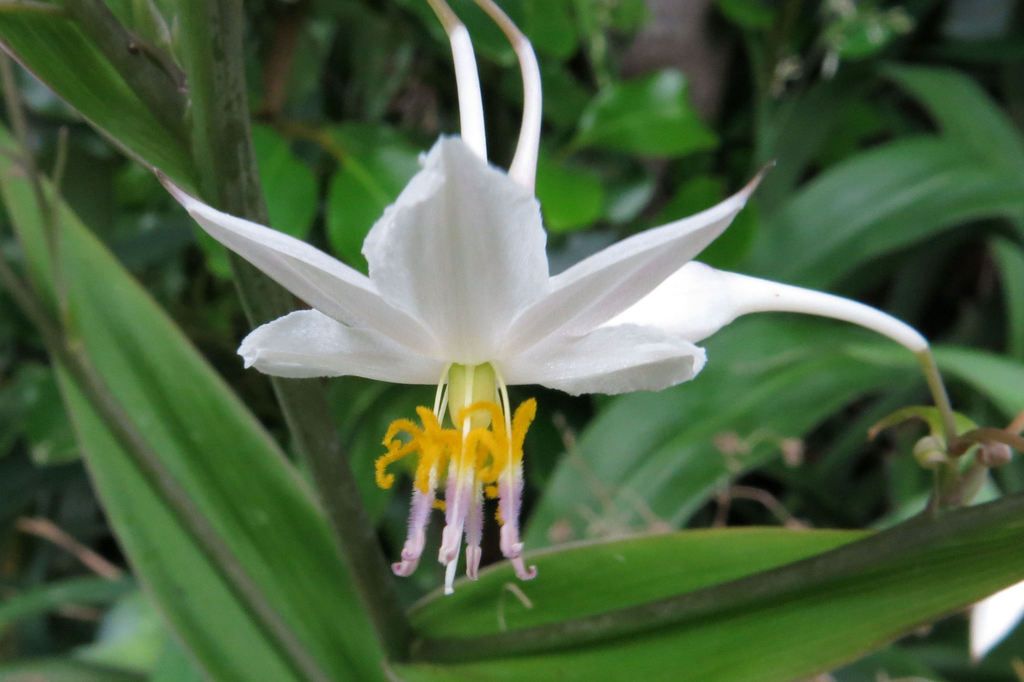
Rengarenga
Arthropodium cirratum
Arthropodium cirratum commonly known as rengarenga, renga lily, New Zealand rock lily, or maikaika, is a species of herbaceous perennial plant, endemic to New Zealand, where it may once have been farmed. It is used for medicine as well as food, and has symbolic importance in traditional Māori culture.
The Māori name rengarenga is a reduplication of Proto-Polynesian *renga which in other related languages corresponds to turmeric, especially its powdered form (see Samoan: lega, Hawaiian: lena); this association is due to both plants' similar stem and root characteristics.
From the article Arthropodium cirratum on Wikipedia (CC BY-SA), quoted section by section
Description
The leaves are 30–60 cm (12–24 in) long and 3–10 cm (1.2–3.9 in) wide. The flower stalk often reaches one metre, and bears many white six-petalled flowers, in groups of two or three, each about 2 cm (0.8 in) across. The stamens are tricoloured - purple and white, with yellow at the curled end. The roots are 2–3 cm (0.8–1.2 in) wide.
Range & habitat
It occurs naturally north of Greymouth and Kaikōura near the sea and, as the name suggests, usually on rocks.
Wikipedia: “Distribution and habitat”
At the table
It is often grown as an ornamental plant. The rhizomes are edible when cooked and can be found throughout the year. The rhizomes were once eaten by the Māori after being cooked in a hāngī. William Colenso believed, for two reasons, that this plant was once cultivated by them: firstly, the plant grows much larger under cultivation than it usually does in the wild; and secondly it was often found near old deserted Māori homes and plantations. However, he lists it as only fourteenth in importance, in his list of eighteen kinds of wild vegetable food used by the Māori.
== References ==
Wikipedia: “Cultivation and uses”
Where it lives
Recorded sightings
—
geo-referenced records in GBIF, from museums, herbaria and field observers.
Drag the globe to turn it. Dots are where records exist, not a range map; darker means more records.
In the stacks
Searching the stacks…
Every page naming Arthropodium cirratum in the Biodiversity Heritage Library →
This page is assembled live from iNaturalist, GBIF, Wikipedia, the Source Library and the Internet Archive. It is not yet part of the hand-edited codex. iNaturalist taxon 409520.