- Plants
- ›Vascular Plants
- ›flowering plants
- ›Dicots
- ›myrtles, evening primroses, and allies
- ›myrtle family
- ›Myrtoideae
- ›Leptospermeae
- ›Kunzea
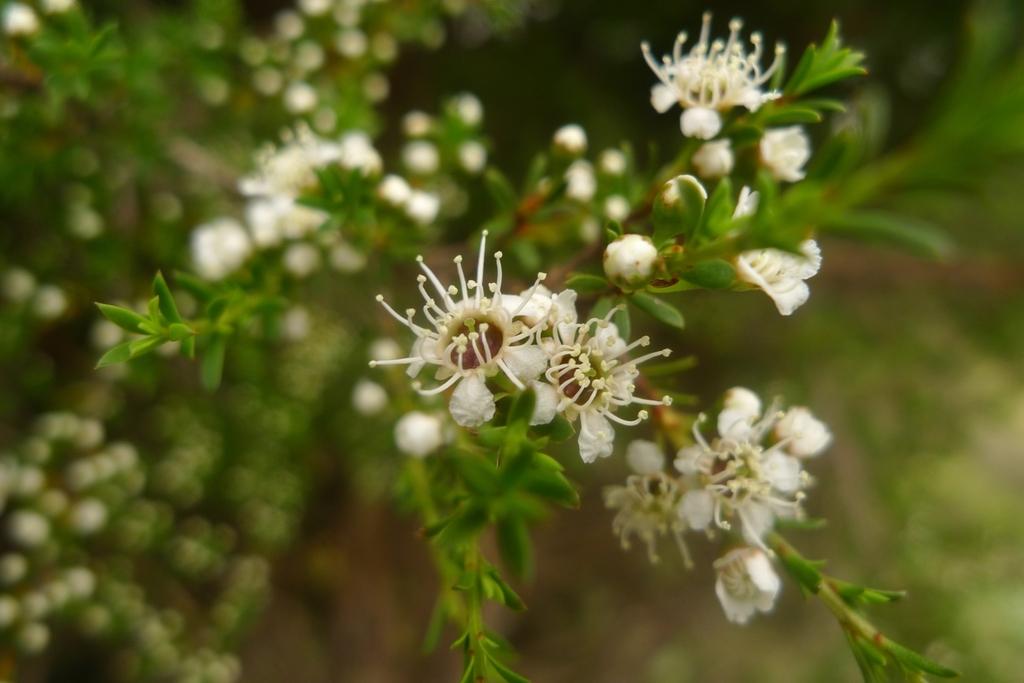
Kanuka
Kunzea serotina
Kunzea serotina, commonly known by its Māori name makahikatoa, is a flowering tree or shrub of the family Myrtaceae in the genus Kunzea, found in both North Island and South Island of New Zealand.
From the article Kunzea serotina on Wikipedia (CC BY-SA), quoted section by section
Description
Kunzea serotina is a tree or shrub that has an erect growth pattern with fastigiate growing branches that form a pyramidal (pyramid-like) canopy. The growth pattern may vary under a stable environment in older trees. The shrub has a single trunk arising from the ground (base). Less commonly, it may have 2 to 3 trunks growing at the same time. The base is covered with a protective wall layer while the rest of the trunk is covered with the dead cambium tissue called the bark. The bark of K. serotina is a greyish-white to pinkish white colour. It has cracks which become bigger and crumpled as the bark grows older, forming a secondary layer of bark. The old bark is similar to the new bark, but has more cracks and crumples, with the upper surface of the older bark hanging loose and eventually peeling off. The plant has numerous branches which grow at or close to the base of the trunk. These are short and stout with a fastigiate branching with numerous leafy branchlets including a brachyblast within the branchlet and forming a curled apex. The vegetative buds are not clearly visible and hidden by the foliage. It has a diameter of 0.2-0.5mm covered with a bud scale, having a yellow-brown to red-brown colour forming an ovate shape. The midrib supports the upper half with a lengthy cuspidate tip, no lateral veins and oil gland and keel apex ciliate. …
Range & habitat
Kunzea is an Australasian genus that is endemic to Australia and New Zealand. Species of Kunzea are commonly found in North and South Island of New Zealand, in Western Australia and the great barrier islands of Australia. The Kunzea ericoides complex consists of 10 species that are endemic to New Zealand, seven of which were described for the first time by Peter James de Lange. Kunzea serotina is one of those seven, and is endemic to the North and South Island of New Zealand. It is a native tree or shrub that is not found anywhere in Australia but restricted to New Zealand.
Wikipedia: “Natural global range”
What it does
The Kunzea eriocoides complex species flowers during early and late spring; the flowering of Kunzea serotina initiates in late spring (November) and peaks in mid-summer (January – February) unlike other Kunzea species in the K. ericoides complex. The later flowering of the species is where the species name is derived from. The flowering of the K. serotina starts in November to May, flowering peaks in January and February and fruiting is from January to December. The seeds germinate and grow in different kind of soil conditions, with the seeds having a lifespan of up to five months in dry conditions. Germination of the seeds depends on the condition where the seed has been dispersed; if it is dispersed under a cover of moss the seed is slow to germinate, but it germinates rapidly if dispersed on bare soil without any cover. K. serotina is a fast growing trees or shrub, but is short lived, living up to 80 – 150 years. The juvenile K. serotina takes approximately seven years (less than ten) to reach reproductive maturity, at which point the tree or shrub reaches a height of 1.5m. During its short lifespan the tree or shrub grows to a height of approximately 15m, increasing the trunk to about 60 cm in diameter. It produces a huge seedbank on the soil surface under the plant, where the seeds await dispersal through rainwater runoff, or germinate if the conditions are viable. …
Wikipedia: “Life cycle/phenology”
Where it lives
Recorded sightings
—
geo-referenced records in GBIF, from museums, herbaria and field observers.
Drag the globe to turn it. Dots are where records exist, not a range map; darker means more records.
In the stacks
Searching the stacks…
Every page naming Kunzea serotina in the Biodiversity Heritage Library →
This page is assembled live from iNaturalist, GBIF, Wikipedia, the Source Library and the Internet Archive. It is not yet part of the hand-edited codex. iNaturalist taxon 411241.