 NL·0542
Herbarium of the Nature Library
- Name
- Delphinapterus leucas
- Family
- Monodontidae
- Native to
- Arctic and sub-Arctic waters: Hudson Bay, Baffin Bay, Beaufort and Bering seas, White Sea, Svalbard, Sea of Okhotsk; isolated populations in the St Lawrence estuary and Cook Inlet
- Habitat
- Polar seas, Estuaries, Sea ice
Beluga
Delphinapterus leucas
Also calledQilalugaq (Inuktitut) · Belukha (Russian) · White whale · Sea canary · Ballena blanca (Spanish) · Baleia-branca (Portuguese)
A pure-white Arctic whale with a bulbous, shape-changing forehead, so talkative that sailors called it the 'sea canary'. Thousands gather each summer in warm river estuaries to calve, feed and moult their skin against the gravel. Some even travel far up rivers.
The beluga whale or the white whale is an Arctic and sub-Arctic cetacean. It is one of two living members of the family Monodontidae, along with the narwhal, and the only member of the genus Delphinapterus. It is also known as the sea canary, due to its high-pitched calls; and the melonhead, though that more commonly refers to the melon-headed whale, which is an oceanic dolphin. Wikipedia
What it can do
- iUnfused neck vertebrae let it nod and turn its head, unusual among whales
- iiChanges the shape of its fatty melon to focus echolocation and perhaps to signal
- iiiNavigates and finds breathing holes in dense pack ice using echolocation
- ivHas entered rivers far inland, e.g. hundreds of kilometres up the Yukon, Amur and Rhine
In the field
Field marks
- aAll-white adult (grey young) with no dorsal fin — only a low ridge along the back
- bRounded, mobile melon and short beak
- cBroad, paddle-shaped flippers that curl at the tips in older males
- dSmall, low blow; often seen in shallow, muddy estuary water
- Voice
- A wide repertoire of whistles, chirps, squeals, clicks and bell-like trills audible through boat hulls, giving the name 'sea canary'.
- Not to be confused with
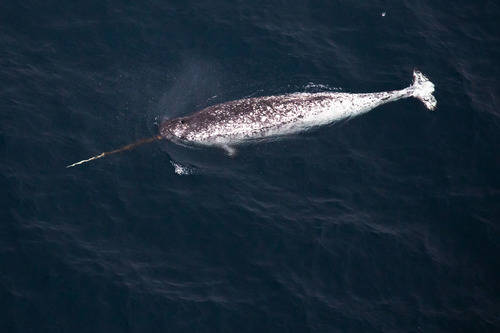
- Narwhal is mottled grey-black, and males carry a spiral tusk. In poor light, a white wave crest or ice floe can be mistaken for a beluga's back.
- Where to see it
- Churchill River estuary, Manitoba (Hudson Bay, tens of thousands in July–August); Saguenay–St. Lawrence Marine Park, Tadoussac (Quebec); Cunningham Inlet, Somerset Island (Nunavut); Solovetsky Islands, White Sea (Russia); Turnagain Arm, Alaska
- When
- Estuary gatherings late June–August; winter at the pack-ice edge
Listen
Looking for field recordings…
Life & habits
- Diet
- Fish (cod, salmon, capelin), squid, shrimp, crabs and worms
- Habitat
- Coastal Arctic waters, estuaries and ice edges
- Size
- 3–5.5 m; up to about 1,600 kg (males larger)
- Lifespan
- Typically 35–50 years; some estimated to reach 80
Social, travelling in pods that can merge into gatherings of thousands in estuaries. Calves are born grey and whiten over several years.
Where it lives
Recorded sightings
—
geo-referenced records in GBIF, from museums, herbaria and field observers.
Native range
Arctic and sub-Arctic waters: Hudson Bay, Baffin Bay, Beaufort and Bering seas, White Sea, Svalbard, Sea of Okhotsk; isolated populations in the St Lawrence estuary and Cook Inlet
Drag the globe to turn it. Dots are where records exist, not a range map; darker means more records.
In the old herbals & bestiaries
Woodcuts and engravings matched from the Source Library’s scanned books by name. Plates marked “relative” show a close kin rather than this exact species. Click a plate to read the page it came from, with translation.

De Piscibus Libri V et De Cetis Liber Unus
Ulisse Aldrovandi · 1661 · p.583

Books on Marine Fishes
Guillaume Rondelet · 1554 · p.818

History of Animals, Book II: On Oviparous Quadrupeds
Conrad Gessner · 1586 · p.702

Compendium of Materia Medica: Illustrated Volume, Middle of the Lower Part
李時珍 · 1596 · p.61
In the stacks
Searching the stacks…
Every page naming Delphinapterus leucas in the Biodiversity Heritage Library →
Marginalia
Inuit communities hunt belugas for muktuk (skin and blubber), a key source of vitamin C in the traditional Arctic diet. In the 1980s a US Navy beluga named NOC was recorded imitating human speech patterns.
Curiosity
Belugas moult each summer, rubbing off old yellowed skin on estuary gravel to reveal fresh white skin beneath.
Kinship



Photographs: iNaturalist contributors under the licences shown. Records: GBIF.org. Historical plates: Source Library (CC BY-SA 4.0; originals public domain). Summary text: Nature Library editors and Wikipedia (CC BY-SA). Medicinal and edibility notes are historical and educational, not advice. iNaturalist taxon 41461.