- Plants
- ›Vascular Plants
- ›flowering plants
- ›Dicots
- ›Soapberries, Cashews, Mahoganies, and Allies
- ›citrus family
- ›Aurantioideae
- ›Citrus
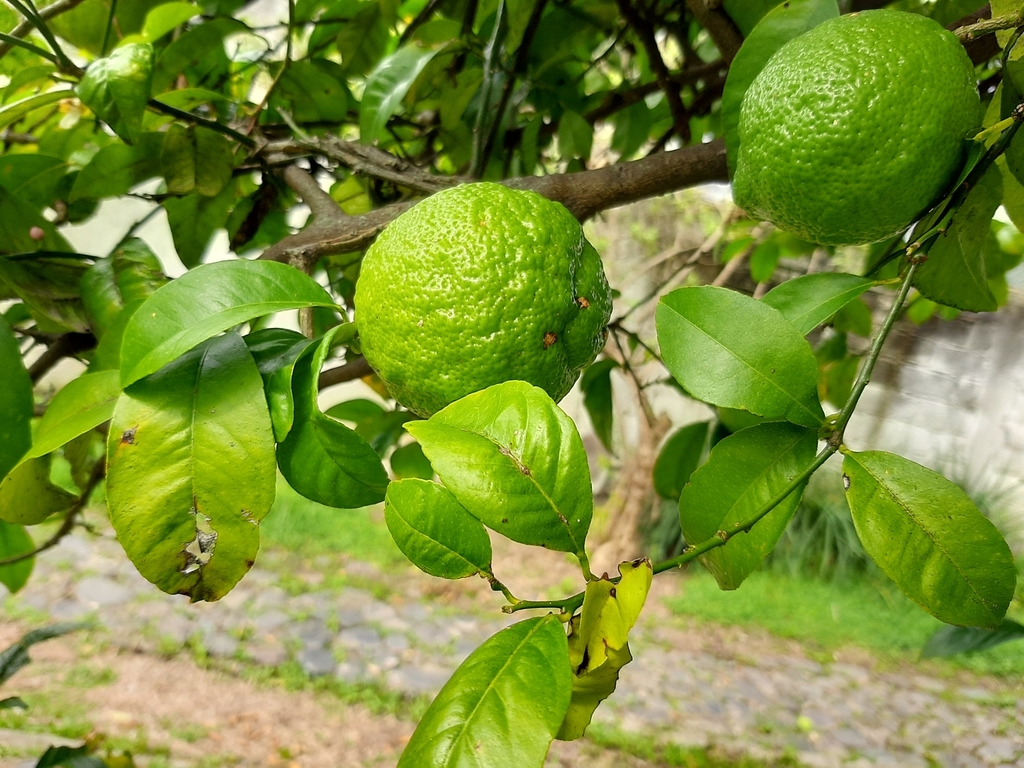
Lime
Citrus × latifolia
Persian lime (Citrus × latifolia), also known by other common names such as seedless lime, Bearss lime, and Tahiti lime, is a citrus fruit species of hybrid origin, known only in cultivation. The Persian lime is a triploid cross between Key lime (Citrus × aurantiifolia) and lemon (Citrus × limon).
Although there are other citrus species that are referred to as "limes", the Persian lime is the most widely cultivated lime species commercially, and accounts for the largest share of the fruits sold as limes. The fruit turns yellow as it ripens, but it is universally sold while still green.
From the article Persian lime on Wikipedia (CC BY-SA), quoted section by section
Description
The tree is a triploid cross between Key lime (Citrus x aurantiifolia) and lemon (Citrus x limon). It is nearly thornless. The fruit is about 6 centimetres (2+1⁄2 inches) in diameter, often with slightly nippled ends, and is usually sold while green, although it yellows as it reaches full ripeness. It is larger, thicker-skinned, with less intense citrus aromatics than the Key lime. The advantages of the Persian lime in commercial agriculture compared to the key lime are the larger size, absence of seeds, hardiness, absence of thorns on the bushes, and longer fruit shelf life. They are less acidic than Key limes and do not have the bitterness that lends to the key lime's unique flavor.
How it is grown
Persian limes were first grown on a large scale in Iran and southern Iraq. The trees are propagated clonally, by grafting or air layering. Persian limes are commercialized primarily in six sizes, known as 110s, 150s, 175s, 200s, 230s and 250s. Large numbers of Persian limes are grown, processed, and exported every year primarily from Mexico to the American, European and Asian markets. In 2014, Brazil was the major exporter of fresh limes to Europe (about 70%) with Mexico supplying most of the remainder.
Cultivars. Cultivars include:
Bearss lime (named after John T. Bearss, who developed this seedless variety about 1895 in his nursery at Porterville, California) Page lime Persian lime SPB-7 Pond's lime Tahiti lime
Wikipedia: “Cultivation”
Where it lives
Recorded sightings
—
geo-referenced records in GBIF, from museums, herbaria and field observers.
Drag the globe to turn it. Dots are where records exist, not a range map; darker means more records.
In the old herbals & bestiaries

Nova Genera Plantarum
Heinrich Adolph Schrader (1767-1836) · 1797 · p.43

Nova Genera Plantarum
Heinrich Adolph Schrader (1767-1836) · 1797 · p.46

Maria Sibylla Merian — Der rupsen begin, voedzel en wonderbaare verandering (1712)
Maria Sibylla Merian · 1717 · p.227

Illustrations of Fungi which Grow in Bavaria and the Palatinate around Ratisbon, Vols 1–2
Jacob Christian Schaeffer; C.H. Persoon (ed.) · 1800 · p.419

Illustrations of Fungi which Grow in Bavaria and the Palatinate around Ratisbon, Vols 1–2
Jacob Christian Schaeffer; C.H. Persoon (ed.) · 1800 · p.422

Illustrations of Fungi which Grow in Bavaria and the Palatinate around Ratisbon, Vols 3–4
Jacob Christian Schaeffer; C.H. Persoon (ed.) · 1800 · p.216

Famine Relief Herbal
Zhu Su · 1406 · p.119

Notable Commentaries on the History of Plants
Leonhart Fuchs · 1542 · p.759

On the Names of Plants
Hieronymus Bock (Tragus) · 1552 · p.260

Discourses on the Six Books of Dioscorides
Dioscorides; Pietro Andrea Mattioli (comm.) · 1568 · p.1205

Discourses on the Six Books of Dioscorides
Dioscorides; Pietro Andrea Mattioli (comm.) · 1568 · p.1206

A New Herbal, or History of Plants
Rembert Dodoens (trans. Henry Lyte) · 1578 · p.603
In the stacks
Searching the stacks…
Every page naming Citrus × latifolia in the Biodiversity Heritage Library →
This page is assembled live from iNaturalist, GBIF, Wikipedia, the Source Library and the Internet Archive. It is not yet part of the hand-edited codex. iNaturalist taxon 415524.