- Fungi Including Lichens
- ›Basidiomycete Fungi
- ›Higher Basidiomycetes
- ›Mushrooms, Bracket Fungi, Puffballs, and Allies
- ›Agaricomycetidae
- ›Common Gilled Mushrooms and Allies
- ›Pluteineae
- ›Pluteaceae
- ›Volvopluteus
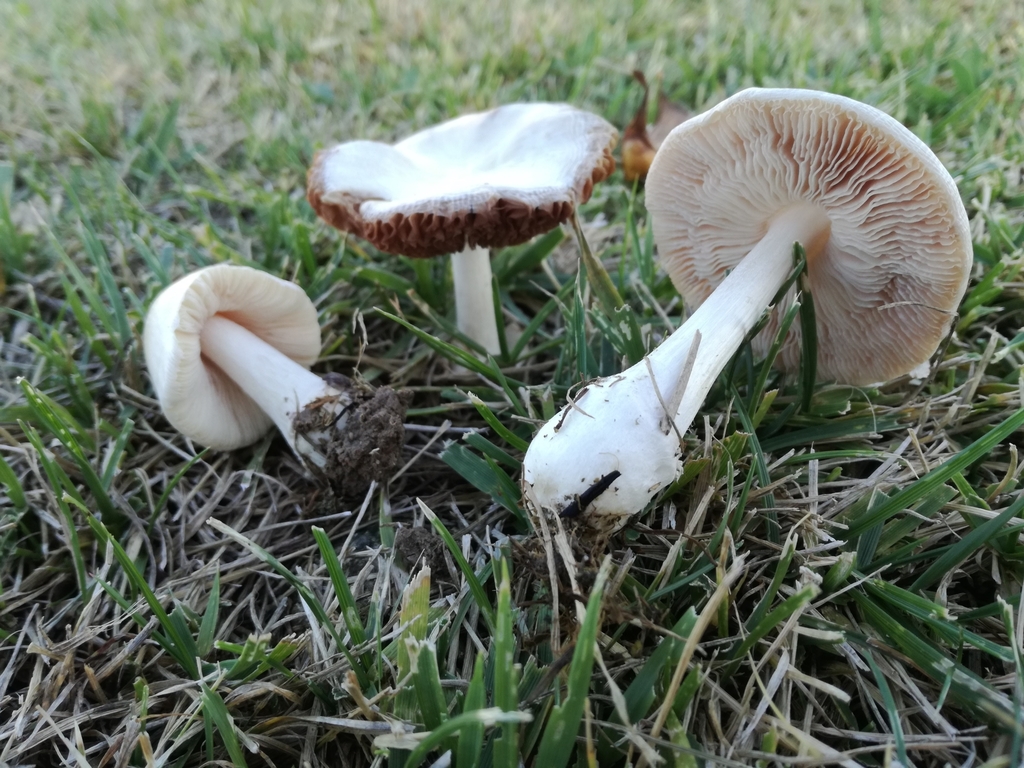
Volvopluteus earlei
Volvopluteus earlei is a species of mushroom in the family Pluteaceae. It was originally described in 1911 by American mycologist William Alphonso Murrill as Volvariopsis earlei, based on collections made in a Cuban banana field. The fungus was later shuffled to the genera Volvaria and Volvariella before molecular studies placed it in Volvopluteus, a genus newly described in 2011.
The cap of Volvopluteus earlei is typically between 2.5–5 cm (1–2 in) in diameter, white, and is markedly viscid when fresh. The gills start out as white but they soon turn pink. The stipe is white and measures 5 cm (2 in) long and 1 cm (0.4 in) wide. It has a smooth, white, sac-like volva at its base. The cap produces a pinkish-brown spore print made of individual elliptical spores measuring up to 11 micrometers long. A saprotrophic fungus that grows on grassy fields, V. earlei has been reported from Africa, Europe, and North America. Microscopic features and DNA sequence data are of great importance for separating this taxon from related species. V. earlei can be distinguished from the three other Volvariella by differences in the size of the fruit bodies, cap color, spore size, and the presence or absence and form of cystidia.
From the article Volvopluteus earlei on Wikipedia (CC BY-SA), quoted section by section
Description
The cap of Volvopluteus earlei is between 25 and 50 mm (1.0 and 2.0 in) in diameter, more or less ovate or hemispherical when young, then expanding to convex or flat. It can have a low, broad umbo in the center in old specimens; the surface is markedly viscid in fresh fruit bodies; the cap is pure white, but sometimes develops pale brown tinges with age. The gills are crowded together, free from attachment to the stipe, ventricose, and up to 6 mm broad; they are white when young but turn pink with age as the spores mature. The cylindrical stipe is 30–50 mm (1.2–2.0 in) long and 2–10 mm (0.1–0.4 in) wide, and broadening towards the base. Its surface is white, smooth or slightly pruinose (as if covered with a fine white powder). The sac-like volva is up to 20 mm (0.8 in) high, white and has a smooth surface. The context is white in the stipe and cap and it does not change color when bruised or exposed to air. The smell and taste of the flesh are described as indistinct or herbaceous. The spore print is pinkish-brown.
The spores are ellipsoid and measure 11–16 by 8–11 μm. Basidia are 20–40 by 8–16 μm; they are usually four-spored but sometimes two-spored, and, more rarely, one-spored forms can occur. Pleurocystidia (cystidia on the gill face) are absent in most collections; if present they are scarce and similar to the cheilocystidia. …
Range & habitat
Volvopluteus earlei is a saprotrophic mushroom that grows in gardens and grassy fields. It was originally found in banana fields in Cuba. In Africa, Spain and Italy it has been reported mostly in urban or anthropogenic garden areas. It usually fruits in groups of several mushrooms but it can also be found growing solitary. This species has been reported from Cuba, North Carolina, Mexico, Spain and Italy. Molecular data have so far corroborated that the European and African collections correspond to the same species.
Wikipedia: “Habitat, distribution, and ecology”
Where it lives
Recorded sightings
—
geo-referenced records in GBIF, from museums, herbaria and field observers.
Drag the globe to turn it. Dots are where records exist, not a range map; darker means more records.
In the stacks
Searching the stacks…
Every page naming Volvopluteus earlei in the Biodiversity Heritage Library →
This page is assembled live from iNaturalist, GBIF, Wikipedia, the Source Library and the Internet Archive. It is not yet part of the hand-edited codex. iNaturalist taxon 416136.