Mallee Riceflower
Pimelea microcephala
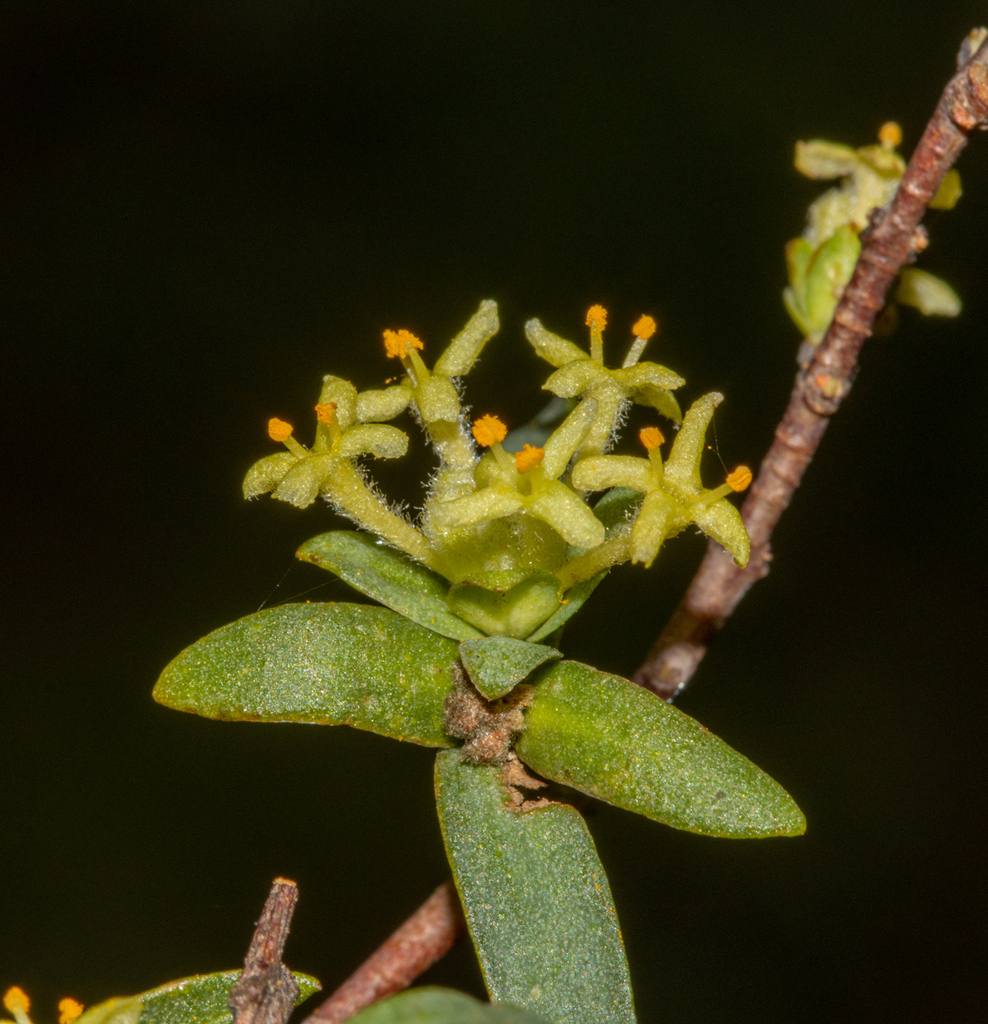
Pimelea microcephala, commonly known as mallee rice-flower or shrubby rice-flower is a species of flowering plant in the family Thymelaeaceae and is endemic to mainland Australia. It is an erect shrub with compact heads of male or female, white to yellow or greenish flowers on separate plants, the heads surrounded by 2 or 4 leaf-like involucral bracts.
From the article Pimelea microcephala on Wikipedia (CC BY-SA), quoted section by section
Description
Pimelea microcephala is an erect, dioecious shrub that typically grows to a height of 0.7–4 m (2 ft 4 in – 13 ft 1 in) and has glabrous stems. Its leaves are arranged in opposite pairs, linear to more or less narrowly elliptic, mostly 7–40 mm (0.28–1.57 in) long and 1–4 mm (0.039–0.157 in) wide on a short petiole. The flowers are white to yellow or greenish and arranged on the ends of branches in compact heads on a peduncle 2–13 mm (0.079–0.512 in) long. The flowers are glabrous inside and usually densely curly-hairy on the outside, on a hairy pedicel. Male flowers are in heads of 8 to 100 flowers, the floral tube 3–7 mm (0.12–0.28 in) long. Female flowers are in heads of 7 to 12, each 2–4 mm (0.079–0.157 in) long. The sepals are 0.2–2 mm (0.0079–0.0787 in) long and the stamens of male flowers are shorter than the sepals. Flowering mainly occurs from April to September and the fruit is a succulent, red nut.
Range & habitat
Mallee rice-flower grows in shrubland, woodland and mallee, and is widespread in all mainland states of Australia and in the Northern Territory. It is found in the north-west of Victoria, in inland New South Wales, in the south of the Northern Territory and in the Avon Wheatbelt, Carnarvon, Coolgardie, Gascoyne, Geraldton Sandplains, Great Victoria Desert, Mallee, Murchison Nullarbor, Pilbara and Yalgoo bioregions of Western Australia. Subspecies glabra is restricted to the north-west of South Australia.
== References ==
Wikipedia: “Distribution and habitat”
Where it lives
Recorded sightings
—
geo-referenced records in GBIF, from museums, herbaria and field observers.
Drag the globe to turn it. Dots are where records exist, not a range map; darker means more records.
In the stacks
Searching the stacks…
Every page naming Pimelea microcephala in the Biodiversity Heritage Library →
This page is assembled live from iNaturalist, GBIF, Wikipedia, the Source Library and the Internet Archive. It is not yet part of the hand-edited codex. iNaturalist taxon 416361.