- Plants
- ›Vascular Plants
- ›flowering plants
- ›Dicots
- ›Soapberries, Cashews, Mahoganies, and Allies
- ›soapberry family
- ›Majidea
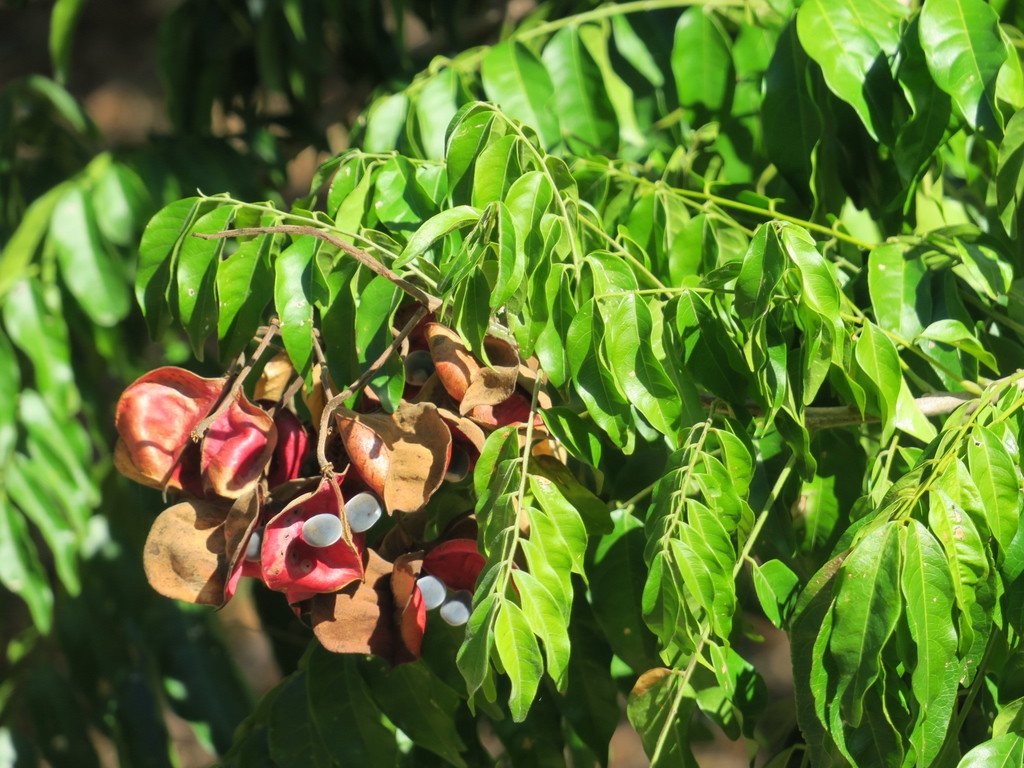
Black pearl
Majidea zanguebarica
Majidea zangueberica (also known as the mgambo tree, black pearl tree or velvet seed tree) is a small tree of the family Sapindaceae. The tree is native to East Africa and grows up to 5 metres (16 ft) tall.
From the article Majidea zanguebarica on Wikipedia (CC BY-SA), quoted section by section
Description
This very ornamental small tree has shiny foliage with an attractive rounded canopy, making it very suitable for small tropical gardens or a container plant in cooler climates. They are hardy only in frost-free zones, otherwise they can make a rare and unique houseplant as they are smaller when container grown. The leaves are compound with up to 10 pairs of leaflets, which are elliptic about 5–7 centimetres (2.0–2.8 in) long and 2–3 cm (0.79–1.18 in) wide. Its highly ornamental seeds mean it's sometimes referred to as the black pearl tree or velvet-seed tree. It blooms with dense clusters of small green-red, fragrant flowers at the end of panicles. Fruit is spherical with three lobes, 3 cm (1.2 in) long. The fruit splits open, showing the bright red interior, with three spherical, velvety blue-black seeds.
At the table
The seeds are often used in artisan jewelry and the dried pods in flower arrangements, the composition of bouquets and decorative potpourri.
Wikipedia: “Uses”
Where it lives
Recorded sightings
—
geo-referenced records in GBIF, from museums, herbaria and field observers.
Drag the globe to turn it. Dots are where records exist, not a range map; darker means more records.
In the stacks
Searching the stacks…
Every page naming Majidea zanguebarica in the Biodiversity Heritage Library →
This page is assembled live from iNaturalist, GBIF, Wikipedia, the Source Library and the Internet Archive. It is not yet part of the hand-edited codex. iNaturalist taxon 416393.