- Fungi Including Lichens
- ›Basidiomycete Fungi
- ›Higher Basidiomycetes
- ›Mushrooms, Bracket Fungi, Puffballs, and Allies
- ›Agaricomycetidae
- ›Common Gilled Mushrooms and Allies
- ›Agaricineae
- ›Webcaps
- ›Cortinarius
- ›Dulciolentes
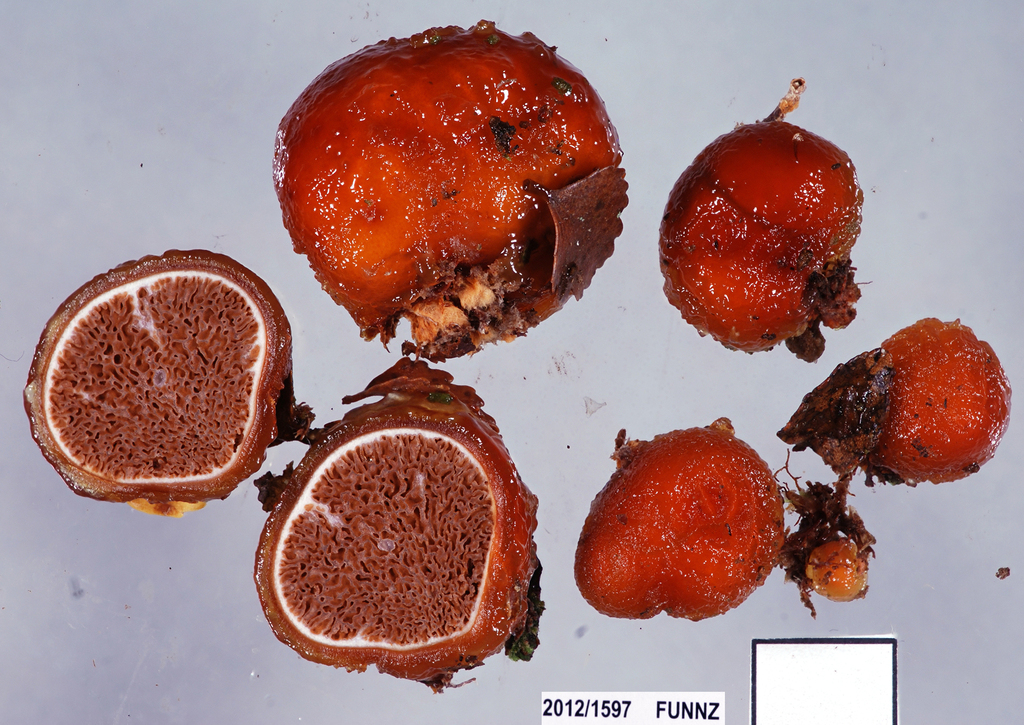
Cortinarius beeverorum
Cortinarius beeverorum is a species of truffle-like fungus belonging to the genus Cortinarius. It is endemic to New Zealand, where it was first described in 2014 by researchers Orlovich, X. Yue Wang, and T. Lebel.
From the article Cortinarius beeverorum on Wikipedia (CC BY-SA), quoted section by section
Description
Cortinarius beeverorum produces fruiting bodies slightly above ground, usually found under leaf litter. They appear round-shaped to slightly flattened and have a diameter of 1 to 3 cm (0.4 to 1.2 in) across. It has a reduced and often absent stipe and columella. The outer layer of the fungus is gelatinous and smooth, sometimes slightly bumpy, with an outer skin of the fruiting body orange-red. Underneath, there is a brown layer, which might reveal itself as the fungus ages. Inside, the fungus has small chambers (locules) that become rust-brown in mature specimens, separated by white tissue. Under a microscope, its spores appear yellow-brown, almond- to oval-shaped, and measure on average 17×10 μm. The spores have a rough surface with bumps and ridges. Its basidia, the structures that produce spores, are 42–69 μm long and are usually club-shaped and carry four spores each.
Range & habitat
Cortinarius beeverorum is ectomycorrhizal, typically associated with southern beech (Nothofagus). This fungus typically appears in autumn. Although it prefers southern beech forests, it has sometimes been found near tea trees (Leptospermum). It has been recorded 26 times across eight different locations, with an estimated range of about 196,000 km2 (76,000 sq mi) and an occupied area of roughly 76 km2 (29 sq mi). Its occurrence spans both the North and South Island.
Wikipedia: “Distribution and habitat”
In human culture
The species is named in honor of Ross Beever, a mycologist, botanist, and plant pathologist who contributed to the research leading to the description of C. beeverorum. It also honours his wife, Jessica Eleanor Beever, a bryologist whose passion for botany has inspired generations of students to study and appreciate the natural world.
Wikipedia: “Etymology”
Where it lives
Recorded sightings
—
geo-referenced records in GBIF, from museums, herbaria and field observers.
Drag the globe to turn it. Dots are where records exist, not a range map; darker means more records.
In the stacks
Searching the stacks…
Every page naming Cortinarius beeverorum in the Biodiversity Heritage Library →
This page is assembled live from iNaturalist, GBIF, Wikipedia, the Source Library and the Internet Archive. It is not yet part of the hand-edited codex. iNaturalist taxon 416577.