- Animals
- ›Chordates
- ›Vertebrates
- ›Mammals
- ›Therians
- ›Placental Mammals
- ›Ungulates, Carnivorans, and Allies
- ›Carnivorans
- ›Pinnipeds
- ›Earless Seals
- ›Monachinae
- ›Antarctic Seals
- ›Lobodon
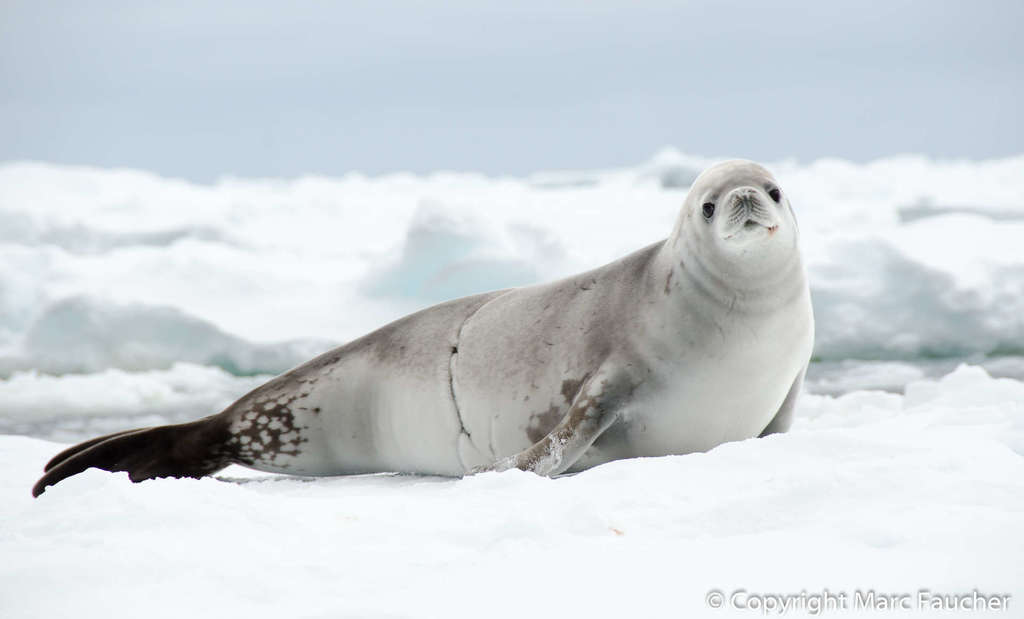
Crabeater Seal
Lobodon carcinophaga
The crabeater seal (Lobodon carcinophaga), also known as the krill-eater seal, is a true seal with a circumpolar distribution around the coast of Antarctica. They are the only member of the genus Lobodon. They are medium- to large-sized (over 2 m (6.6 ft) in length), relatively slender and pale-colored, found primarily on the free-floating pack ice that extends seasonally out from the Antarctic coast, which they use as a platform for resting, mating, social aggregation and accessing their prey. They are by far the most abundant seal species in the world. While population estimates are uncertain, there are at least 7 million and possibly as many as 75 million individuals. This success of this species is due to its specialized predation on the abundant Antarctic krill of the Southern Ocean, for which it has uniquely adapted, sieve-like tooth structure. Indeed, its scientific name, translated as "lobe-toothed (lobodon) crab eater (carcinophaga)", refers specifically to the finely lobed teeth adapted to filtering their small crustacean prey.
Despite its name, the crabeater seal does not eat crabs.
From the article Crabeater seal on Wikipedia (CC BY-SA), quoted section by section
Description
Adult seals (over five years old) grow to an average length of 2.3 m (7.5 ft) and an average weight of around 200 kg (440 lb). Females are on average 6 cm (2.4 in) longer and around 8 kilograms (18 lb) heavier than males, though their weights fluctuate substantially according to season; females can lose up to 50% of their body weight during lactation, and males lose a significant proportion of weight as they attend to their mating partners and fight off rivals. During summer, males typically weigh 200 kilograms (440 lb), and females 215 kilograms (474 lb). A molecular genetic based technique has been established to confirm the sex of individuals in the laboratory. Large crabeater seals can weigh up to 300 kg (660 lb). Pups are about 1.2 metres (3.9 ft) in length and 20 to 30 kilograms (44 to 66 lb) at birth. While nursing, pups grow at a rate of about 4.2 kilograms (9.3 lb) a day, and grow to be around 100 kilograms (220 lb) when they are weaned at two or three weeks. These seals are covered mostly by brown or silver fur, with darker coloration around flippers. The color fades throughout the year, and recently molted seals appear darker than the silvery-white crabeater seals that are about to molt. Their body is comparatively more slender than other seals, and the snout is pointed. …
Range & habitat
Crabeater seals have a continuous circumpolar distribution surrounding Antarctica, with only occasional sightings or strandings in the extreme southern coasts of Argentina, South Africa, Australia and New Zealand. They spend the entire year on the pack ice zone as it advances and retreats seasonally, primarily staying within the continental shelf area in waters less than 600 m (2,000 ft) deep. They colonized Antarctica during the late Miocene or early Pliocene (15–25 million years ago), at a time when the region was much warmer than today. The population is connected and fairly well mixed (panmictic), and genetic evidence does not suggest any subspecies separations. A genetic survey did not detect evidence of a recent, sustained genetic bottleneck in this species, which suggests that populations do not appear to have suffered a substantial and sustained decline in the recent past. Currently, no reliable estimates of the total crabeater seal population are available. Past estimates relied on minimal opportunistic sighting and much speculation, ranging from 2 million to 50–75 million individuals. Genetic evidence suggests that crabeater population numbers may have increased during the Pleistocene. The most recent point estimate is 7 million individuals, some 85 percent of all Antarctic seals, but this 7 million number, too, is considered a likely underestimate. …
Wikipedia: “Distribution and population”
What it does
Crabeater seals have a typical, serpentine gait when on ice or land, combining retractions of the foreflippers with undulations of the lumbar region. This method of locomotion leaves a distinctive sinuous body track and can be extremely effective. When not subject to overheating (i.e. on cold days), speeds on land of 19–26 km/h (12–16 mph) have been recorded for short distances. Satellite tracking data have resulted in conservative estimates of swimming speeds of 66 km/day and 12.7 km/h. While swimming, crabeaters have been known to engage in porpoising (leaping entirely out of the water) and spyhopping (raising the body vertically out of the water for visual inspection) behaviors. The most gregarious of the Antarctic seals, crabeaters have been observed on the ice in aggregations of up to 1,000 hauled out animals and in swimming groups of several hundred individuals, breathing and diving almost synchronously. These aggregations consist primarily of younger animals. Adults are more typically encountered alone or in small groups of up to three on the ice or in the water. Crabeater seals give birth during the Antarctic spring from September to December. Rather than aggregate in reproductive rookeries, females haul out on ice to give birth singly. Adult males attend female-pup pairs until the female begins estrus one to two weeks after the pup is weaned before mating. …
Wikipedia: “Behavior”
Listen
Looking for field recordings…
Where it lives
Recorded sightings
—
geo-referenced records in GBIF, from museums, herbaria and field observers.
Drag the globe to turn it. Dots are where records exist, not a range map; darker means more records.
In the stacks
Searching the stacks…
Every page naming Lobodon carcinophaga in the Biodiversity Heritage Library →
This page is assembled live from iNaturalist, GBIF, Wikipedia, the Source Library and the Internet Archive. It is not yet part of the hand-edited codex. iNaturalist taxon 41700.