- Animals
- ›Chordates
- ›Vertebrates
- ›Mammals
- ›Therians
- ›Placental Mammals
- ›Ungulates, Carnivorans, and Allies
- ›Carnivorans
- ›Pinnipeds
- ›Eared Seals
- ›Zalophus
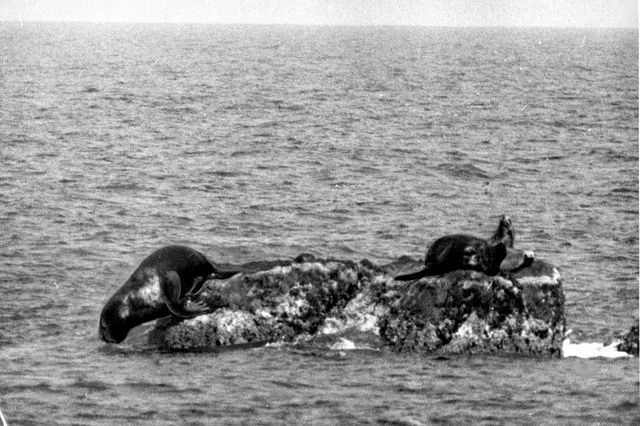
Japanese Sea Lion
Zalophus japonicus
The Japanese sea lion (Zalophus japonicus) (Japanese: ニホンアシカ, romanized: Nihon ashika, Korean: 강치, 바다사자) was an aquatic mammal that became extinct in the 1970s. It was considered to be a subspecies of the related California sea lion (Z. californianus) until 2003. They inhabited the western North Pacific and its marginal seas including the Sea of Okhotsk and the Sea of Japan, especially around the coastal areas of the Japanese archipelago and the Korean Peninsula. They generally bred on sandy beaches which were open and flat, but sometimes in rocky areas. They were hunted commercially in the 1900s, leading to their extinction.
From the article Japanese sea lion on Wikipedia (CC BY-SA), quoted section by section
Description
Male Japanese sea lions were dark grey, reaching lengths of 2.3 to 2.5 metres (7.5 to 8.2 ft) and weighed about 450 to 560 kilograms (990 to 1,230 lb). Females were significantly smaller at 1.64 to 1.8 metres (5.4 to 5.9 ft) long and weighed about 120 kilograms (260 lb) with a lighter grey colour than the males.
Range & habitat
Japanese sea lions were found along the northwest Pacific coastline, specifically in Japan, Korea, southern Kamchatka Peninsula, and the Sakhalin Island. However, they may not have existed in Kamchatka, with their northernmost range extending only to the Kuril Islands. Sightings of individual Japanese sea lions still persist in Korea, but these are probably misidentified Steller's sea lions (Eumetopias jubatus). The only reliable report from Kamchatka may have been of a single individual shot at Moneron Island in 1949. Old Korean accounts also describe that the sea lion and spotted seal (Phoca largha) were found in a broad area containing the BoHai Sea, the Yellow Sea, and the Sea of Japan. Many places along the Japanese coastline are named after sea lions or seals, such as Ashika-iwa (海驢岩 or 海鹿岩, sea lion rock), Ashika-jima (海獺島 or 海鹿島, sea lion island), and Cape Inubō (犬吠埼, dog-barking point). Bones of Z. japonicus dating to 3500–2000 BC were found in the Shell Mound in Dongsam-dong, Busan. Genetic evidence confirms the former presence of Z. japonicus on the Liancourt rocks.
They usually resided on flat, open, and sandy beaches, but rarely in rocky areas. Their preference was to rest in caves.
Wikipedia: “Distribution and habitat”
Listen
Looking for field recordings…
Where it lives
Recorded sightings
—
geo-referenced records in GBIF, from museums, herbaria and field observers.
Drag the globe to turn it. Dots are where records exist, not a range map; darker means more records.
In the stacks
Searching the stacks…
Every page naming Zalophus japonicus in the Biodiversity Heritage Library →
This page is assembled live from iNaturalist, GBIF, Wikipedia, the Source Library and the Internet Archive. It is not yet part of the hand-edited codex. iNaturalist taxon 41739.