- Plants
- ›Vascular Plants
- ›flowering plants
- ›Dicots
- ›Guinea-flowers and allies
- ›Guinea-flower family
- ›Hibbertia
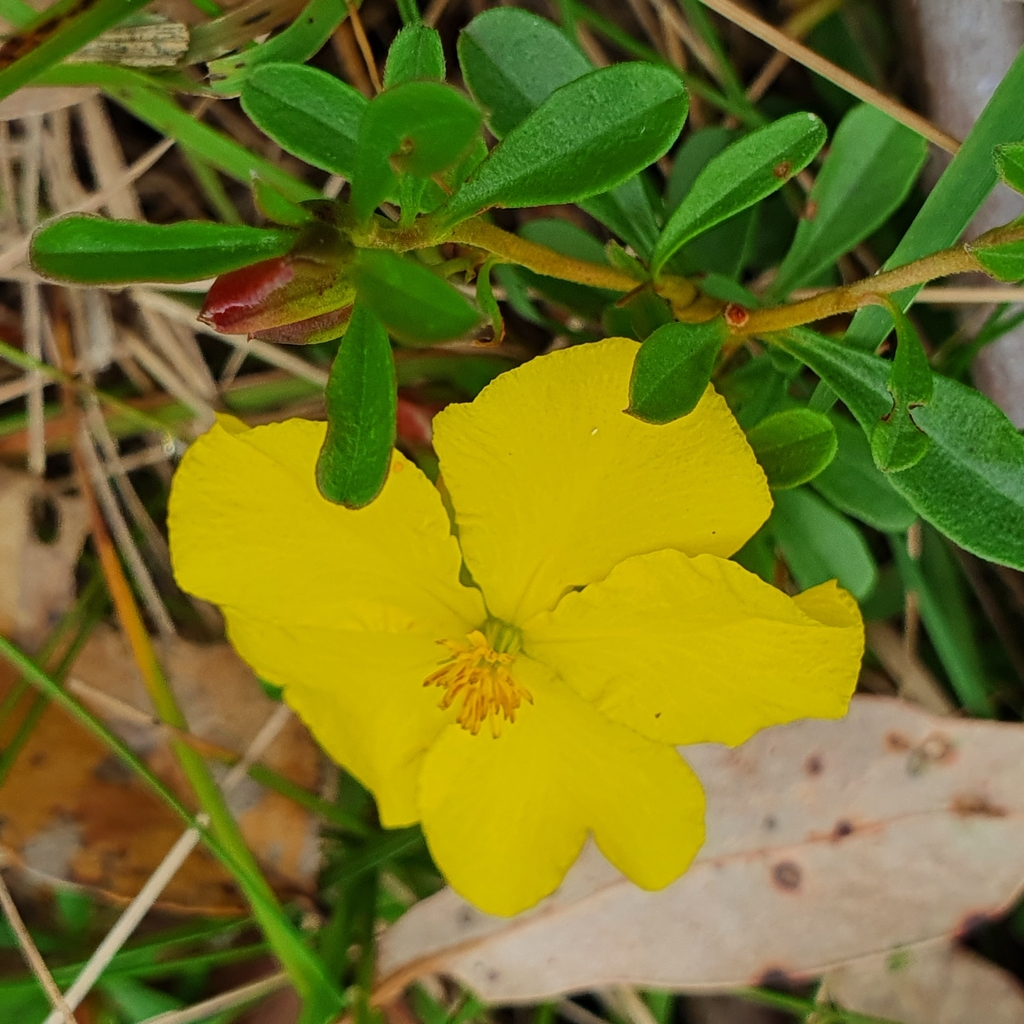
Wedge Guinea Flower
Hibbertia diffusa
Hibbertia diffusa is a species of perennial shrub, in the family Dilleniaceae, endemic to the south eastern region in Australia. It has yellow five-petalled flowers. Flowering occurs from spring to autumn. This plant often appears prostrate, and may reach 30 cm in height. The habitat is open forest on the coast and nearby mountain ranges. Heathland plants on headlands by the sea are many branched with entire leaves, 4 to 5 mm long. This plant appeared...
From the article Hibbertia diffusa on Wikipedia (CC BY-SA), quoted section by section
Description
Hibbertia diffusa is a prostrate to low-lying shrub that typically grows to a height of up to 30 cm (12 in) and usually has glabrous stems. The leaves are egg-shaped to lance-shaped with the narrower end towards the base, 4–30 mm (0.16–1.18 in) long and 3–9 mm (0.12–0.35 in) wide on a short petiole. The flowers are sessile and mostly arranged on the ends of branchlets, the five sepals 6–8 mm (0.24–0.31 in) long and the five bright yellow petals 7–10 mm (0.28–0.39 in) long. There are twenty to twenty-five stamens arranged in groups around the two or three glabrous carpels. Flowering occurs from September to November.
Range & habitat
Wedge guinea flower grows in open forest on the coast and ranges of south-eastern Queensland, New South Wales and far north-eastern Victoria.
== References ==
Wikipedia: “Distribution and habitat”
Where it lives
Recorded sightings
—
geo-referenced records in GBIF, from museums, herbaria and field observers.
Drag the globe to turn it. Dots are where records exist, not a range map; darker means more records.
In the stacks
Searching the stacks…
Every page naming Hibbertia diffusa in the Biodiversity Heritage Library →
This page is assembled live from iNaturalist, GBIF, Wikipedia, the Source Library and the Internet Archive. It is not yet part of the hand-edited codex. iNaturalist taxon 417788.