- Plants
- ›Vascular Plants
- ›flowering plants
- ›Dicots
- ›Legumes, Milkworts, and Allies
- ›Legumes
- ›Faboideae
- ›Mirbelieae
- ›Daviesia
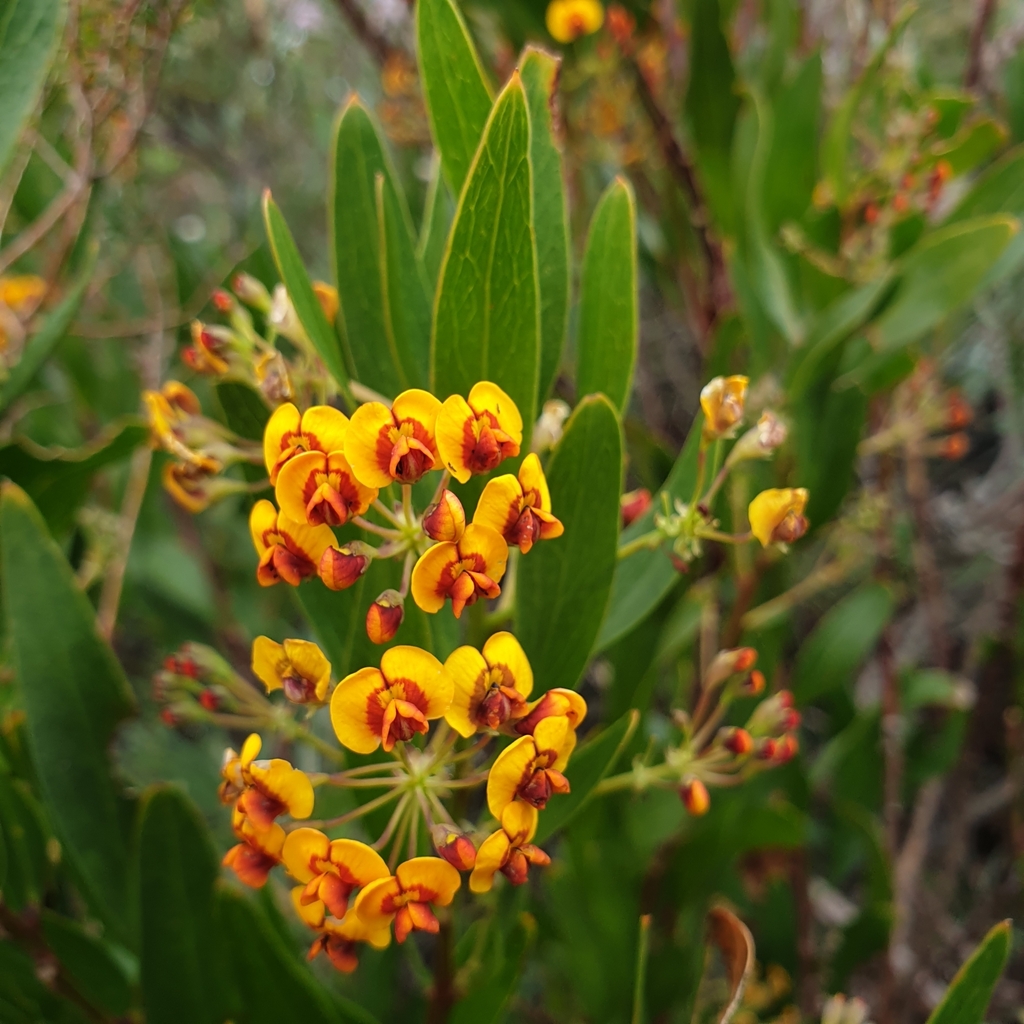
narrow leaf bitter pea
Daviesia corymbosa
Daviesia corymbosa, also known as narrow leaf bitter pea, is a species of flowering plant in the family Fabaceae native to the state of New South Wales in eastern Australia. A shrub to 2 m (6.6 ft) high, it grows in sandstone soils in open eucalyptus woodland or heath. It produces showy flowerheads of red and yellow flowers in the spring and early summer.
From the article Daviesia corymbosa on Wikipedia (CC BY-SA), quoted section by section
Description
Daviesia corymbosa grows as an open shrub and reaches 2 m (6.6 ft) high. Like other members of the pea family it has phyllodes rather than leaves. These are variable in shape, ranging from obovate (egg-shaped) or oval to linear and measure 2–12 cm (1–4.5 in) long and 0.2–2.5 cm (0.079–0.984 in) wide, and are green in colour with a prominent network of veins. The yellow to red flowers appear from August to December, but peak in Spring over September and October, and are arranged in groups of 5 to 20 in umbelliform or corymbose racemes. The seed pods ripen in November and December. The corymbose flowerheads of Daviesia corymbosa distinguish it from other bitter pea species. Furthermore, its green phyllodes contrast with the pale grey-green phyllodes of D. laevis and D. latifolia.
Range & habitat
Daviesia corymbosa is endemic to New South Wales, where it is found on sandstone soils east of the Great Dividing Range from Myall Lakes to Green Cape. The habitat is dry sclerophyll forest or heath. Associated species include red bloodwood (Corymbia gummifera), yellow bloodwood (C. eximia), narrow-leaved apple (Angophora bakeri), smooth-barked apple (A. costata), and silvertop ash (Eucalyptus sieberi), and watergum (Tristaniopsis laurina) and scrub beefwood (Stenocarpus salignus) along creeks.
Wikipedia: “Distribution and habitat”
What it does
Daviesia corymbosa regenerates from bushfire by resprouting. It is a host plant for the jewel beetle species Ethonion jessicae. The beetle larvae live in galls on the stems of host plants.
Wikipedia: “Ecology”
How it is grown
Peas of the genus Daviesia are only rarely grown in cultivation. A showy plant when in flower, D. corymbosa can grow in well-drained soils in sun or dappled shade. It can be propagated by seed to cuttings.
== References ==
Wikipedia: “Cultivation”
Where it lives
Recorded sightings
—
geo-referenced records in GBIF, from museums, herbaria and field observers.
Drag the globe to turn it. Dots are where records exist, not a range map; darker means more records.
In the stacks
Searching the stacks…
Every page naming Daviesia corymbosa in the Biodiversity Heritage Library →
This page is assembled live from iNaturalist, GBIF, Wikipedia, the Source Library and the Internet Archive. It is not yet part of the hand-edited codex. iNaturalist taxon 418318.