- Fungi Including Lichens
- ›Basidiomycete Fungi
- ›Higher Basidiomycetes
- ›Mushrooms, Bracket Fungi, Puffballs, and Allies
- ›Agaricomycetidae
- ›Common Gilled Mushrooms and Allies
- ›Agaricineae
- ›Galeropsidaceae
- ›Panaeolus
- ›Panaeolina
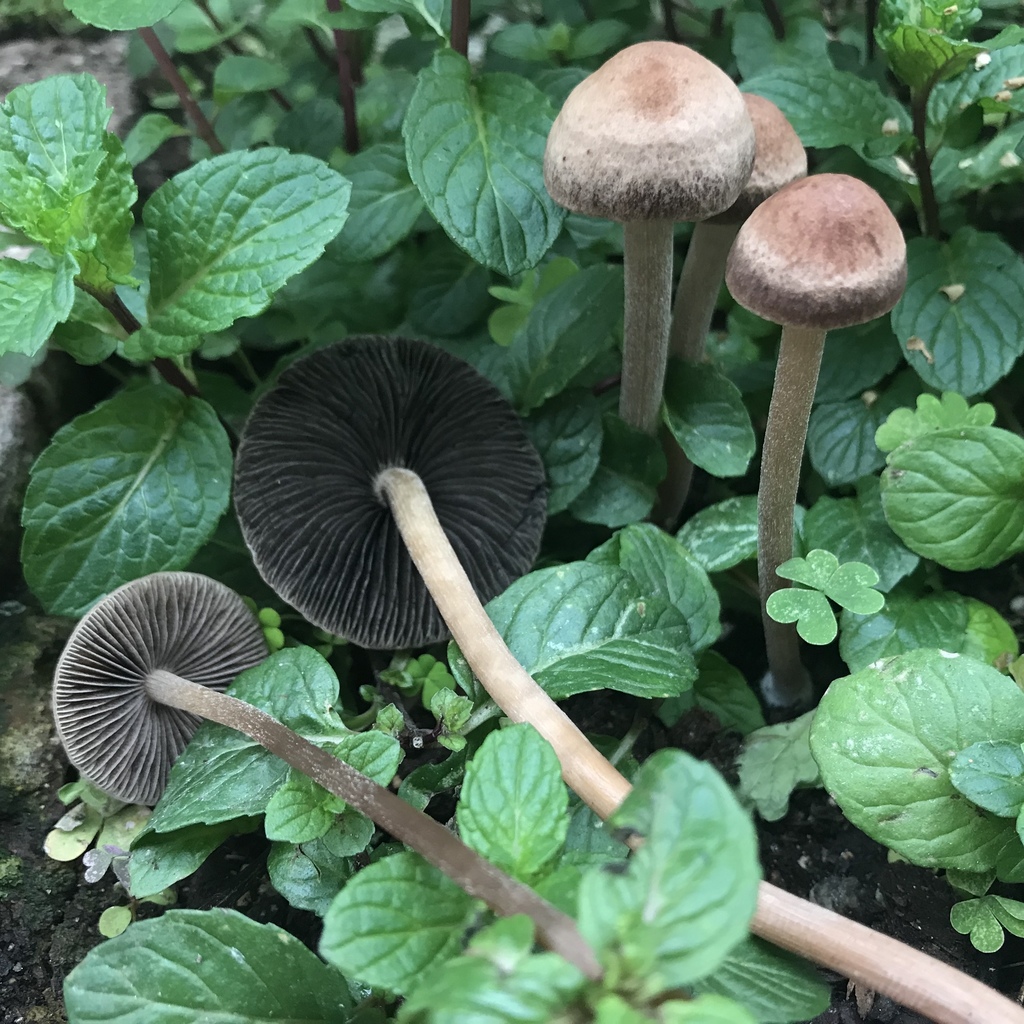
Banded Mottlegill
Panaeolus cinctulus
Panaeolus cinctulus, syn. P. subbalteatus, commonly known as the belted panaeolus, banded mottlegill, or subbs, is a very common, widely distributed psilocybin mushroom.
From the article Panaeolus cinctulus on Wikipedia (CC BY-SA), quoted section by section
Description
The cap is 1.5–6 centimetres (1⁄2–2+1⁄2 in) wide, hemispherical to convex when young to broadly umbonate or plane in age, smooth, hygrophanous, striking cinnamon-brown when moist, soot-black when wet which disappears as the mushroom completely dries out. The outer band is usually darker. The flesh is thin and brownish. The gills are close, adnate to adnexed, cream-colored when young, later mottled dingy brown then to soot-black. The gill edges are white and slightly fringed, but turn blackish when fully mature. The spore print is black. The stipe is 4–10 cm long, 1–10 mm thick, equal or tapered at the ends, reddish brown or covered by whitish powder, hollow, no veil remnants, longitudinally white-fibrillose, striate at the apex or twisting vertically down the entire length of the stipe. The stem base and mycelium occasionally stain blue. The taste is farinaceous (like flour) when fresh, saliferous (salty) when dried. The odor is slightly farinaceous.
Microscopic features. The spores are 11–14 x 7.5–9.5 μm, smooth, elliptical to rhomboid in face view, thick-walled, elliptical in side view.
Similar species. Morphologically, P. cinctulus can be easily confused with other species of psilocybin mushrooms. They have a resemblance to P. fimicola and prefer the same habitats, but the latter species has sulphidia on the gill faces. It can also resemble P. foenisecii and P. olivaceus.
Range & habitat
Panaeolus cinctulus is a cosmopolitan species that grows solitary to gregarious to cespitose (densely clumped) on compost piles, well-fertilized lawns and gardens, and, rarely, directly on horse dung. It grows from spring to fall, abundantly after rain. It can be found in many regions, including: Africa (South Africa), Austria, Canada (Alberta, British Columbia, New Brunswick, Prince Edward Island, Ontario, Quebec, Nova Scotia), Denmark, Finland, France, Germany, Great Britain, Guadeloupe, Estonia, Iceland, India, Ireland, Italy, South Korea, Japan, Mexico, New Guinea, New Zealand, Norway, Philippines, Russia, Romania , Slovenia, South America (Argentina, Chile, Brazil) and the United States (common in Oregon, Alaska, Washington, and both northern and southern California, but known to occur in all 50 states). According to American mycologist David Arora, P. cinctulus is the most common psilocybin mushroom in California. It has also been sighted in Melbourne, Australia, Central Queensland, Australia Belgium and the Czech Republic.
Wikipedia: “Habitat and formation”
In human culture
The descriptor subbalteatus comes from the Latin words sub ('somewhat') and balteat ('girdled'), a reference to the dark outer band of the cap.
Wikipedia: “Etymology”
Where it lives
Recorded sightings
—
geo-referenced records in GBIF, from museums, herbaria and field observers.
Drag the globe to turn it. Dots are where records exist, not a range map; darker means more records.
In the stacks
Searching the stacks…
Every page naming Panaeolus cinctulus in the Biodiversity Heritage Library →
This page is assembled live from iNaturalist, GBIF, Wikipedia, the Source Library and the Internet Archive. It is not yet part of the hand-edited codex. iNaturalist taxon 418443.