- Animals
- ›Chordates
- ›Vertebrates
- ›Mammals
- ›Therians
- ›Placental Mammals
- ›Ungulates, Carnivorans, and Allies
- ›Even-toed Ungulates and Cetaceans
- ›Ruminants
- ›Bovids
- ›Antelopes, Goats, and Sheep
- ›Typical Antelopes
- ›Ammodorcas
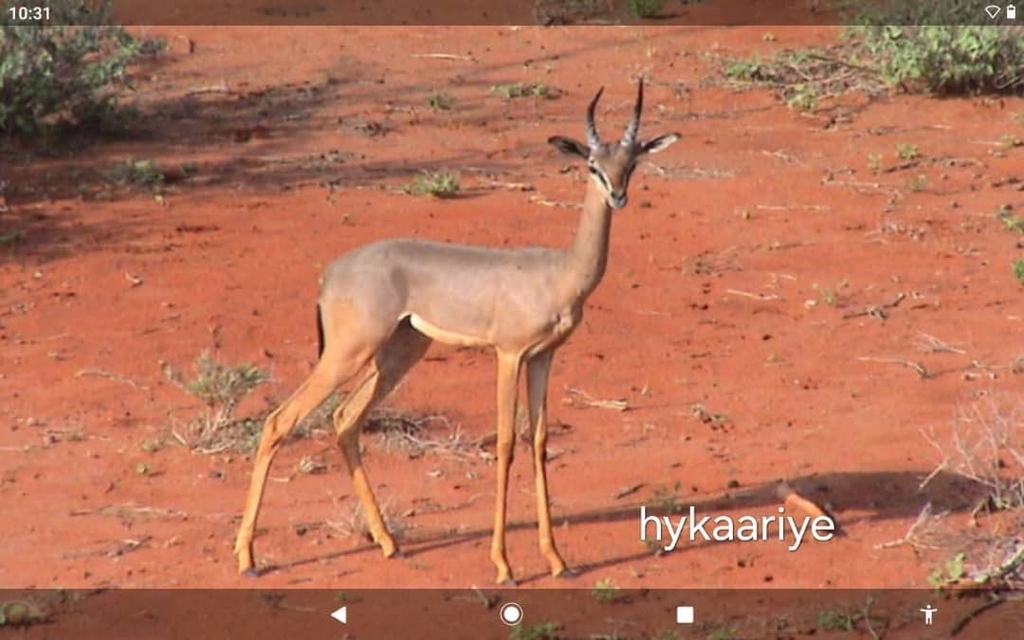
Dibatag
Ammodorcas clarkei
The dibatag (Ammodorcas clarkei), or Clarke's gazelle, is a medium-sized slender antelope native to Ethiopia and Somalia. Though not a true gazelle, it is similarly marked, with long legs and neck. It is often confused with the gerenuk due to their striking resemblance. The typical head-and-body length is about 103 to 117 cm (41 to 46 in). They stand up to about 80 to 90 cm (31 to 35 in). Male dibatag weigh between 20 and 35 kg (44 and 77 lb), whereas females range from 22 and 29 kg (49 and 64 lb). The length of the curved horns, present only on males, is typically between 10 and 25 cm (3.9 and 9.8 in). The upper parts are gray to fawn, while the dorsal and lateral areas are cinnamon to rufous (reddish brown). The underparts, rump and the insides of the legs are all white. While markings are visible on the face, there are none on the flanks or the buttocks.
Dibatag are alert and secretive, and their brown coat provides an excellent camouflage, making the dibatag one of the antelopes most difficult to hunt. They are diurnal animals, and navigate in very small herds. Both sexes attain sexual maturity at 12 to 18 months. The species is polygynous. After a gestational period of six to seven months, a single offspring is born. Parturition usually occurs from September to November. The lifespan typically averages 10 to 12 years. Dibatag may maintain temporary territories demarcated by preorbital gland secretions, urine or feces. Primarily browsers, the dibatag feed on foliage and young shoots and shrubs.
From the article Dibatag on Wikipedia (CC BY-SA), quoted section by section
Description
The dibatag is a medium-sized antelope with a slim body and long neck and legs. The typical head-and-body length is about 103 to 117 cm (41 to 46 in). It stands up to about 80 to 90 cm (31 to 35 in) at the shoulder. The male weighs between 20 and 35 kg (44 and 77 lb), whereas the female ranges from 22 and 29 kg (49 and 64 lb). The long dark tail ends in a rounded but indistinct tassel. The tail is nearly 30 to 36 cm (12 to 14 in) long. The curved horns, resembling those of reedbuck, are present only on males, with the pointing tips facing forward. The length of horns is typically between 10 and 25 cm (3.9 and 9.8 in), though Rowland Ward recorded a length of 33 cm (13 in) from Somalia. This antelope is sexually dimorphic, because females tend to be smaller than males and lack horns.
The species has a small, flat, pointed, wedge-shaped head with large eyes and medium-sized ears. A similarity to the gazelles is the black, branched structure in the interior of the ears. The mouth is very small and the upper lip slightly elongated. There are strong facial markings resembling those of a gazelle. A chestnut brown streak runs from the crown up to the nostrils along the nose, flanked on both sides by parallel white stripes that circle the eyes. A white spot marks the throat. The soft and smooth coat is gray to fawn in the upper parts. …
Range & habitat
Dibatag inhabit a mix of different habitat types. They may occasionally visit treelands. They are thought to be more commonly found in areas where Commiphora shrubs grow. They occur within the altitude range of 200 to 1,200 m (660 to 3,940 ft). Habitat preference does not vary significantly with seasons. A study published in 1972 found a greater number of the dibatag in areas rich in red soil. The dibatag is endemic to the evergreen bushland of the Ogaden region of southeastern Ethiopia and adjoining parts in northern and central Somalia. In the past their range extended from the southern parts of northern Somalia through southeastern Ethiopia and central Somalia (between the coastline of the Indian Ocean and bounded by the Fafen River in the west and the Shebelle River in the southwest). Rock paintings of two dibatag were discovered on the west bank of the Nile River and north of the Aswan Dam in Egypt, suggesting a southward migration of the species in the Predynastic period in Egypt. Nowadays, however, the dibatag has disappeared from the majority of its historical range. From 1985 to 2006, over two decades, the overall decline has been estimated at more than 30 percent of the original population. In the northern Ogaden, the animal has become very rare owing to a high density of human settlements and large numbers of armed pastoralists and their livestock. …
Wikipedia: “Habitat and distribution”
What it does
Dibatag are diurnal animals (they are active in the daytime). They navigate either in solitude or in very small herds, resembling the social behavior of the gerenuk. Singles and pairs are most common, though groups of up to six individuals have been reported. Generally groups of over four individuals are rarely observed. The reaction of dibatag towards gerenuk is obscure, with there being reports of their loose associations as well as avoidance of each other. These territorial animals may maintain temporary territories demarcated by preorbital gland secretions, urine or feces. They defecate at fixed points and form dung piles. Males fight one another to defend their territory. Sparring is a notable part of fighting behavior: one male pushes and shoves against the neck and horns of the opponent, trying to throw him off balance. The stance is head down with the nose tucked between the forelegs for protection. Dibatags are well adapted to semi-arid habitats, with the capability of surviving on very little or no water. They meet most water requirements only from food. Their long neck and limbs enable them to place their forelegs on branches and reach higher branches. The brown pelage helps them hide in bushes. Alert and secretive, the dibatag hides in vegetation and remains motionless while watching for possible threats. …
Wikipedia: “Ecology and behavior”
In human culture
The dibatag was first described in 1891 by British zoologist Oldfield Thomas, who gave it the scientific name Ammodorcas clarkei. It is the sole member of the genus Ammodorcas, and is placed in the family Bovidae. Some authors such as Rod East of the IUCN SSC Antelope specialist group have classified it under a separate tribe Ammodorcadini. When Thomas first studied specimens from Somalia in 1891, he observed that the animal seemed to combine the horns of a reedbuck with the characteristic features of a gazelle (muzzle, facial markings, and anteorbital glands). At first, he considered it to be a reedbuck, though it appeared unnatural that a reedbuck should occur in the dry sandy plateau of Somalia. Thomas originally considered it a relative of the genus Redunca due to similarities in the morphology of horns, and placed it under the genus Cervicapra. However, after considering further specimens, he placed it under the separate genus Ammodorcas. No subspecies have been identified. The dibatag, which holds its black tail straight up when it is fleeing, gets its common name from the Somali words for 'tail' and 'erect': dabu and tag. The dibatag is also known as Clarke's gazelle, after T. W. H. Clarke, an Australian big game hunter who collected the type specimen.
Wikipedia: “Taxonomy and etymology”
Listen
Looking for field recordings…
Where it lives
Recorded sightings
—
geo-referenced records in GBIF, from museums, herbaria and field observers.
Drag the globe to turn it. Dots are where records exist, not a range map; darker means more records.
In the stacks
Searching the stacks…
Every page naming Ammodorcas clarkei in the Biodiversity Heritage Library →
This page is assembled live from iNaturalist, GBIF, Wikipedia, the Source Library and the Internet Archive. It is not yet part of the hand-edited codex. iNaturalist taxon 42272.