- Plants
- ›Vascular Plants
- ›flowering plants
- ›Dicots
- ›Heathers, Balsams, Primroses, and Allies
- ›heath family
- ›Epacrids, Styphelias and Allies
- ›Styphelieae
- ›Melichrus
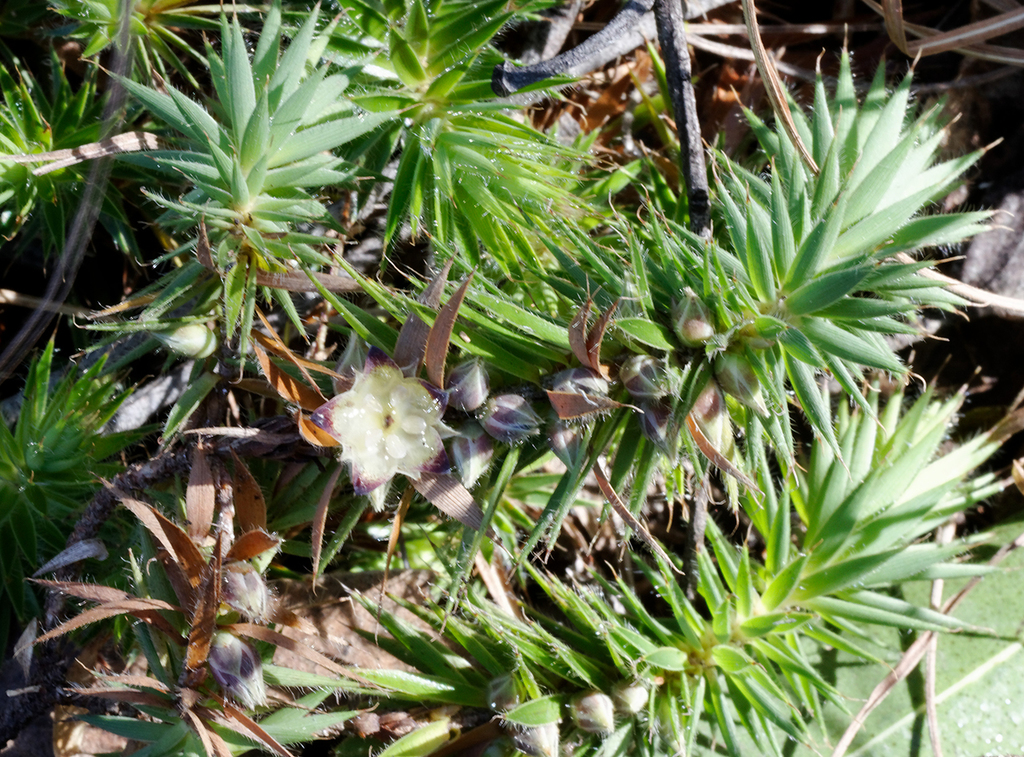
Jam Tarts
Melichrus procumbens
Melichrus procumbens, commonly known as jam tarts, is a flowering plant in the family Ericaceae and is endemic to eastern Australia. It is a low-lying shrub, often forming mats, with hairy, lance-shaped leaves, fragrant, cream-coloured flowers and flattened spherical, green to red drupes.
From the article Melichrus procumbens on Wikipedia (CC BY-SA), quoted section by section
Description
Melichrus procumbens is a low-lying shrub that sometimes forms mats or grows to a height of 20 cm (8 in). Its leaves are erect or pressed against the stem near the ends of branches or spreading lower down, 11–28 mm (0.43–1.10 in) long and 1.2–4.0 mm (0.05–0.16 in) wide on a petiole 0.5 mm (0.02 in) wide, with 10 to 14 ribs on the lower surface. The flowers are borne on the underside of branches, cream-coloured to pale green with a pink tinge. The bracteoles are 3.0–5.5 mm (0.12–0.22 in) long and the sepals are 5.0–7.5 mm (0.2–0.3 in) long and greenish with silky hairs. The petals form a saucer-shaped tube 2.0–2.5 mm (0.08–0.10 in) long with spreading lobes 3.0–3.5 mm (0.12–0.14 in) long. Flowering occurs from February to July to September, and the fruit is a green to red, smooth, flattened spherical drupe 2–4 mm (0.08–0.16 in) long .
Range & habitat
Jam tarts grows in heath and forest on sandstone or granite from south-eastern Queensland to the coast and Hornsby Plateau near Sydney.
Wikipedia: “Distribution and habitat”
What it does
The flowers of Melichrus procumbens face downwards, close to the ground, suggesting pollination by ground-crawling insects such as ants. The common name (jam tarts) comes from the peculiar shape of the open flower and the large amount of nectar present.
Wikipedia: “Ecology”
Where it lives
Recorded sightings
—
geo-referenced records in GBIF, from museums, herbaria and field observers.
Drag the globe to turn it. Dots are where records exist, not a range map; darker means more records.
In the stacks
Searching the stacks…
Every page naming Melichrus procumbens in the Biodiversity Heritage Library →
This page is assembled live from iNaturalist, GBIF, Wikipedia, the Source Library and the Internet Archive. It is not yet part of the hand-edited codex. iNaturalist taxon 423595.