- Animals
- ›Arthropods
- ›Hexapods
- ›Insects
- ›Winged and Once-winged Insects
- ›Grasshoppers, Crickets, and Katydids
- ›Katydids, Crickets, and Allies
- ›Katydids, wētā, and allies
- ›Tettigonioidea
- ›Katydids
- ›Shieldback Katydids
- ›Tettigoniini
- ›Tettigonia
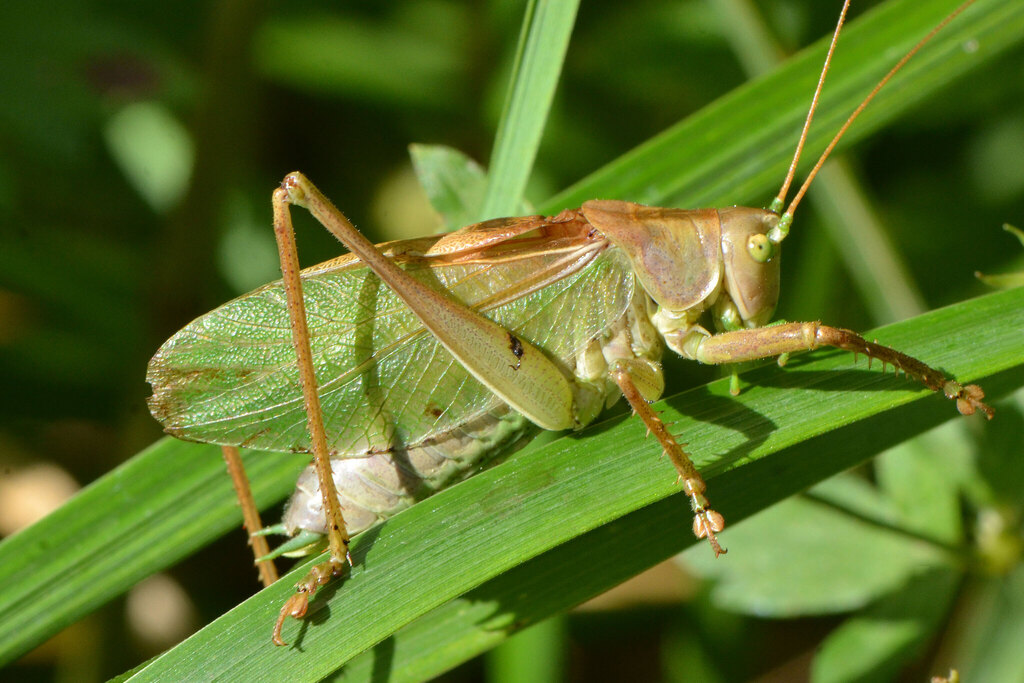
Upland Green Bush-cricket
Tettigonia cantans
Tettigonia cantans is a species of bush crickets (or katydids) belonging to the family Tettigoniidae subfamily Tettigoniinae.
From the article Tettigonia cantans on Wikipedia (CC BY-SA), quoted section by section
Description
The adult males grow up to 20–30 millimetres (0.79–1.18 in) long, while females reach 29–35 millimetres (1.1–1.4 in). The basic coloration of the body is usually green, with a brown stripe on the back. These grasshoppers hardly fly, their wings are shorter and wider than in the other Tettigonia species, only slightly covering the end of the abdomen. The ovipositor of the female extends beyond the tip of the wings.
Range & habitat
Tettigonia cantans is present in most of Europe, in the eastern Palearctic realm, in Near East, and in North Africa. The distribution extends from the Pyrenees to China. In the Mediterranean region, Tettigonia cantans is restricted to the higher elevations of the mountains. It is absent from most parts of Western Europe (Great Britain, western France, most of Iberian Peninsula).
Wikipedia: “Distribution”
Listen
Looking for field recordings…
Where it lives
Recorded sightings
—
geo-referenced records in GBIF, from museums, herbaria and field observers.
Drag the globe to turn it. Dots are where records exist, not a range map; darker means more records.
In the stacks
Searching the stacks…
Every page naming Tettigonia cantans in the Biodiversity Heritage Library →
This page is assembled live from iNaturalist, GBIF, Wikipedia, the Source Library and the Internet Archive. It is not yet part of the hand-edited codex. iNaturalist taxon 423693.