- Plants
- ›Vascular Plants
- ›flowering plants
- ›Dicots
- ›myrtles, evening primroses, and allies
- ›myrtle family
- ›Myrtoideae
- ›Leptospermeae
- ›Kunzea
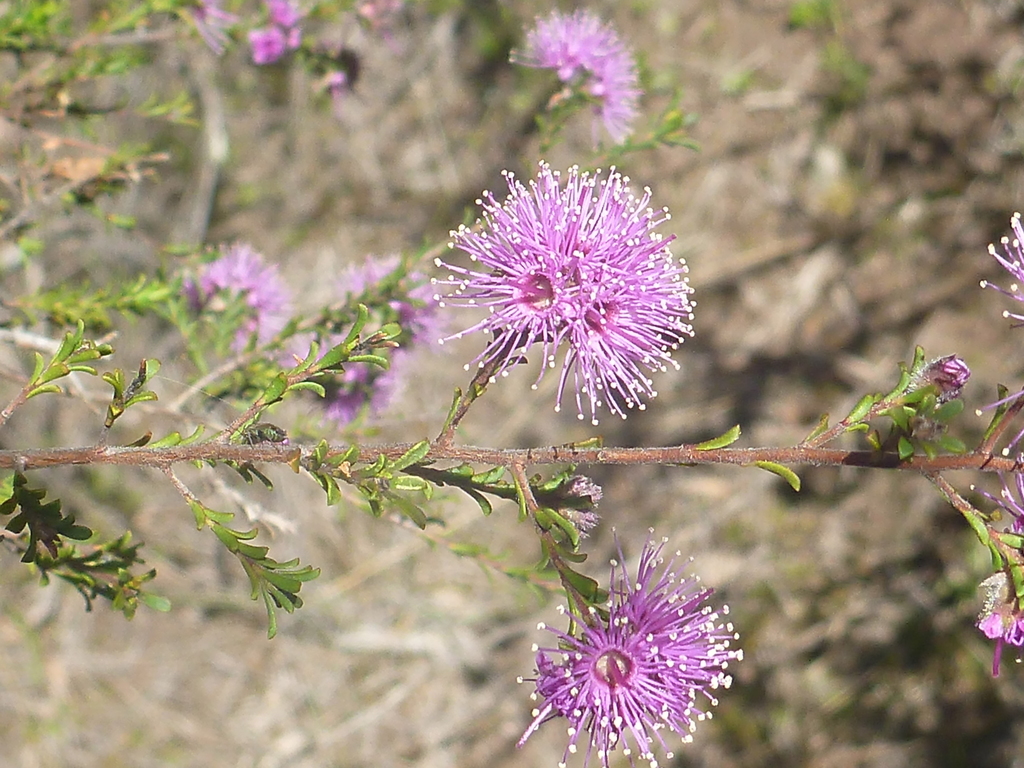
Kunzea obovata
Kunzea obovata is a flowering plant in the myrtle family, Myrtaceae and is endemic to eastern Australia. It is a spreading shrub with unusually-shaped leaves and clusters of pink to purple flowers. It is restricted to northern New South Wales and south-eastern Queensland.
From the article Kunzea obovata on Wikipedia (CC BY-SA), quoted section by section
Description
Kunzea obovata is an erect, spreading shrub which grows to a height of up to 3 m (10 ft) with its branches silky hairy when young. The leaves are egg-shaped with the narrower end towards the base, have a dished upper surface and a down-turned tip. They are 3–9 mm (0.1–0.4 in) long, about 1 mm (0.04 in) wide with a petiole about 1 mm (0.04 in) long and are covered with soft hairs when young. The flowers are arranged in clusters of up to eighteen or more flowers on the ends of the branches. The floral cup is about 3 mm (0.1 in) long and hairy. The sepal lobes are broadly triangular, about 1 mm (0.04 in) long and pointed. The petals are deep purplish, sometimes pink, egg-shaped, about 2 mm (0.08 in) long and there 35 to 50 stamens which are 3–5 mm (0.1–0.2 in) long. The style is 4–6 mm (0.16–0.24 in) long. Flowering mostly occurs from September to November and the fruit are urn-shaped capsules which are 4–5 mm (0.16–0.20 in) long and about 3 mm (0.1 in) wide.
Range & habitat
This kunzea grows in forest in soils derived from granite, on the tablelands north from Deepwater. It is conserved in national parks including Girraween and Boonoo Boonoo National Parks.
== References ==
Wikipedia: “Distribution and habitat”
Where it lives
Recorded sightings
—
geo-referenced records in GBIF, from museums, herbaria and field observers.
Drag the globe to turn it. Dots are where records exist, not a range map; darker means more records.
In the stacks
Searching the stacks…
Every page naming Kunzea obovata in the Biodiversity Heritage Library →
This page is assembled live from iNaturalist, GBIF, Wikipedia, the Source Library and the Internet Archive. It is not yet part of the hand-edited codex. iNaturalist taxon 424085.