- Animals
- ›Arthropods
- ›Hexapods
- ›Insects
- ›Winged and Once-winged Insects
- ›Grasshoppers, Crickets, and Katydids
- ›Grasshoppers, Locusts, and Allies
- ›Grasshoppers
- ›Short-horned Grasshoppers and Locusts
- ›Short-horned Grasshoppers
- ›Eyprepocnemidinae
- ›Eyprepocnemidini
- ›Eyprepocnemis
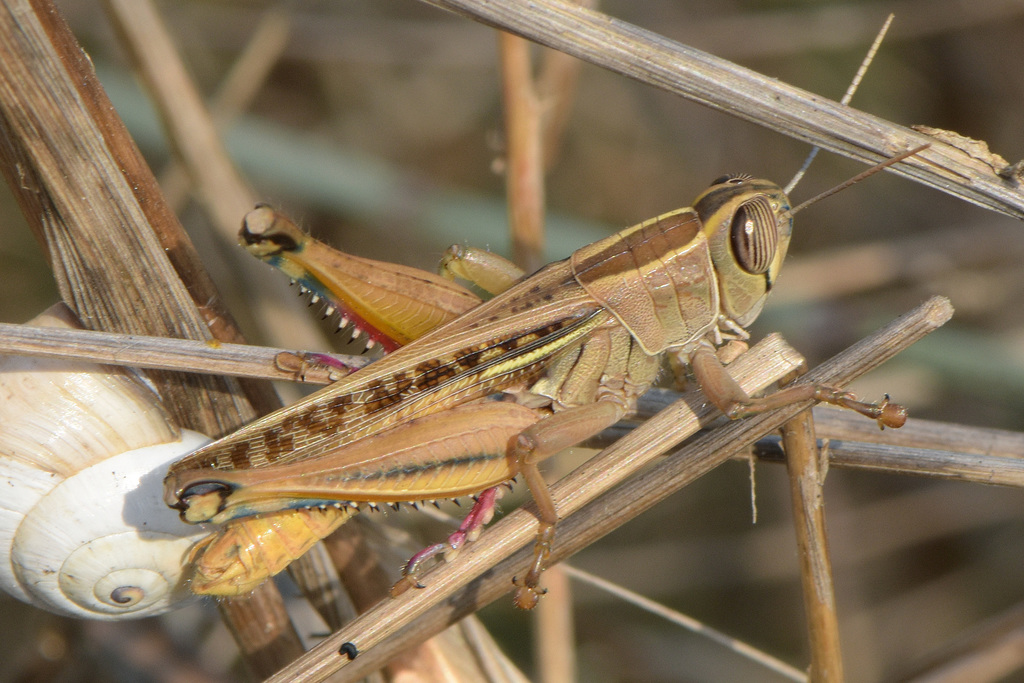
Lamenting Grasshopper
Eyprepocnemis plorans
Eyprepocnemis plorans, the lamenting grasshopper, is a species of insect in the family Acrididae. It is the type species of the genus Eyprepocnemis, and is found in Africa, parts of the Middle East, and southern Europe. It typically inhabits wetlands and other moist habitats.
From the article Eyprepocnemis plorans on Wikipedia (CC BY-SA), quoted section by section
Description
This is a medium-sized grasshopper, with females growing to a length of about 4.5 cm (1.8 in), while males are slightly smaller. The general colour is greyish-brown. The head and prothorax have a central dark band edged with paler stripes. The eye has a longitudinal dark streak, a characteristic shared by Anacridium aegyptium, Heteracris annulosa and Heteracris adspersa. The femurs of the hind legs have greenish, blue and yellow striations, and the hind tibia have reddish or bluish iridescence, and black and white spines.
Range & habitat
Eyprepocnemis plorans is native to much of Africa, parts of the Middle East such as Iran, and southern Europe, where it is present in southern Greece, southern Italy, Sicily, Sardinia and southern Spain. It seems to be expanding its range northwards in Italy, possibly as a result of putative climate change. It usually occurs in wetlands, reed beds, freshwater and salt marshes, riverside vegetation, coastal vegetation and man-made habitats. It appreciates vertical-growing stems such as reeds, and habitats with tall forbs mixed with lower-growing plants.
Wikipedia: “Distribution and habitat”
What it does
Grasshoppers are in general polyphagous, eating vegetation from many different plant sources. Eyprepocnemis plorans feeds mainly on grasses and sedges. The female deposits an egg pod in the ground and the eggs hatch in the spring. The nymphs undergo five moults, becoming more similar to the adult insect at each developmental stage; they do not undergo metamorphosis and mature in the summer. In parts of the range many adults survive the winter. This species is rather wary and is a good flier.
Wikipedia: “Ecology”
Listen
Looking for field recordings…
Where it lives
Recorded sightings
—
geo-referenced records in GBIF, from museums, herbaria and field observers.
Drag the globe to turn it. Dots are where records exist, not a range map; darker means more records.
In the stacks
Searching the stacks…
Every page naming Eyprepocnemis plorans in the Biodiversity Heritage Library →
This page is assembled live from iNaturalist, GBIF, Wikipedia, the Source Library and the Internet Archive. It is not yet part of the hand-edited codex. iNaturalist taxon 424336.