- Plants
- ›Vascular Plants
- ›flowering plants
- ›Dicots
- ›Roses, Elms, Figs, and Allies
- ›Nettle Family
- ›Forsskaolea
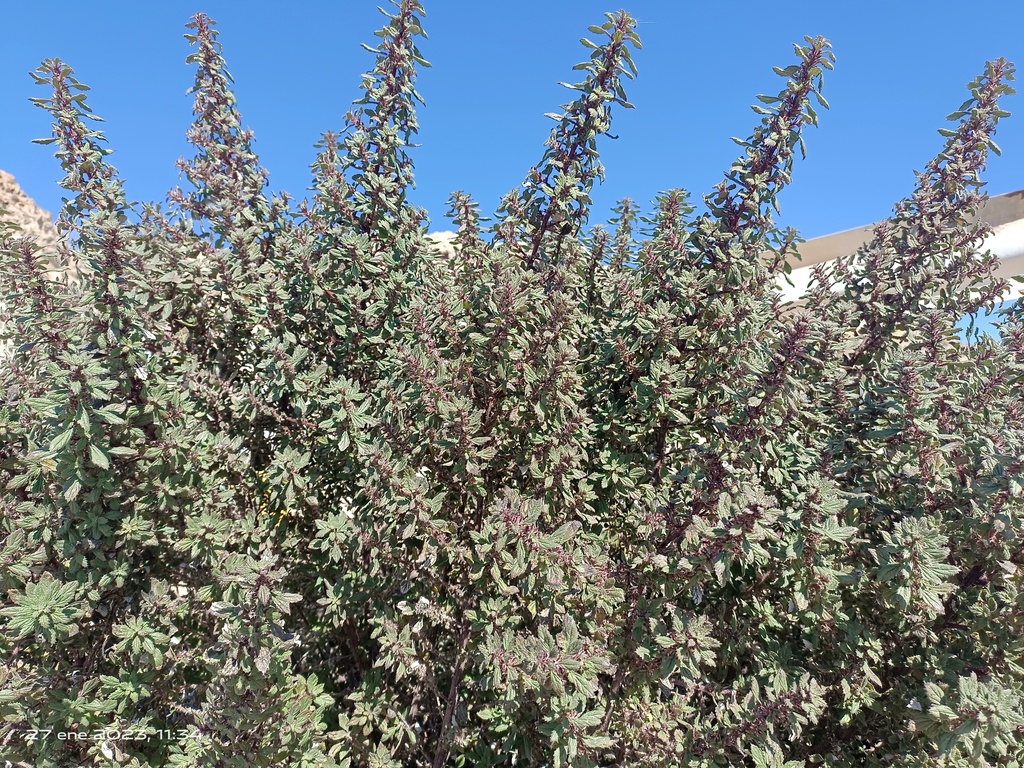
Desert Nettle
Forsskaolea tenacissima
Forsskaolea tenacissima is a member of the non-stinging nettles genus Forsskaolea and is in the same family as the stinging kind, Urticaceae. Described as "looking like a tough character that does not want or need a caress", F. tenacissima makes its home where not many plant species survive, in stony soils, road edges, in the gravel wadi
and "in the rock crevices and water-receiving depressions" above the stone pavements of the Hamadas.
From the article Forsskaolea tenacissima on Wikipedia (CC BY-SA), quoted section by section
Description
The almost upright 65 centimetres (26 in) fleshy, stiff-haired, woody annual F. tenacissima appears after the rains in rocky and difficult to grow in places like the Sahel of Mauritania, and Northeast Africa (the Horn of Africa), and now recorded in Niger. It is a chamaephyte that is much relished by livestock.
Leaves and stems 5 millimetres (0.20 in) to 20 millimetres (0.79 in) leaf stalks. Broad-side of leaves are squared-oval to round 1 centimetre (0.39 in) to 5 centimetres (2.0 in) long and 1 centimetre (0.39 in) to 7 centimetres (2.8 in) wide. Upper leaf surfaces have straight and hooked hairs and the lower leaf is densely white-wooly with hair. Small leafy outgrowth at the base of the leaf are rounded, 3 millimetres (0.12 in) to 5 millimetres (0.20 in) long, 1.5 millimetres (0.059 in) to 2.5 millimetres (0.098 in) wide, persistent and dry—not green. Flowers Five involucral bracts narrow and tapering to a point, 5 millimetres (0.20 in) to 6 millimetres (0.24 in) long and densely wooly. Four to eight male flowers and two to six female flowers in the center of the flower head which is attached right to the stem. Three unequal sepals; 3 millimetres (0.12 in) long stamen with a pointy anther and a conical 2 millimetres (0.079 in) long ovary which is surrounded with dense wool. …
Range & habitat
Common in arid and semi-arid waste lands in sandy clay gravelly soils from sea level to 1,200 metres (3,900 ft) like Mediterranean woodlands and shrublands, semi-steppe shrublands, shrub-steppes, deserts and extreme deserts.
Native Palearctic: Northern Africa: Algeria, Egypt Southwestern Europe: Spain Southeastern Europe: Malta Western Asia: Israel, Jordan, Libya, Palestine, Sinai, Tunisia Current Palearctic: Northern Africa: Algeria, Egypt Southwestern Europe: Spain Southeastern Europe: Malta Western Asia: Afghanistan, Iran, Israel, Jordan, Libya, Pakistan, Palestine, Sinai, Tunisia Asia Temperate: India Afrotropic: Arabian Peninsula: Saudi Arabia, Oman, United Arab Emirates Northeast Tropical Africa: Eritrea West Tropical Africa: Mauritania
Wikipedia: “Distribution”
Where it lives
Recorded sightings
—
geo-referenced records in GBIF, from museums, herbaria and field observers.
Drag the globe to turn it. Dots are where records exist, not a range map; darker means more records.
In the stacks
Searching the stacks…
Every page naming Forsskaolea tenacissima in the Biodiversity Heritage Library →
This page is assembled live from iNaturalist, GBIF, Wikipedia, the Source Library and the Internet Archive. It is not yet part of the hand-edited codex. iNaturalist taxon 424782.