- Animals
- ›Arthropods
- ›Hexapods
- ›Insects
- ›Winged and Once-winged Insects
- ›Ants, Bees, Wasps, and Sawflies
- ›Narrow-waisted Wasps, Ants, and Bees
- ›Ants, Bees, and Stinging Wasps
- ›Bees and Apoid Wasps
- ›Bees
- ›Miner, Fairy, Allied Panurgine, and Oxaeine Bees
- ›Typical Mining Bees
- ›Andrenini
- ›Andrena
- ›Charitandrena
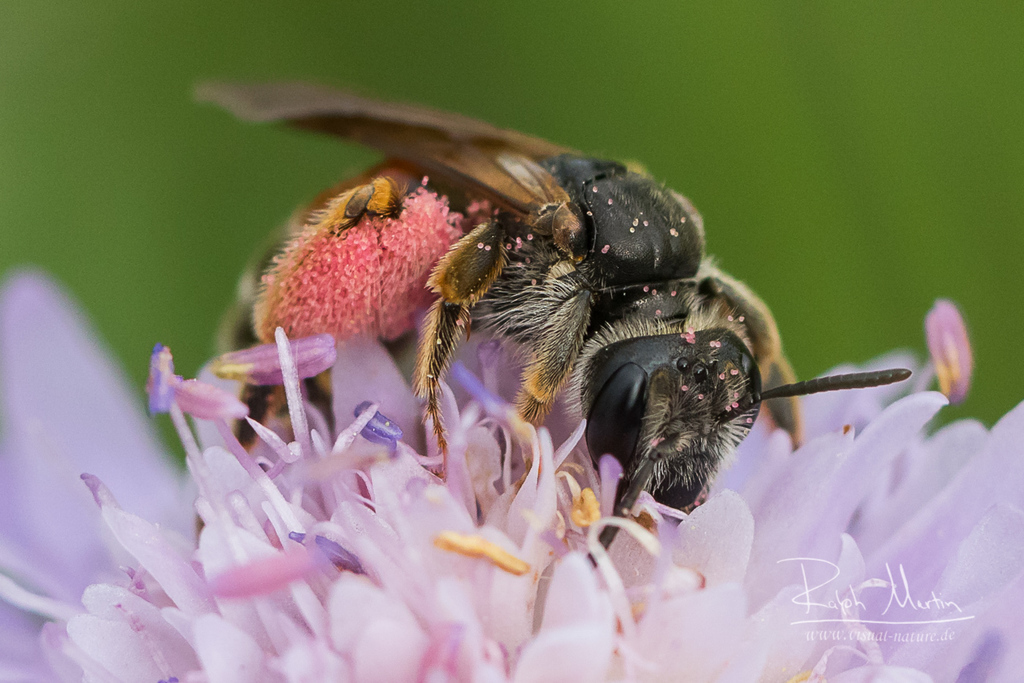
Large Scabious Mining Bee
Andrena hattorfiana
Andrena hattorfiana is a species of mining bees belonging to the family Andrenidae subfamily Andreninae.
From the article Andrena hattorfiana on Wikipedia (CC BY-SA), quoted section by section
Description
The adults grow up to 13–16 millimetres (0.51–0.63 in) long. They have a black-brown body with sparse light hair, while the first and the second abdominal segment are reddish. The females have a pollen basket of curved hairs on the sides of the thorax.
Range & habitat
This endangered solitary bee is present in most of Europe and in the Near East. From central Spain via Ukraine to the Urals and via Asia Minor to the Caucasus; north to southern England and south Wales, in Norway and Sweden to 60.5 ° N, in Finland to 62.5 ° N, in Russia to Perm, south to Sicily, Peloponnese and southern Turkey; not in Crete. In the eastern Mediterranean area (westwards to Sicily) the ssp. dimidiata BRULLE, 1832 occurs. The species is generally uncommon.
Wikipedia: “Range”
What it does
Andrena hattorfiana is an oligolectic species, feeding on cardiac plants (Dipsacaceae); The main pollen source in the area is Knautia arvensis, the secondary pollen source is Knautia dipsacifolia. If the Knautia already wither before the end of the flight time, pollen of Scabiosa columbaria is also collected. It is a solitary bee that can be seen easily from up to 5 meters away. It can be encountered from May through August. The females usually lay eggs in a nest excavated by themselves in sandy soils. Nest has five to ten brood cells, each having one egg and pollen as food for the larva. Every day there is one offspring produced in good weather conditions for foraging, and five to ten in a lifetime. These nests are made in dry parts of a traditionally managed hay field in medium pressure horse-graze pastures with sparse vegetation and on human-trampled paths. These bees rely heavily on pollen, that is almost like a species saving resource. The critical pollen resource for 10 reproducing Andrena hattorfiana ♀ varied from 27 to 361 plant individuals. Therefore, being able to get pollen from only one flower may have helped lead this species to the endangerment of being extinct. With the specific conditions in which a nest must be made could have aided in bringing this species closer to being endangered of being extinct. …
Wikipedia: “Ecology”
In human culture
Dedicated to Baron (?) Von Hattorf, from whose collection the specimen described by Fabricius comes from.
Wikipedia: “Etymology”
Listen
Looking for field recordings…
Where it lives
Recorded sightings
—
geo-referenced records in GBIF, from museums, herbaria and field observers.
Drag the globe to turn it. Dots are where records exist, not a range map; darker means more records.
In the stacks
Searching the stacks…
Every page naming Andrena hattorfiana in the Biodiversity Heritage Library →
This page is assembled live from iNaturalist, GBIF, Wikipedia, the Source Library and the Internet Archive. It is not yet part of the hand-edited codex. iNaturalist taxon 424814.