- Plants
- ›Vascular Plants
- ›flowering plants
- ›Dicots
- ›Gentians, Dogbanes, Madders, and Allies
- ›Dogbane Family
- ›Apocynoideae
- ›Apocyneae
- ›Chonemorphinae
- ›Chonemorpha
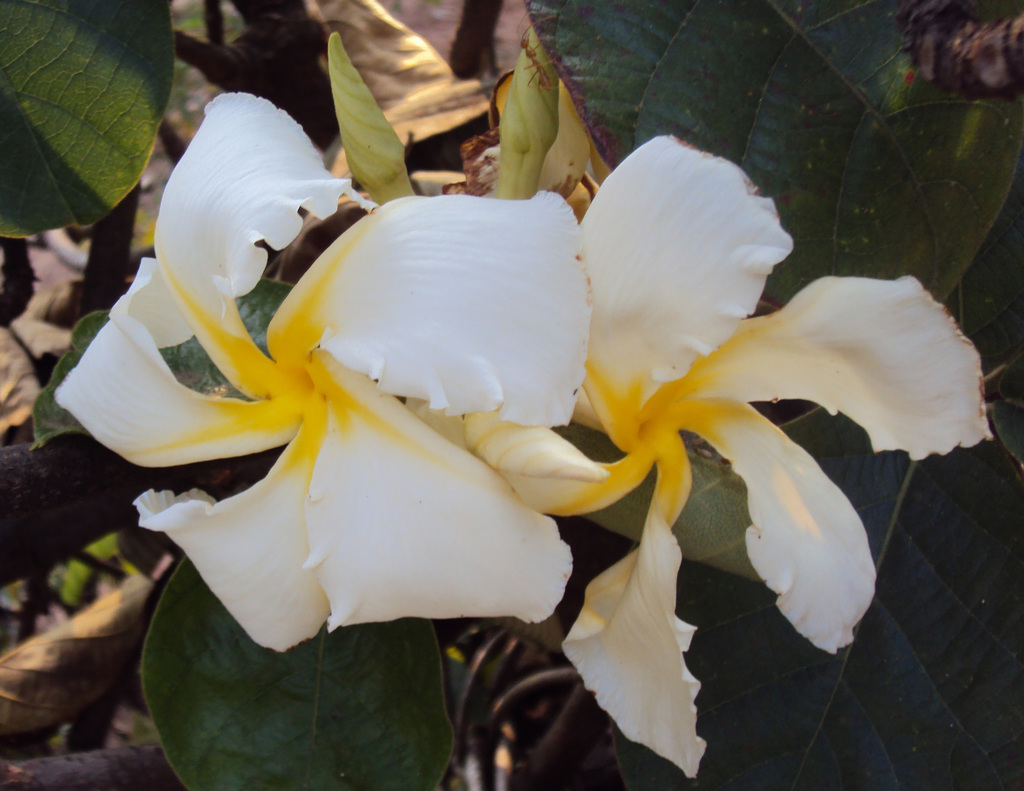
Frangipani vine
Chonemorpha fragrans
Chonemorpha fragrans, the frangipani vine or climbing frangipani, is a plant species in the genus Chonemorpha. It is a vigorous, generally evergreen, climbing shrub producing stems 30 m (98 ft) or more long that can climb to the tops of the tallest trees in the forests of Southeast Asia. It has scented, white flowers and large shiny leaves. It is native to China, India (the Himalayas), Indonesia, Malaysia, Myanmar, Sri Lanka and Thailand. It is very commonly used in Ayurveda (an Indian traditional medicine) and it is also cultivated mostly worldwide in frost-free places.
From the article Chonemorpha fragrans on Wikipedia (CC BY-SA), quoted section by section
Description
Chonemorpha fragrans is a vigorous climber, reaching up to 30 m (98 ft). It can also grow or spread to about 7 m (23 ft) wide, depending on the support. It has a rusty brown, or grey barked stem which is numerously lenticelled. The bark can produce fibre of good quality. It is evergreen in most tropical climates. Elsewhere, in the spring, the fresh new leaves are bright green with a bronze hue. The mature leaves are large, deep green, shiny, and hirsute (hairy), especially underneath. They are broadly ovate, orbicular, or elliptic in shape. They have a 2cm long petiole, and they are 15–45 cm (6–18 in) wide and 13–45 cm (5–18 in) long, with 10–12 pairs of lateral, prominent veins. It has terminal (end of stem), clusters of blooms, appearing from spring to autumn, from May to July, or between April and October. They are highly fragrant, and the scent is thought to be very similar to that of the Singapore White plumeria. They have tubular sepals, which are 1 cm long, a white corolla which is 8–10 cm (3–4 in) long. It has a hairy throat, which is yellow. After it has bloomed, between July and September, it produces a lanceolate or oblong seedcase. Inside the seed case, are flat seeds, shortly beaked with long white silky coma. All parts of the plant produce a milk-like substance when damaged.
Biochemistry. …
Range & habitat
It is native to a large area of Asia, from the Himalayas to Java. In temperate Asia, it is found within China (within the provinces of Yunnan Sheng and Guangxi). Within tropical Asia, it is found in the countries of Bangladesh, Bhutan, India, (including Nicobar Islands,) Nepal, Sri Lanka, Myanmar, Thailand, Brunei, East Timor, Indonesia, (including the islands of Sulawesi, Lesser Sunda Islands and Sumatra) Malaysia and the Philippines. It is cultivated also in Fujian and Guangdong in China.
Wikipedia: “Range”
At the table
It has been used in folk medicine to help treat various disorders. It is used (roots, leaves, bark-stem,) in Ayurveda (an Indian traditional medicine), to treat various things such as skin diseases, leprosy, scabies, syphilis, gynecological disorders, inflammation, constipation, worm infestations (ascaris), hyperacidity, diabetes, jaundice, coughs, bronchitis, stomach disorders, intermittent fevers, anaemia, typhoid, polyuria, boils, eye diseases, poisoning, and bronchitis. It is also used as a laxative. The crushed roots of the plant, which are sweet and bitter, are used to make a decoction drink to help remove a retained placenta, or to treat amebic dysentery. The stem of the plant is used to treat fractures and rheumatalgia. The leaves of the plant are used a churna or extract used in combination with the other plant materials. As the plant has diverse biological activities including muscle relaxant and antiparasitic properties. The plant is sometimes cultivated for the fibre that is obtained from its stem, which is used to make fishing nets, especially in East Java.
Wikipedia: “Uses”
How it is grown
As the plant is semi-deciduous in subtropical areas, it can tolerate some colder temperatures (about 30 - 40°F,) but will then be fully dormant during the winter months, but it prefers a frost-free warm position. It may lose leaves if temperature drops below 45°F. In USA, it is hardy to between USDA Zone 9b: to -3.8 °C (25 °F) and USDA Zone 11: above 4.5 °C (40 °F). It prefers to grow in well-drained, acid soils, which are rich and free draining. Loamy soil is the ideal soil type as it does not like poor soils. It needs ample moisture during the summer months, but not constantly moist. It can grown in full or partial sun. but is best in full sun, for better flowering. Within the garden setting, it is best grown on large structures (such as pergolas, trellises or columns). Alternatively it can naturally ramble over tall trees, as they do not cling to walls. It is used to create a 'tropical' feel within the garden. It is a disease free, and are not affected by frangipani rust. They can be grown in pots but prefer to be directly into the ground. During the winter, is the preferred time to prune to restrict the climbing growth to a manageable size.
Propagation. It is possible to propagate Chonemorpha fragrans via seed. These can be collected from a mature plant via paper bags placed over the flower heads. Then the pods are dried and then broken open to reveal the seeds. …
Wikipedia: “Cultivation”
Where it lives
Recorded sightings
—
geo-referenced records in GBIF, from museums, herbaria and field observers.
Drag the globe to turn it. Dots are where records exist, not a range map; darker means more records.
In the stacks
Searching the stacks…
Every page naming Chonemorpha fragrans in the Biodiversity Heritage Library →
This page is assembled live from iNaturalist, GBIF, Wikipedia, the Source Library and the Internet Archive. It is not yet part of the hand-edited codex. iNaturalist taxon 425553.