- Plants
- ›Vascular Plants
- ›flowering plants
- ›Dicots
- ›myrtles, evening primroses, and allies
- ›myrtle family
- ›Myrtoideae
- ›Syzygieae
- ›Syzygium
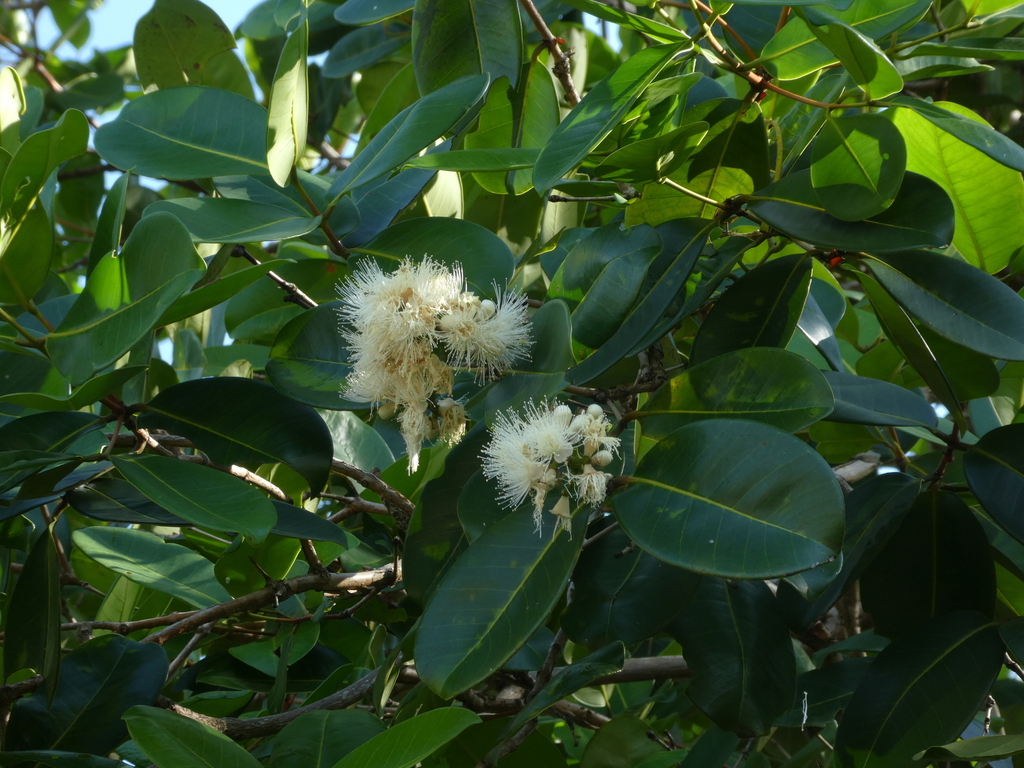
Syzygium forte
Syzygium forte, commonly known as flaky-barked satinash, white apple or brown satinash, is a tree in the family Myrtaceae native to New Guinea and northern Australia. It was first described in 1865 and is classified as least concern. The fruit are edible, and it is used as a landscaping tree for streets and parks.
From the article Syzygium forte on Wikipedia (CC BY-SA), quoted section by section
Description
Syzygium forte typically grows up to 25 metres (82 ft) in height in its native habitat, with reddish brown or pinkish, flakey bark. The leaves are arranged in opposite pairs on the twigs and are mid green in colour, paler below. They are somewhat leathery and have revolute margins. The leaf lamina measure up to 14 by 8 centimetres (5.5 by 3.1 in) with a thick and pale mid-rib. Those of subspecies S. f. forte are usually orbicular to obovate, while those of subspecies S. f. potamophilum can be narrowly ovate, elliptic or lanceolate. Flowering occurs between September and January. The much-branched inflorescence terminates the leafy twigs in subspecies S. f. forte, and are produced below the leaves or inside the crown in subspecies S. f. potamophilum. The white flowers form in dense clusters with multiple white stamens. The fruits are a globular white berry up to 6 centimetres (2 in) diameter, containing a single large seed.
Range & habitat
Syzygium forte is native to New Guinea and the northern parts of Western Australia, the Northern Territory and Queensland in Australia. The subspecies S. f. potamophilum is found in all three states, and is the only species found in Western Australia. It is thought to be endemic to Australia. The other, S. f. forte, is found in the Northern Territory, Queensland and New Guinea. It prefers sandy soils and is both cyclone resistant and salt tolerant. As a result it is commonly found in beach forests and rocky headlands, but is also found in rainforests to an altitude of around 450 metres (1,480 ft). In Western Australia this species is found in gallery forest along watercourses in the Kimberley region, where it grows in sandstone soils up to 200 metres (660 ft) above sea level.
Wikipedia: “Distribution and habitat”
What it does
The fruit are eaten by cassowaries and fruit bats. The flowers attract many species of birds and insects.
Wikipedia: “Ecology”
At the table
Indigenous Australians ate the fruit and used the leaves as a fish poison. This species is too large for most private gardens but is useful as a park and street tree. The Cairns Regional Council has planted well over 400 of both subspecies combined throughout the city and suburbs. The tree sometimes produces timber worth milling, with a density of approximately 0.69 to 0.96 kg/L.
Wikipedia: “Cultivation and uses”
In human culture
The genus name Syzygium was coined by Joseph Gaertner in 1788, and is taken from the Greek word syzgos, meaning "jointed" and is a reference to the paired leaves displayed by members of the genus. The species epithet forte is from the Latin fortis meaning 'strong'.
Wikipedia: “Etymology”
Where it lives
Recorded sightings
—
geo-referenced records in GBIF, from museums, herbaria and field observers.
Drag the globe to turn it. Dots are where records exist, not a range map; darker means more records.
In the stacks
Searching the stacks…
Every page naming Syzygium forte in the Biodiversity Heritage Library →
This page is assembled live from iNaturalist, GBIF, Wikipedia, the Source Library and the Internet Archive. It is not yet part of the hand-edited codex. iNaturalist taxon 426757.