- Plants
- ›Vascular Plants
- ›flowering plants
- ›Dicots
- ›Gentians, Dogbanes, Madders, and Allies
- ›Dogbane Family
- ›milkweeds
- ›Marsdenieae
- ›Telosma
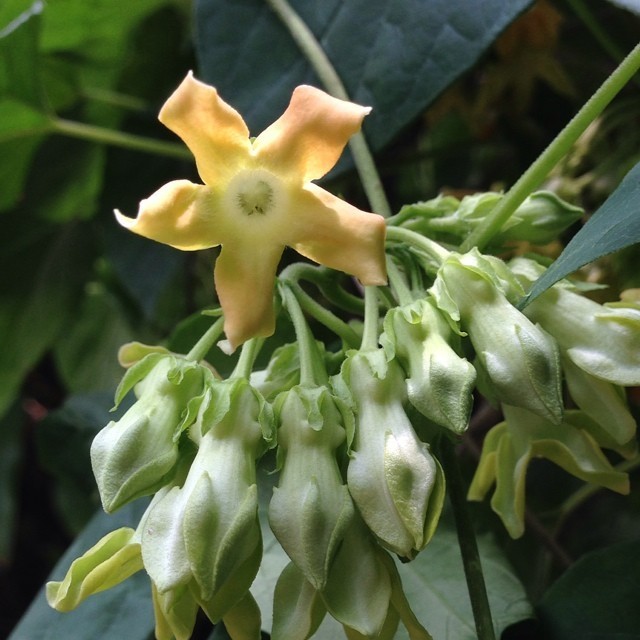
Chinese violet
Telosma cordata
Telosma cordata is a species of flowering plant in the family Apocynaceae (tribe Marsdenieae), native to China and Indo-China. It is cultivated elsewhere and may occur wild as an introduced species. Common names include Chinese violet, cowslip creeper, Pakalana vine, Tonkin jasmine and Tonkinese creeper. The plant bears clusters of golden yellow blooms along the vining stems during summer months. Individual blooms emerge successively over a period of weeks emitting a rich, heavy fragrance during the day and night.
From the article Telosma cordata on Wikipedia (CC BY-SA), quoted section by section
Description
Telosma cordata is classified as a creeper that can climb as far as 2–5 meters. The vine is small, round and very tough; it is considered poisonous for pigs. As the tree is older, the vine will change from green to brown. The top is covered with dense white bush that can cover other trees completely. The plant can be reproduced by cutting or seeding and grows in airy soil in bright sunlight. It can be found in evergreen, mixed deciduous forests, grove woods and dry forests all over Indo-China.
Leaf. Telosma cordata has single heart-shaped leaves growing in pairs. The leaf is about 4–7.5 cm wide and about 6–11 cm long with smooth underside. The leaf is very thin, with veins that can be clearly seen. The stem is about 1.2–2 cm long.
Flower. The flowers bloom as a bouquet consisting of about 10–20 flowers. The greenish-yellow flower has a strong fragrance especially in the evening. It has a diameter of about 1.5 cm with 5 petals and 5 stamens which are connected to each other and to the pistil. The blooming season is usually March–May, although sometimes flowers can be found in July–October.
Fruit. The fruit is smooth, green and round with pointed ends. The interior contains many flat seeds with white fluff attached to the ends. The produce season is around June–August.
Wikipedia: “Characteristics”
At the table
The top, fruit and flowers can all be consumed as vegetables in Southeast Asian cuisines. The top is believed to be the most nutritious part. The flower is used in desserts and for ornamental purposes in bouquets and wreaths. The plant's vines are tough and can be used as ropes. The wood can be used for construction in some cases. The plant has also been used for traditional medicinal purposes, as an antipyretic, an antidote for poison, a tranquilizer, and for the relief of backbone pain. Telosma cordata flower contains antioxidants, including phenolic acids, flavonoids, and anthocyanins; using citric acid during blanching preserved more phenolics and antioxidant activity than water alone. The fower extracts have significant potential to promote neuronal survival and possess notable anti-acetylcholinesterase, neurotrophic, and antioxidant properties.
Wikipedia: “Uses”
Where it lives
Recorded sightings
—
geo-referenced records in GBIF, from museums, herbaria and field observers.
Drag the globe to turn it. Dots are where records exist, not a range map; darker means more records.
In the stacks
Searching the stacks…
Every page naming Telosma cordata in the Biodiversity Heritage Library →
This page is assembled live from iNaturalist, GBIF, Wikipedia, the Source Library and the Internet Archive. It is not yet part of the hand-edited codex. iNaturalist taxon 426800.