- Plants
- ›Vascular Plants
- ›flowering plants
- ›Dicots
- ›myrtles, evening primroses, and allies
- ›Melastomes
- ›Melastomatoideae
- ›Dissochaeteae
- ›Pachycentria
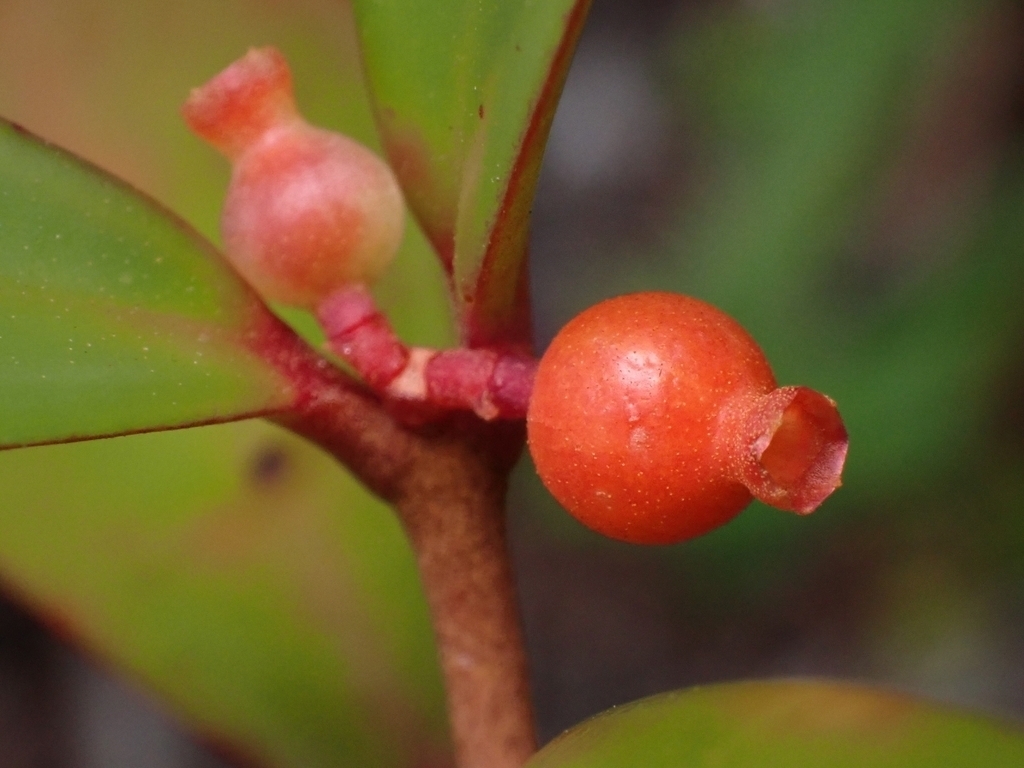
Pachycentria glauca
Pachycentria glauca is a small epiphytic shrub in the Melastomataceae family. It has 2 subspecies: P. glauca subsp. glauca and P. glauca subsp. maingayi. The glauca subspecies is endemic to Borneo, the maingayi subspecies is native to Peninsular Malaysia and Thailand, perhaps Sumatra. It grows on trees, other epiphytes (so, a double epiphyte) and rocks in partial shade. It is intimately associated with particular ant species, growing on their gardens, providing a home for them, feeding them and having its seeds dispersed by them.
From the article Pachycentria glauca on Wikipedia (CC BY-SA), quoted section by section
Description
The species is a small shrub, epiphytic, with many hanging, creeping or erect branches and adventitious roots that have irregular, globose swellings up to 2 cm in diameter. These swellings have the same anatomical structure as a storage root. The round branchlets have minute scales, with the older branches are stunted and have thickened node, the globose swellings. Leaves are elliptic-lanceolate or obovate-suborbicular with a cuneate base and an apex that can be truncate, rounded or acute, often red below, some 1.4 to 4 cm by 0.5 to 2 cm in size. The terminal or axillary inflorescences have solitary or pairs of flowers. Flowers have white to pink petals. Anthers are slender and have a long thin, curved upward tip, the style points downward. Septae disappear in young buds. The young berries are urceolate (urn/pitcher-shaped), but become globose, about 5mm in diameter, when immature they are green with a reddish rim, and become red on ripening. …
Range & habitat
The autonym subspecies, P. glauca subsp. glauca is endemic to Borneo. The maingayi subspecies is native, to Peninsular Malaysia. There is a single recording of it occurring on the adjacent north coast of Sumatera. In 2009, the subspecies was identified growing in the Sankalakhiri Range of extreme south Thailand.
Wikipedia: “Distribution”
What it does
The species is pollinated by bees, using buzz pollination, using vibrations to collect the pollen. One flower in an inflorescence opens per day, the open flower has stamens bent to one side of the flower, their tips arrange in close proximity with the style remaining either in the middle or pointing to the other side. The bee vibrates and pollen comes from the pores of the anthers. After pollination the petals reflex and stamens spread. The fruit are dispersed by small to mid-sized birds and ants disperse seeds. The ants (Philidris and Crematogaster species and Camponotus (Myrmotarsus) irritabilis) take seeds from bird poo or from the ripe fruit. Seedlings are observed on ant plants and in ant gardens. Not only the seeds are attractive to ants, the plant grows pearl bodies as well.
Subspecies glauca is found in kerangas, dry hill and old secondary forest from sea level to 1100m elevation. It grows as an epiphyte very frequently (perhaps exclusively) on ant plants, especially on other epiphytes such as Hydnophytum, Myrmecodia and Lecanopteris. The root swellings of the plant has been observed to be inhabited by ants.
The maingayi subspecies is found in primary lowland, kerangas and heath forests at the same elevation ranges as its sibling subspecies. …
Wikipedia: “Habitat and ecology”
Where it lives
Recorded sightings
—
geo-referenced records in GBIF, from museums, herbaria and field observers.
Drag the globe to turn it. Dots are where records exist, not a range map; darker means more records.
In the stacks
Searching the stacks…
Every page naming Pachycentria glauca in the Biodiversity Heritage Library →
This page is assembled live from iNaturalist, GBIF, Wikipedia, the Source Library and the Internet Archive. It is not yet part of the hand-edited codex. iNaturalist taxon 427309.