- Plants
- ›Vascular Plants
- ›flowering plants
- ›Dicots
- ›sandalwoods, mistletoes, and allies
- ›showy mistletoes
- ›Lorantheae
- ›Dendrophthoinae
- ›Dendrophthoe
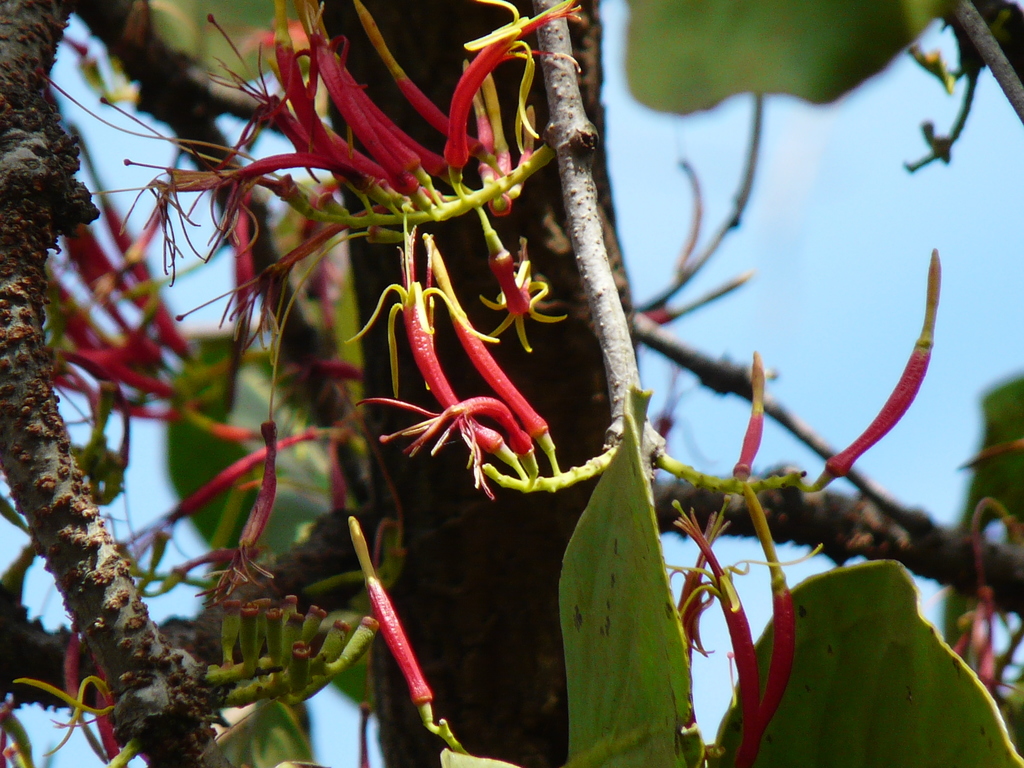
leafy mistletoe
Dendrophthoe falcata
Dendrophthoe falcata is one of the hemiparasitic plants that belong to the mistletoe family Loranthaceae. It is the most common of all the mistletoes that occur in India. At the moment reports say that it has around 401 plant hosts. The genus Dendrophthoe comprises about 31 species spread across tropical Africa, Asia, and Australia (Flora of China, 2003) among which 7 species are found in India.
D.falcata bears grey bark, thick coriaceous leaves variable in shape with stout flowers (Wealth of India. 2002). The inflorescence of D.falcata was described formerly as axillary or as developing from the scars of fallen leaves, but Y.P.S Pundir (1996) determined it to be of strictly cauliflorous nature and noted also that it bears a certain similarity to those of the fig species Ficus glomerata, F. pomifera and F. hispida. Two of its varieties are widespread in India namely, var. falcata (honeysuckle mistletoe) and var. coccinea (red honeysuckle mistletoe) distinguishable by their bearing white and red flowers respectively. (Flowers of India). To date, D.falcata bears the distinction of being the mistletoe species with the largest global host range (Calvin and Wilson, 2009) - a range which is continuously and rapidly widening to include more and more host species.
From the article Dendrophthoe falcata on Wikipedia (CC BY-SA), quoted section by section
What it does
Seed dispersal and pollination are usually mediated by the birds that thrive on fruits from the parasite and/or host. Particularly in southern India, Tickel’s flowerpecker (also called the pale-billed flowerpecker) is reported to facilitate seed dispersal of D. falcata among Neem through fecal excretions or regurgitations (Karunaichamy et al., 1999; Hambali, 1977 and references therein). Studies conducted at the higher altitudes of the Western Ghats (where both the mistletoes and the flowerpeckers occur predominantly), which parallel the western coast of India infer that the flowerpecker pollinated mistletoes have particularly developed features specialized to attract a unique vector both to facilitate pollination and seed dispersal: the fruit and flowers have similar resemblance and more significantly, the fruiting time overlap with the next flowering season (Davidar, 1983). The hair-crested drongo (sometimes called the spangled drongo) and sunbirds are also known to feed on the nectar from the D.falcata flowers adding to the list of pollinators to this mistletoe (Kunwar et al., 2005).
Wikipedia: “Seed dispersal and pollination”
At the table
Dendrophthoe falcata is used as traditional medicine through South and Central Asia. It possesses remarkable potential as a medicinal plant, as is evident from the wound healing, anti-microbial, anti-oxidant and antinociceptive properties of its ethanolic extracts (Pattanayak and Sunita, 2008, Shihab et al., 2006). Medicinal properties of this hemiparasite may vary in effects respective to different hosts it establishes a relation with (Mallavadhani et al., 2006). The whole plant is used in indigenous system of medicine as cooling, bitter, astringent, aphrodisiac, narcotic and diuretic (Alekutty e al., 1993) and is useful in treating pulmonary tuberculosis, asthma, menstrual disorders, swelling wounds, ulcers, renal and vesical calculi and vitiated conditions of kapha and pitta (Anarthe et al., 2008; Sastry, 1952; Pattanayak et al., 2008 ). Also, the decoction of plant used by women as an anti-fertility agent has been evidenced to possess anticancer activity (Nadkarni, 1993). The leaf ethanolic extract significantly and dose dependently inhibits the acetic acid induced writhing in mice (Shihab et al., 2006) and has indicated a low level toxicity in the brine shrimp lethality assays. Besides, a more recent work by Pattanayak et al. (2008) shows significant tumor reduction in induced mammary carcinogenesis in Wistar female rats when fed with hydroalcoholic extracts of D. falcata.
Wikipedia: “Medicinal uses”
Where it lives
Recorded sightings
—
geo-referenced records in GBIF, from museums, herbaria and field observers.
Drag the globe to turn it. Dots are where records exist, not a range map; darker means more records.
In the stacks
Searching the stacks…
Every page naming Dendrophthoe falcata in the Biodiversity Heritage Library →
This page is assembled live from iNaturalist, GBIF, Wikipedia, the Source Library and the Internet Archive. It is not yet part of the hand-edited codex. iNaturalist taxon 427493.