- Plants
- ›Vascular Plants
- ›flowering plants
- ›Dicots
- ›magnolias, nutmegs, and allies
- ›custard-apples
- ›Annonoideae
- ›Annoneae
- ›Goniothalamus
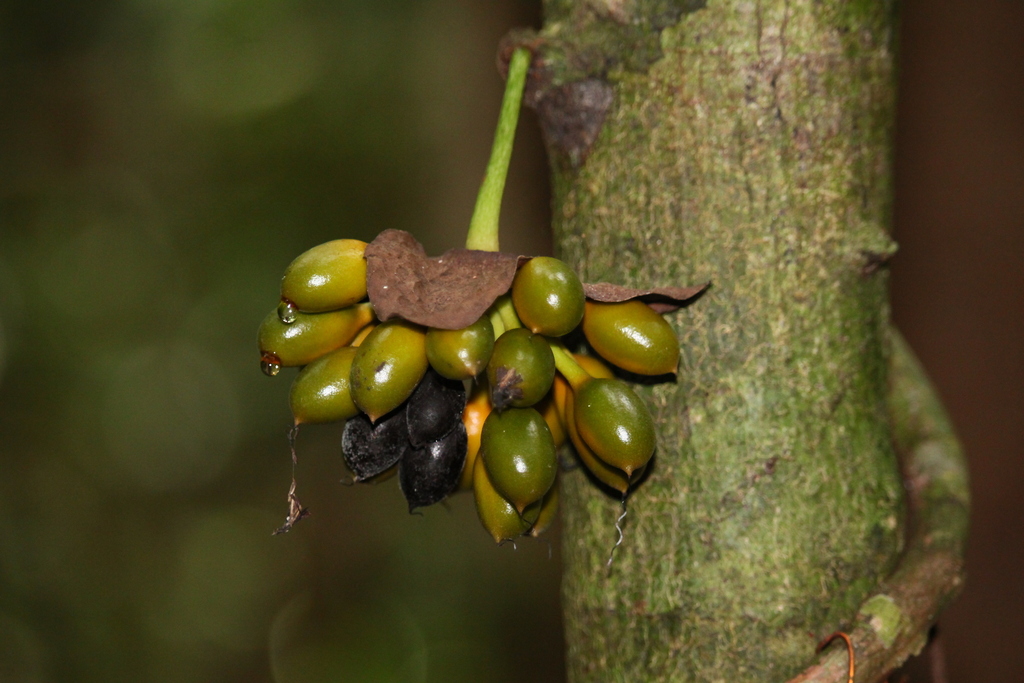
Goniothalamus tortilipetalus
Goniothalamus tortilipetalus is a species of plant in the family Annonaceae. It is native to Peninsular Malaysia and Thailand. Murray Ross Henderson, the Scottish botanist who first formally described the species, named it after its twisted (tortilis in Latin) petals.
From the article Goniothalamus tortilipetalus on Wikipedia (CC BY-SA), quoted section by section
Description
It is a tree reaching 6 meters (20 ft) in height. Its small, hairless, grey to black branches have longitudinal wrinkles. Its black, wrinkled petioles are 0.7–1.6 centimeters with a channel on their upper surfaces. It leathery, hairless, oblong to oval leaves are 20–39 by 6.5–11.5 centimeters (7.9–15.4 by 2.6–4.5 in) with wedge-shaped bases and abruptly tapering tips. The leaves are covered with minutes dots; their upper surface is shiny and pale brown to olive-colored while the undersides are dull and pale brown. Its leaves have 14–22 secondary veins that arch and connect with one another about 6 millimeters from leaf edge. The leaves have prominent tertiary veins. Its solitary (sometimes in pairs) flowers are born on hairless, wrinkled pedicels that are 2–3.7 centimeters long. The pedicels emerge from warty tubercles on the main trunk. Its leathery to membranous, triangular to oval sepals are 1.9–3.1 by 1.5–2.6 centimeters with fused bases and short blunt-pointed tips. The sepals are hairless except their tips which have minute red hairs. The outside of the sepals are shiny while the insides are dull and covered in minute dots. Its flowers have 6 petals in two rows of three. The chartreuse, leathery, lance-shaped, twisted outer petals are 3.5–10 by 1–3.2 centimeters with tips that taper to a blunt point. The outer petals are covered on both surfaces with minute hairs. …
Range & habitat
It has been observed growing in lowland forests with soil rich in calcium carbonate at elevations of 60 to 300 meters (200 to 980 ft).
Wikipedia: “Habitat and distribution”
At the table
Bioactive molecules extracted from its bark have been reported to have vasoconstrictive activity in tests with rat arteries.
== References ==
Wikipedia: “Uses”
Where it lives
Recorded sightings
—
geo-referenced records in GBIF, from museums, herbaria and field observers.
Drag the globe to turn it. Dots are where records exist, not a range map; darker means more records.
In the stacks
This page is assembled live from iNaturalist, GBIF, Wikipedia, the Source Library and the Internet Archive. It is not yet part of the hand-edited codex. iNaturalist taxon 427752.