- Plants
- ›Vascular Plants
- ›flowering plants
- ›Dicots
- ›Soapberries, Cashews, Mahoganies, and Allies
- ›Quassia Family
- ›Ailanthus
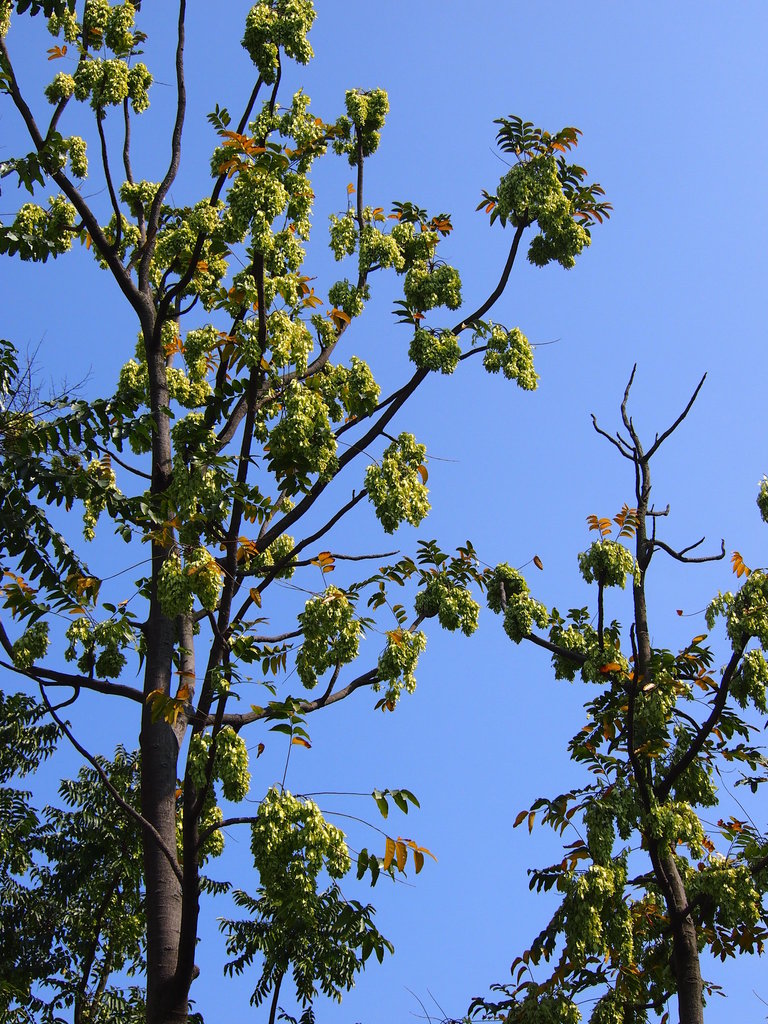
Ailanthus fordii
Ailanthus fordii, otherwise known as green ailanthus or evergreen ailanthus, is an evergreen tree in the family Simaroubaceae. It is native to the low evergreen forests of Hong Kong.
From the article Ailanthus fordii on Wikipedia (CC BY-SA), quoted section by section
Description
Ailanthus fordii is a dioecious, evergreen tree that can grow up to 5 metres (16 ft) tall. The branchlets are grey-brown and are densely puberulent. Odd, pinnately compound leaves are gathered at the upmost part of the branches and are 40-60 centimeters long. The petiole is 0.7–1.3 cm (0.3–0.5 in) long, and there are 13-27 leaflets, mostly opposite. The leaflets are oblong-ovate, and are 7–13 centimetres (2.8–5.1 in) long 4–6 cm (1.6–2.4 in) wide. The buds are inflorescence terminal, paniculate, and are 20-40 centimeters long. The flowers can be unisexual or polygamous, and they are calyx-cup shaped. Petals are about 2–3 millimetres (0.08–0.12 in). In female flowers, the anthers are imperfectly developed. The samara is 3–5 centimetres (1.2–2.0 in) long and 1–1.8 cm (0.4–0.7 in) wide. The flowering period is October to November, and the fruiting period is December to April the following year.
== References ==
In human culture
Ailanthus fordii was first discovered in Cape D'Aguilar between the years 1884 and 1886.
Wikipedia: “History”
Where it lives
Recorded sightings
—
geo-referenced records in GBIF, from museums, herbaria and field observers.
Drag the globe to turn it. Dots are where records exist, not a range map; darker means more records.
In the stacks
Searching the stacks…
Every page naming Ailanthus fordii in the Biodiversity Heritage Library →
This page is assembled live from iNaturalist, GBIF, Wikipedia, the Source Library and the Internet Archive. It is not yet part of the hand-edited codex. iNaturalist taxon 429287.