- Animals
- ›Arthropods
- ›Hexapods
- ›Insects
- ›Winged and Once-winged Insects
- ›Ants, Bees, Wasps, and Sawflies
- ›Narrow-waisted Wasps, Ants, and Bees
- ›Proctotrupomorpha
- ›Diaprioidea
- ›Diapriidae
- ›Diapriinae
- ›Spilomicrini
- ›Neurogalesus
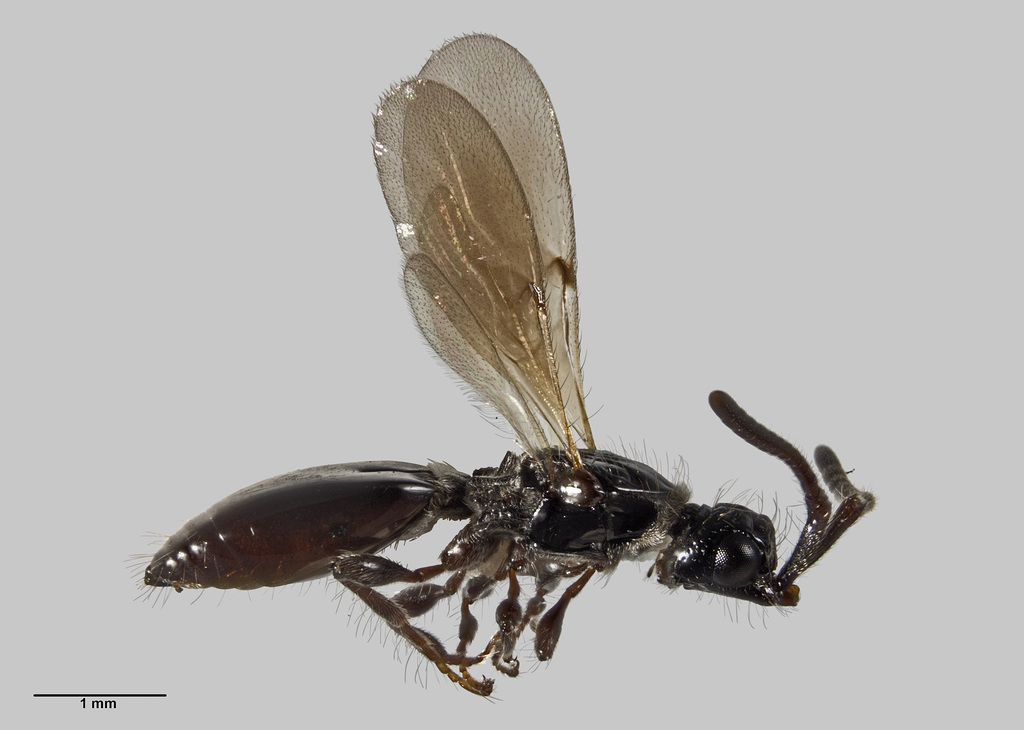
Neurogalesus carinatus
Neurogalesus carinatus is a species of parasitic wasp in the family Diapriidae, first described in 1907. It uses the Australian soldier fly Inopus rubriceps as a host, sharing its range in pastured areas of South East Queensland, northern New South Wales and its non-native range on the North Island of New Zealand.
From the article Neurogalesus carinatus on Wikipedia (CC BY-SA), quoted section by section
Description
Neurogalesus carinatus have deep red-coloured legs and antennae, with a female body length of up to 5.5mm. It can be distinguished from Neurogalesus dissimilis and Neurogalesus rubripes (two wasps with similar appearances) by having a sulcus on either side of the median groove at the base of the abdomen.
Range & habitat
The earliest recorded sighting of Neurogalesus carinatus in New Zealand is in 1985, after a specimen was collected from Mangere in Auckland. As of 2014, no specimens have been collected from New Zealand native bush environments, suggesting that the fly exclusively lives in urban environments and pastures. No species of fly other than Inopus rubriceps present in New Zealand are known to act as hosts for Neurogalesus carinatus.
== References ==
Wikipedia: “Distribution”
Listen
Looking for field recordings…
Where it lives
Recorded sightings
—
geo-referenced records in GBIF, from museums, herbaria and field observers.
Drag the globe to turn it. Dots are where records exist, not a range map; darker means more records.
In the stacks
Searching the stacks…
Every page naming Neurogalesus carinatus in the Biodiversity Heritage Library →
This page is assembled live from iNaturalist, GBIF, Wikipedia, the Source Library and the Internet Archive. It is not yet part of the hand-edited codex. iNaturalist taxon 429847.