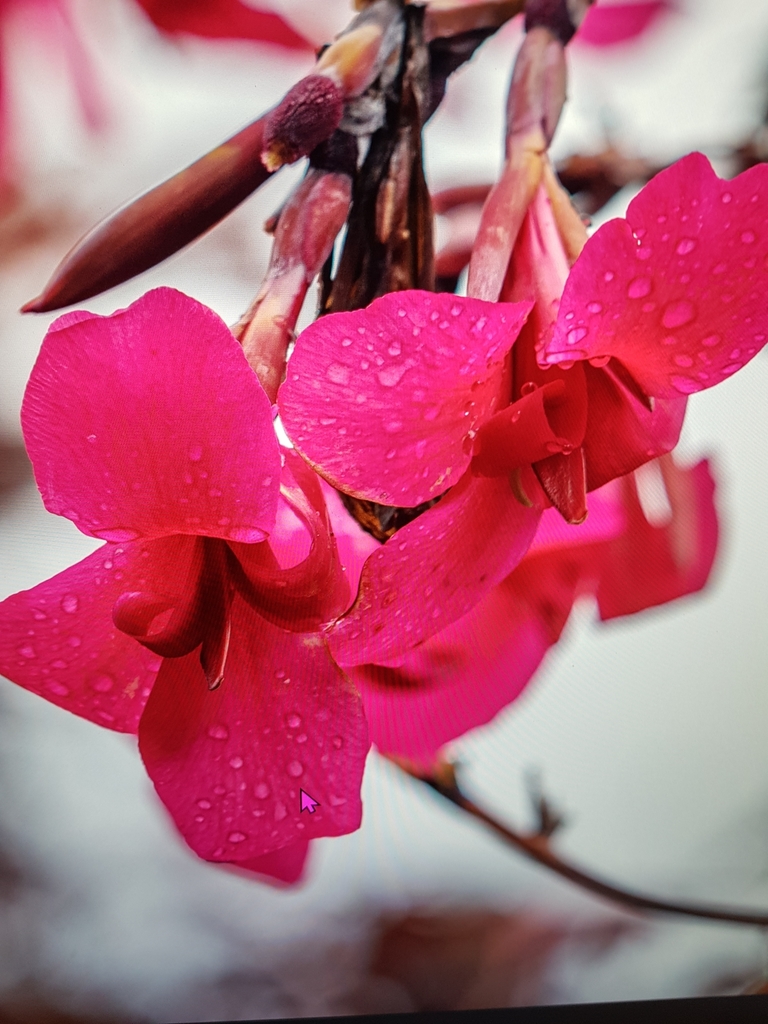
Canna iridiflora
Canna iridiflora (Ruiz & Pav.) is a species of the Canna genus, belonging to the family Cannaceae, a native of Peru, Columbia and Costa Rica at altitudes of 1,800–2,850 m (5,910–9,350 ft). It was introduced to England in 1816 (Johnson's Gardeners Dictionary, 1856). Not to be confused with C. iridiflora Wild., which is a synonym for C. indica.
From the article Canna iridiflora on Wikipedia (CC BY-SA), quoted section by section
Description
Herb up to 5 m tall. Flowers hanging down in large pendants of pink, riding above large, green leaves. Spreading stems and gently spreading leaves creates a goblet shaped clump. Plant height 5 m (16 ft). The foliage is green with pale inner edge and dark outer edge. Flowers are pendant shaped carmine-red to purple, 10–14 cm (4-5½ in) long, with a relatively long tubular part and 8 coloured lobes; petals not reflexed; staminodes 4. The solitary staminal locule (pollin-producing portion of the stamen) can be up to 5.5 inches (14 centimeters) in length, equaled only by Strelitzia nicolai.
Range & habitat
C. iridiflora is native to Peru, Colombia and Costa Rica at altitudes of 1,800–2,850 m (5,910–9,350 ft).
Wikipedia: “Distribution”
How it is grown
It was introduced to England in 1816. It is hardy to zone 10 and is frost tender. In the north latitudes it is in flower from August to October, and the seeds ripen in October.
Wikipedia: “Cultivation”
Where it lives
Recorded sightings
—
geo-referenced records in GBIF, from museums, herbaria and field observers.
Drag the globe to turn it. Dots are where records exist, not a range map; darker means more records.
In the stacks
Searching the stacks…
Every page naming Canna iridiflora in the Biodiversity Heritage Library →
This page is assembled live from iNaturalist, GBIF, Wikipedia, the Source Library and the Internet Archive. It is not yet part of the hand-edited codex. iNaturalist taxon 430782.