- Plants
- ›Vascular Plants
- ›flowering plants
- ›Dicots
- ›begonias, gourds, and allies
- ›gourd family
- ›Benincaseae
- ›Coccinia
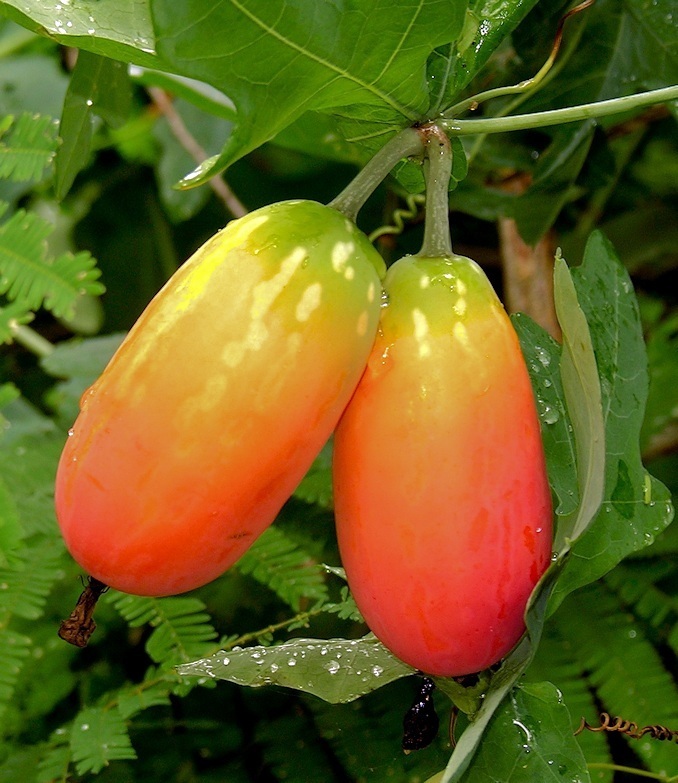
Porcupine Bushpumpkin
Coccinia sessilifolia
Coccinia sessilifolia is a species of Coccinia from southern Africa.
From the article Coccinia sessilifolia on Wikipedia (CC BY-SA), quoted section by section
Description
Perennial, dioecious climber. The plants produce a woody hypocotyl tuber and herbaceous, up to 5 m long shoots. The shoots are glabrous and have a waxy bluish green cover. Leaves are alternate usually sessile. Only the first leaves leaves of the shoots and in rare cases on mature shoots, short petioles can be observed. The lamina is 1.5–12.5 × 2.2–13.5 cm, usually profoundly 5-lobate, more or less amplexicaulous. Upper lamina glabrous with clear to whitish pustules. Lower lamina paler than upper lamina, glabrous, often with small dark glands along the main nerves. Tendrils are simple, very rarely unequally bifid. Probracts up to 1.7 mm long but usually missing. Flowers in each sex usually solitary, sometimes male flowers are in few-flowered racemes. Receptacle pale green, glabrous. Calyx teeth 1.5–3.5 mm long, lanceolate to (narrow) triangulate, erect to reflexed. Corolla 1.5–3 cm long, whitish cream to pale yellow, rarely dull orange-brown with conspicuous green venation, lobes 0.9–2 cm. Stamens 3, reduced to staminodia in female flowers. Anthers in male flowers sinuate, in a globose head. Ovary cylindrical, glabrous. Style in male flowers missing, in female flowers columnar, greenish yellow. Stigmas bulging, greenish yellow. Fruit 8–12 × 3–4 cm, ellipsoid to oblong, when immature green with white longitudinal spots to stripes with waxy bloom, ripe red. …
Range & habitat
Coccinia sessilifolia occurs in South Africa (Gauteng, Free State, Limpopo, Mpumalanga, North West, and western Northern Cape), Namibia (Erongo, Khomas, Oshana, Otjozondjupa), and Botswana (Central District. Kgatleng, North-West District, South-East District).
Wikipedia: “Distribution”
What it does
Semi-arid open habitats, except for Cape region and high mountains. Flowering January–May, October–December.
Wikipedia: “Ecology”
Where it lives
Recorded sightings
—
geo-referenced records in GBIF, from museums, herbaria and field observers.
Drag the globe to turn it. Dots are where records exist, not a range map; darker means more records.
In the stacks
Searching the stacks…
Every page naming Coccinia sessilifolia in the Biodiversity Heritage Library →
This page is assembled live from iNaturalist, GBIF, Wikipedia, the Source Library and the Internet Archive. It is not yet part of the hand-edited codex. iNaturalist taxon 430860.