- Plants
- ›Vascular Plants
- ›flowering plants
- ›Dicots
- ›Gentians, Dogbanes, Madders, and Allies
- ›madder family
- ›Cinchonoideae
- ›Chiococceae
- ›Cubanola
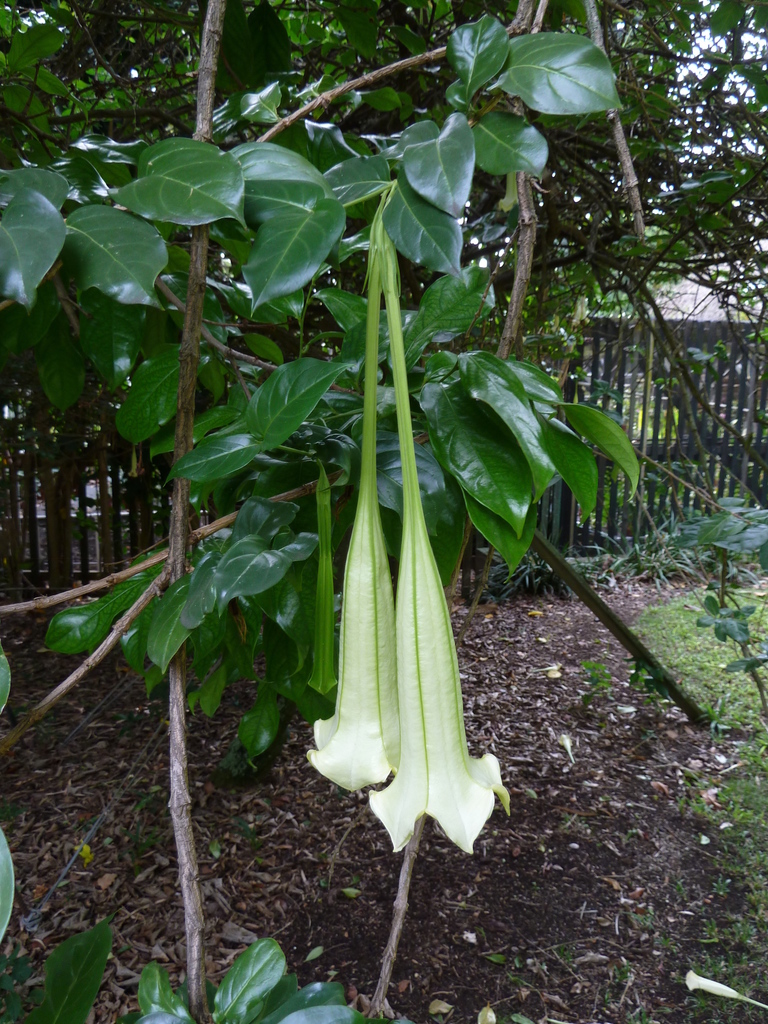
Cubanola domingensis
Cubanola domingensis, or campanita, is a species of small tree in the family Rubiaceae endemic to the Dominican Republic. The plant is known for its downward-facing, trumpet-like blossoms.
From the article Cubanola domingensis on Wikipedia (CC BY-SA), quoted section by section
Description
Cubanola domingensis are shrubs or small trees up to 2 m in height with pendant, white flowers. Leaves with petioles 1–3 mm long, blades ovate or elliptic 6–12 cm long, 3.3–6 cm wide, acuminate or acute at apex, obtuse or acute at base. Calyx lobes 1.1-2.5 cm long, 1–2 mm wide. Corolla 18.5-19.8 long, tube 6.5–7 cm long, lobes 7–8 mm long. Fruit ellipsoid, 3-4.3 cm long, apex obtuse.
Range & habitat
They are endemic to the Dominican Republic, where they are found in the provinces of Puerto Plata, Santo Domingo, San Pedro de Macorís, and La Altagracia.
Wikipedia: “Distribution and habitat”
What it does
This plant usually grows in partial or full shade. This plant grows in limestone areas and thus does well in alkaline soils. Being fully tropical, it is cold sensitive. In subtropical areas such as South Florida, cold weather may cause the leaves and flowers to drop.
Wikipedia: “Ecology”
In human culture
The specific epithet domingensis, meaning of domingo, refers to the capital of the Dominican Republic, Santo Domingo.
Wikipedia: “Etymology”
Where it lives
Recorded sightings
—
geo-referenced records in GBIF, from museums, herbaria and field observers.
Drag the globe to turn it. Dots are where records exist, not a range map; darker means more records.
In the stacks
Searching the stacks…
Every page naming Cubanola domingensis in the Biodiversity Heritage Library →
This page is assembled live from iNaturalist, GBIF, Wikipedia, the Source Library and the Internet Archive. It is not yet part of the hand-edited codex. iNaturalist taxon 430904.