- Animals
- ›Chordates
- ›Vertebrates
- ›Mammals
- ›Therians
- ›Placental Mammals
- ›Primates, Rodents, and Allies
- ›Lagomorphs
- ›Hares and Rabbits
- ›Sylvilagus
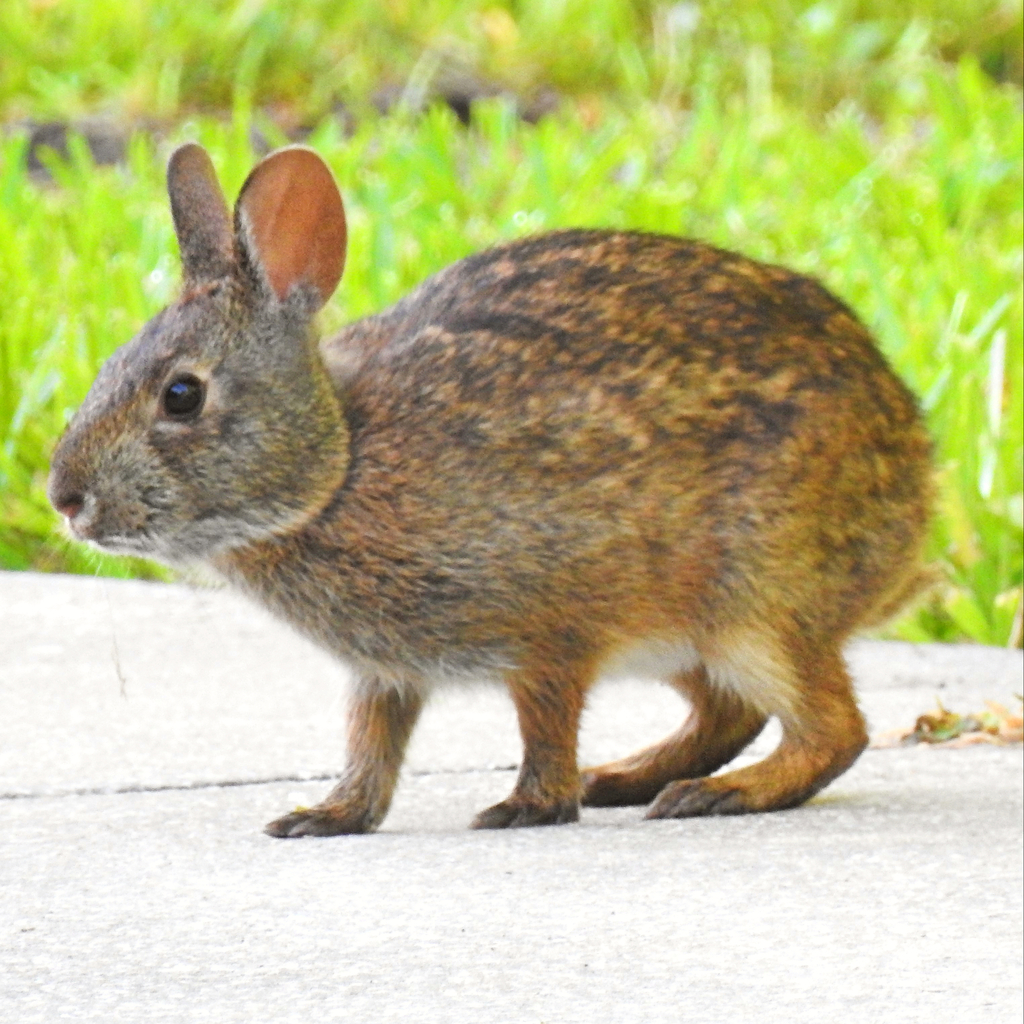
Marsh Rabbit
Sylvilagus palustris
The marsh rabbit (Sylvilagus palustris) is a small cottontail rabbit found in marshes and swamps of coastal regions of the Eastern and Southern United States, from Virginia to the lower Florida Keys. Being a small brown rabbit, it is similar in appearance to the widespread eastern cottontail (Sylvilagus floridanus), but is characterized by its smaller ears, legs, and tail, as well as its grayish-brown underparts.
Marsh rabbits are common throughout their range, except for in the Everglades, where the invasive Burmese python has reduced their numbers, and the lower Florida Keys, where the subspecies known as the Lower Keys marsh rabbit (Sylvilagus palustris hefneri) is threatened by rising sea levels and human development of the land. They prefer to live in marshes, swamps, and alongside coastal waters and rivers, as they are excellent swimmers. The marsh rabbit is often compared to the aquatic swamp rabbit (Sylvilagus aquaticus), which is found along the Gulf coast and further inland in the southeastern United States, though the swamp rabbit has larger ears, tail and legs, as well as a distinctly white underside of its tail.
From the article Marsh rabbit on Wikipedia (CC BY-SA), quoted section by section
Description
Marsh rabbits have blackish brown or dark reddish fur on their back, head, and upper body. The belly is a dingy brownish gray in most cases, but can also have a dull white appearance in mainland rabbits. The leading edges of the ears display small black tufts with ochre on the inside. The rough hair on the rabbit's back may be fringed with black hairs. The black portions of the upper parts often change to a dull grayish buff in spring and summer months, returning to a reddish or ochre color in fall, followed by darker black in the winter. Marsh rabbits of peninsular Florida typically display darker and redder colors with a cinnamon-rufous nape, feet, and legs. Juveniles display much darker and duller colors than adults. Marsh rabbits are typically smaller than eastern cottontail (Sylvilagus floridanus) rabbits, though they are otherwise similar in their general appearance. Adults from the Florida peninsula weigh approximately 2.2–2.6 pounds (1.00–1.18 kg) with a total length upwards of 17 inches (43 cm). Adults from the mainland regions typically grow larger, weighing up to 3.5 pounds (1.6 kg) and reaching more than 17.5 inches (44 cm) in length. The hind feet of the average mainland marsh rabbit are also larger, at 3.6 inches (9.1 cm) compared with 3.5 inches (8.9 cm) for the typical specimen of the Florida peninsula. …
Range & habitat
The marsh rabbit is found in wet areas of low elevation from southeast Virginia through Florida to the Florida Keys, with populations occurring throughout eastern North and South Carolina, southeast Georgia, and southeast Alabama as well. Each subspecies is found in particular parts of the broader range. The Carolina marsh rabbit (S. p. palustris) ranges from the Dismal Swamp, Virginia, along the eastern coast to northern sections of Florida and through the Gulf Coast into Mobile Bay, Alabama. It occupies coastal lowland areas, swamps, and rivers and is rarely found more than forty miles from the coast. The Florida marsh rabbit (S. p. paludicola) occupies the peninsular region of Florida, from south of the Florida Panhandle to the upper Keys. There is a region north of Miami along the east coast where this subspecies is not found. The endangered Lower Keys marsh rabbit (S. p. hefneri) is only found in the southern Florida Keys. The marsh rabbit commonly inhabits brackish and freshwater marshes, mainly of cattails and cypress. In southern Florida, they commonly occupy sandy islands and mangrove swamps. They are strictly limited to regions with ready access to water, unlike most rabbits. Often, they will enter tidal marshes, but remain near high ground for protection. …
Wikipedia: “Habitat and distribution”
What it does
Marsh rabbits are most active nocturnally; they spend most of the daylight hours resting in hidden areas. Frequent hiding spots include dense thickets, hollow logs, and stands of cattails and grasses. They have also been known to take advantage of the abandoned burrows of other animals. During the day, if not using the burrow of another animal, a marsh rabbit will create a depression in the earth among dense vegetation, under thickets, or within tree cavities. This depression is known as a form, and is a place where a rabbit will often return with food and other items (such as the leftover molts of crayfish or plastrons from Florida box turtles) to chew on, though forms from other rabbits may be taken if convenient. They are assisted in the digging of forms and nests through the use of their long toenails. Marsh rabbits frequently make runway trails in dense vegetation along marsh edges. These trails can be identified easily as the rabbits mark active runways with fecal pellets, though pellets are deposited on raised surfaces such as stumps and rocks as well. They may travel up to 5 kilometers (3.1 mi) in a day. One distinguishing habit of marsh rabbits is that they walk on all fours, placing each foot down alternately like a cat. Although they can hop like all rabbits, they are more agile in dense vegetation with this walking tendency. …
Wikipedia: “Behavior”
Listen
Looking for field recordings…
Where it lives
Recorded sightings
—
geo-referenced records in GBIF, from museums, herbaria and field observers.
Drag the globe to turn it. Dots are where records exist, not a range map; darker means more records.
In the stacks
Searching the stacks…
Every page naming Sylvilagus palustris in the Biodiversity Heritage Library →
This page is assembled live from iNaturalist, GBIF, Wikipedia, the Source Library and the Internet Archive. It is not yet part of the hand-edited codex. iNaturalist taxon 43102.