- Animals
- ›Chordates
- ›Vertebrates
- ›Mammals
- ›Therians
- ›Placental Mammals
- ›Primates, Rodents, and Allies
- ›Lagomorphs
- ›Hares and Rabbits
- ›Sylvilagus
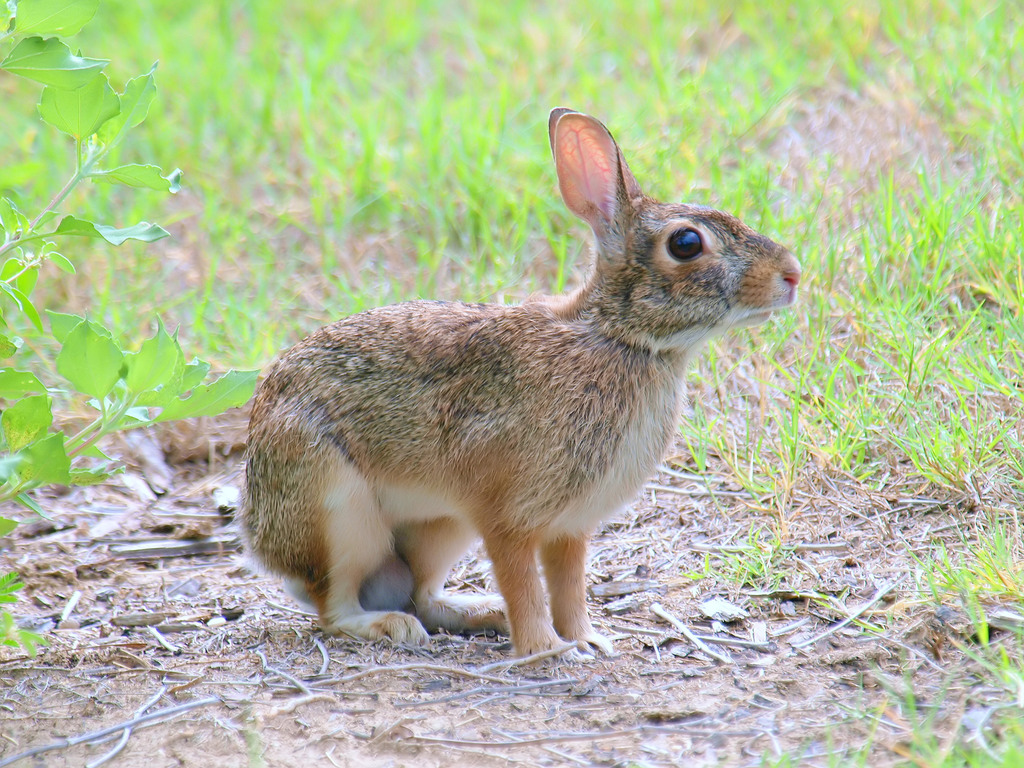
Eastern Cottontail
Sylvilagus floridanus
The eastern cottontail (Sylvilagus floridanus) is a species of rabbit in the family Leporidae. It is the most widespread and abundant rabbit species in North America, inhabiting a wide range that extends from southern Canada throughout most of the United States and into parts of Mexico, Central America, and the northern regions of South America. Known for its distinctive fluffy white tail, which resembles a cotton ball and gives the species its common name, the eastern cottontail typically inhabits open fields, meadows, and brushy areas where it can easily find cover and food. It is a primarily herbivorous, crepuscular mammal that feeds on grasses, herbs, twigs, and bark, and plays an important role in the ecosystem as prey for a variety of predators including foxes, hawks, and owls. Due to its adaptability to human-altered landscapes such as suburban and agricultural areas, the eastern cottontail has maintained stable population levels and is not considered threatened. It is also well known for its high reproductive rate, with females capable of producing multiple large litters annually, which contributes to its widespread presence.
From the article Eastern cottontail on Wikipedia (CC BY-SA), quoted section by section
Description
The eastern cottontail has a distinctive white spot on its forehead when young and fur that ranges from reddish-brown to grayish-brown, with large hind feet, long ears, and a short, fluffy white tail. Its underside is white, and there is a rusty patch near the tail. It differs from a hare in its overall smaller size and brownish-gray coloring around the head and neck, with a lighter-colored body and a white underside on the tail. The species also has large brown eyes and long ears adapted for detecting predators. During winter, the eastern cottontail's pelage becomes more gray than brown. Kits (young rabbits) develop a similar coloring after a few weeks but are born with a white blaze running down their forehead, which fades as they mature. This rabbit is medium-sized, measuring 36–48 cm (14–19 in) in total length, including a tail that averages 5.3 cm (2.1 in). Adults typically weigh between 1.8 and 4.4 lb (800 and 2,000 g), with an average of around 2.6 lb (1,200 g). Females tend to be slightly heavier than males, although the sexes broadly overlap in size. The species exhibits slight geographic variation in body size, with individuals generally increasing in mass from southern to northern latitudes, in line with Bergmann's rule. …
Range & habitat
The eastern cottontail inhabits meadows, shrubby areas, and edge habitats throughout the eastern and south-central United States, southern Canada, eastern Mexico, Central America, and northernmost South America. It is also present on Margarita Island in the Caribbean. The species is especially abundant across the Midwest of North America, and its range expanded northward as forests were cleared by settlers. Originally absent from New England, it has since been introduced there, where it now competes with the native New England cottontail (Sylvilagus transitionalis). It has also been introduced to parts of Oregon, Washington, and British Columbia. In the 1950s and 1960s, the species was introduced to France and northern Italy, where it underwent rapid territorial expansion and population growth. It was also introduced to Cuba at some point, most likely from the United States in the early 20th century when massive efforts were being made to introduce new species to the island. Populations in the mountainous regions of the southwestern United States and western Mexico are now considered a separate species, the robust cottontail (S. holzneri). Optimal eastern cottontail habitat includes open grassy areas, clearings, and old fields that support abundant green vegetation, with shrubs or hedgerows providing cover. …
Wikipedia: “Range and habitat”
What it does
The eastern cottontail is a territorial species that relies on speed and agility to evade predators. When chased, it typically escapes in a zigzag pattern and can reach speeds of up to 18 mph (29 km/h). Cottontails favor habitats where they can feed in the open but quickly retreat to cover when threatened. Preferred environments include forest edges, swamps, brushy thickets, hedgerows, and open fields with nearby shelter. Instead of digging burrows, eastern cottontails rest in a form—a shallow, scratched-out depression in grass or beneath dense vegetation—and may use groundhog (Marmota monax) burrows during severe weather or heavy snow. Eastern cottontails are mostly crepuscular and nocturnal, foraging primarily at dawn, dusk, and night. However, they can be seen during the day, particularly in overcast or foggy conditions. They spend much of the daytime resting under vegetative cover and often remain motionless for extended periods to avoid detection. Activity is year-round, as the species does not hibernate.
Home range. Eastern cottontail home ranges are roughly circular in open and uniform habitats. Individuals generally remain within the same range throughout life, although shifts can occur due to weather or vegetation changes. …
Wikipedia: “Behavior and ecology”
In human culture
The genus name Sylvilagus is derived from Latin silva, meaning "forest" or "woodland," and lagus, a form adapted from Ancient Greek: λαγώς : lagṓs, meaning "hare" or "rabbit," thus translating roughly to "woodland hare." The species epithet floridanus means "of Florida," referencing the region where the species was first scientifically identified.
Evolution and phylogeny. The eastern cottontail belongs to the Leporidae family, which includes all rabbits and hares. Within this family, Sylvilagus is a New World genus that diverged from Old World rabbits and hares millions of years ago. Molecular and morphological studies have identified several distinct species and subspecies within Sylvilagus, highlighting a complex evolutionary history shaped by geographic isolation and environmental adaptation. Separate populations of the eastern cottontail found in different regions display markedly different genetic compositions, which may factor into their adaptability to diverse habitats. Fossil records and genetic data suggest the eastern cottontail expanded its range following the last glacial period, taking advantage of cleared forest landscapes and open habitats.
Wikipedia: “Etymology”
Listen
Looking for field recordings…
Where it lives
Recorded sightings
—
geo-referenced records in GBIF, from museums, herbaria and field observers.
Drag the globe to turn it. Dots are where records exist, not a range map; darker means more records.
In the stacks
Searching the stacks…
Every page naming Sylvilagus floridanus in the Biodiversity Heritage Library →
This page is assembled live from iNaturalist, GBIF, Wikipedia, the Source Library and the Internet Archive. It is not yet part of the hand-edited codex. iNaturalist taxon 43111.