- Animals
- ›Chordates
- ›Vertebrates
- ›Mammals
- ›Therians
- ›Placental Mammals
- ›Primates, Rodents, and Allies
- ›Lagomorphs
- ›Hares and Rabbits
- ›Lepus
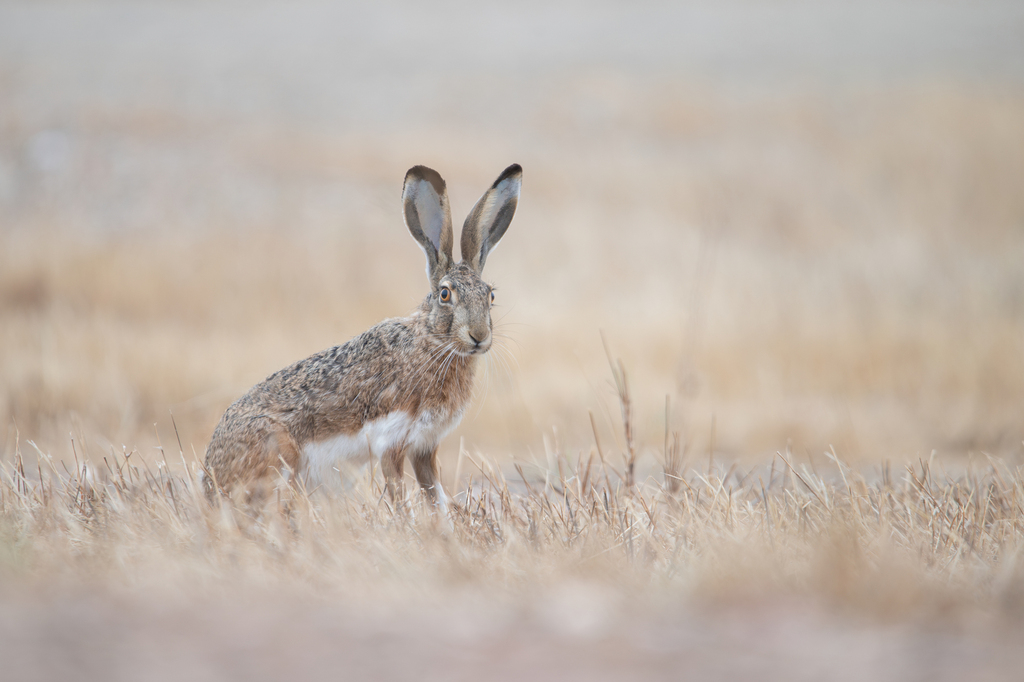
Granada Hare
Lepus granatensis
The Granada hare (Lepus granatensis), also known as the Iberian hare (Spanish: liebre Ibérica), is a species of hare that is endemic to the Iberian Peninsula and the island of Mallorca. A small species compared to other European hares, it has long been hunted as an important game species.
From the article Granada hare on Wikipedia (CC BY-SA), quoted section by section
Description
The Granada hare is a hare of average adult weight 2–2.6 kilograms (4.4–5.7 lb) with distinctive reddish outer legs and a clear contrast between the gray-brown fur of its back and the white of its underside and inner legs. This white colouration travels to the tips of the toes. It is smaller than the broom hares (L. castroviejoi) and European hares (L. europaeus) that also occupy the Iberian peninsula, having a head and body length of 44.5 to 47.3 centimetres (17.5 to 18.6 in), hind foot length of 11.66 to 12.74 cm (4.59 to 5.02 in), and ear length of 9.25 to 10.27 cm (3.64 to 4.04 in). The species has some degree of sexual dimorphism, with females being heavier on average when compared to males.
What it does
Females will produce 2 young in each litter on average, though litters as large as 7 leverets have been recorded. It may be parasitized by Taenia pisiformis, a tapeworm, as well as coccidiosis-causing parasites in the genus Eimeria. These parasites have marked effects on the host hare's escape ability, with negative effects increasing with parasite quantity and variety. Many other parasites are known to affect the Granada hare, including those in genera Ixodes, Spilopsyllus, Mosgovoyia, Trichostrongylus, Graphidium, Nematodiroides, Passalurus, Micipsella, Hyalomma, Haemaphysalis, Rhipicephalus, Haemodipsus, Linguatula, and Dicrocoelium. It has never been found to contract European brown hare syndrome, though it is susceptible to some strains of rabbit hemorrhagic disease virus known since the 1990s. It may also develop bacterial infections, such as tularemia.
== References ==
Wikipedia: “Behaviour and ecology”
Listen
Looking for field recordings…
Where it lives
Recorded sightings
—
geo-referenced records in GBIF, from museums, herbaria and field observers.
Drag the globe to turn it. Dots are where records exist, not a range map; darker means more records.
In the stacks
Searching the stacks…
Every page naming Lepus granatensis in the Biodiversity Heritage Library →
This page is assembled live from iNaturalist, GBIF, Wikipedia, the Source Library and the Internet Archive. It is not yet part of the hand-edited codex. iNaturalist taxon 43119.