- Plants
- ›Vascular Plants
- ›flowering plants
- ›Dicots
- ›Heathers, Balsams, Primroses, and Allies
- ›Lecythis Family
- ›Lecythis
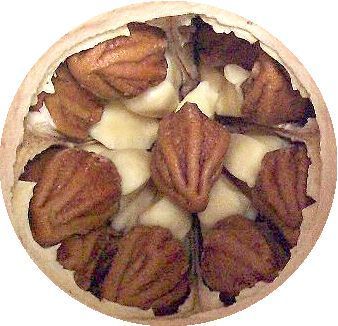
Lecythis zabucajo
Lecythis zabucajo, the sapucaia or paradise nut, is a large nut-producing tree occurring in the Guianas, Suriname, Venezuela, Ecuador, Honduras and Brazil, and which distribution range is much the same as that of the greater spear-nosed bat (Phyllostomus hastatus). Although not singling out Lecythis zabucajo, Jacques Huber noted in 1909 that fruit bats played the most important role in seed dispersal in Amazonian forests. The quality of its nuts led to the species' being introduced to numerous tropical countries, notably Trinidad, where it has flourished. The nuts are a valuable food resource and yield oil suitable for cooking and domestic use.
This species is closely related to the Brazil nut, both belonging to the family Lecythidaceae and having coconut-sized fruits. The tree's large woody gourd-like fruits with edible white flesh are used for water vessels and for ornamental purposes. The fruit is called 'monkey pot', a name used for a number of other species, including Lecythis elliptica, Lecythis grandiflora, and Lecythis pisonis. The name is said to derive from baiting an empty fruit with food and fixing it to a low branch; a monkey can easily insert its paw through the opening, but cannot withdraw it once it has grasped the contents.
From the article Lecythis zabucajo on Wikipedia (CC BY-SA), quoted section by section
Description
'Lecythis' is derived from the Greek 'lekythos', a narrow-necked oil flask, while 'zabucajo' is a rendition of 'sapucaia', one of the local names for this tree and also used for Lecythis pisonis.
This species is common in the Guianas and eastern Venezuela, but less frequently found in central and western Amazonia. It is a large canopy or emergent tree of non-inundated forests, growing to 55 m tall. When young its twigs are glabrous and markedly lenticellate, or puberulous. Mature bark is brown to grayish brown, and deeply fissured vertically. The sapwood is creamish to yellowish white, while the heartwood is usually reddish brown. The leaves are dropped shortly before the flowers have fully opened – (anthesis); petioles are 3–10 mm long, and puberulous or glabrous; the leaf blades are narrowly to widely elliptic, 6–11.5 × 2–5.5 cm, glabrous, chartaceous, the base obtuse, very narrowly decurrent onto petiole, the margins crenate, the apex acuminate; secondary veins occur in 10–16 pairs. Flowering is from June to September. …
In human culture
Jean Baptiste Christophore Fusée Aublet (1720–1778) first described Lecythis zabucajo as a result of his two-year stay in French Guiana between 1762 and 1764, when he held the office of Apothecary Botanist. During this period he gathered material for his book Histoire des Plantes de la Guyane Françoise which was published in 1775. Aublet's ill-health cut short his stay in Guiana, and after a brief stay in Haiti he returned to Paris in 1765.
Wikipedia: “History”
Where it lives
Recorded sightings
—
geo-referenced records in GBIF, from museums, herbaria and field observers.
Drag the globe to turn it. Dots are where records exist, not a range map; darker means more records.
In the stacks
Searching the stacks…
Every page naming Lecythis zabucajo in the Biodiversity Heritage Library →
This page is assembled live from iNaturalist, GBIF, Wikipedia, the Source Library and the Internet Archive. It is not yet part of the hand-edited codex. iNaturalist taxon 431223.