- Plants
- ›Vascular Plants
- ›flowering plants
- ›Dicots
- ›Gentians, Dogbanes, Madders, and Allies
- ›madder family
- ›Rubioideae
- ›Psychotrieae
- ›Psychotria
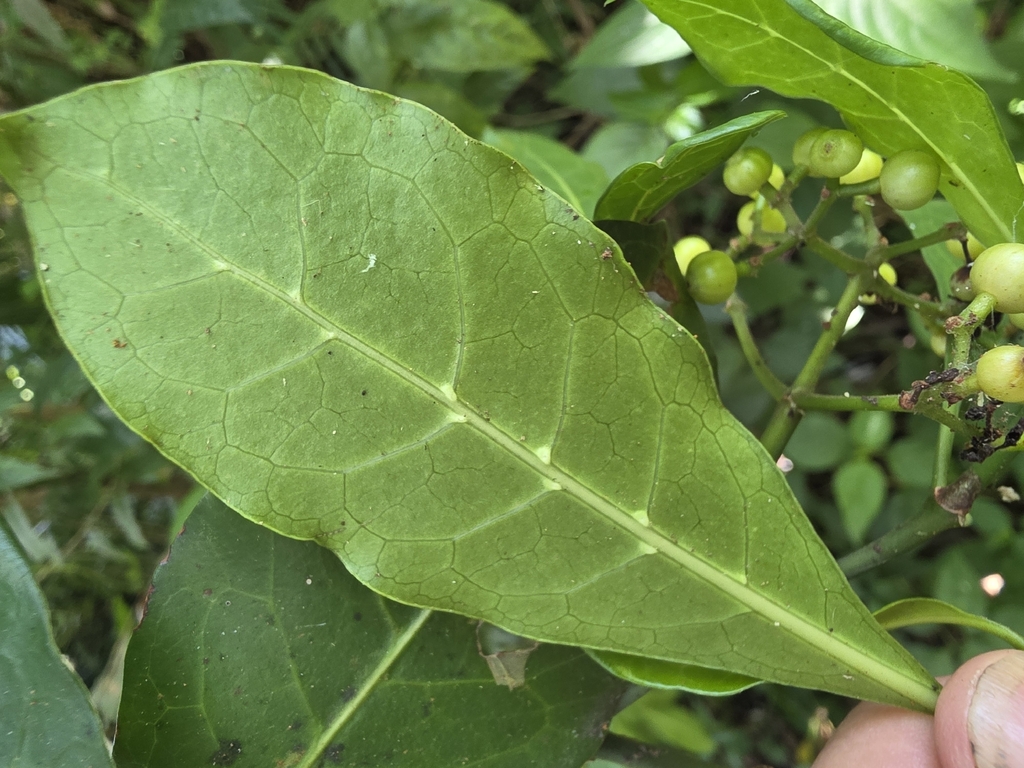
black bird-berry
Psychotria capensis
The Bird-berry (Psychotria capensis (Eckl.) Vatke) is a southern African evergreen shrub or small tree. It belongs to a genus which is used medicinally in many regions, 'Psychotria' being from the Greek for 'rejuvenating', in reference to the healing properties of certain species. Kew lists some 2,000 species of Psychotria growing throughout the warmer regions of both hemispheres, but only two of them occur in southern Africa, namely P. capensis and P. zombamontana.
From the article Psychotria capensis on Wikipedia (CC BY-SA), quoted section by section
Description
It grows to some 3 to 8 meters tall, and has a slender trunk, with horizontal branches and pale brown bark. The elliptic to obovate leaves are large (70-150 x 15-60 mm), leathery, glabrous, dark green above and paler below. They are opposite and often drooping. Yellow flowers are produced in terminal branched heads some 80 mm across from August to January, and are followed by bunches of pea-sized, shiny yellow fruits turning red or black when ripe. The wood is hard and fine-grained, yellowish-brown in colour.
Usually a shrub, sometimes a tree up to 10-15 feet height, with 3-6 inch stem diam., and with crooked and forked timber. Leaves evergreen, shining above, paler below, widely lanceolate, elliptic or obovate-oblong, 3-6 inches long, 1/2 – 1 1/2 inches wide, shortly petioled, distinctly veined, rounded at the apex or bluntly pointed, glabrous above, and either glabrous or pubescent below. Panicles few or many-flowered, terminal, trichotomously forked, 1-4 inches across. Calyx-tube short, minutely 5-toothed. Corolla yellow, shortly tubular, with 5-parted limb and a hairy throat. Stamens in the throat of the corolla tube, with shortly oblong anthers. Pistil bifid. Berries numerous, reddish, 3 lines diameter, with only a scar where the calyx has been. Stipules shortly ovate from a broad base, bluntly pointed. …
Range & habitat
It occurs along the South African south and east coasts, from Knysna through the Eastern Cape and KwaZulu-Natal. It is also present in eastern Mpumalanga and Limpopo provinces and northwards in Zimbabwe and Mozambique. It is found from sea level to 1,500 m in evergreen forests, along forest margins, dune scrub, along river courses and on rocky outcrops in high rainfall grassland.
Wikipedia: “Range and habitat”
Where it lives
Recorded sightings
—
geo-referenced records in GBIF, from museums, herbaria and field observers.
Drag the globe to turn it. Dots are where records exist, not a range map; darker means more records.
In the stacks
Searching the stacks…
Every page naming Psychotria capensis in the Biodiversity Heritage Library →
This page is assembled live from iNaturalist, GBIF, Wikipedia, the Source Library and the Internet Archive. It is not yet part of the hand-edited codex. iNaturalist taxon 431505.