- Plants
- ›Vascular Plants
- ›flowering plants
- ›Dicots
- ›myrtles, evening primroses, and allies
- ›myrtle family
- ›Myrtoideae
- ›Syzygieae
- ›Syzygium
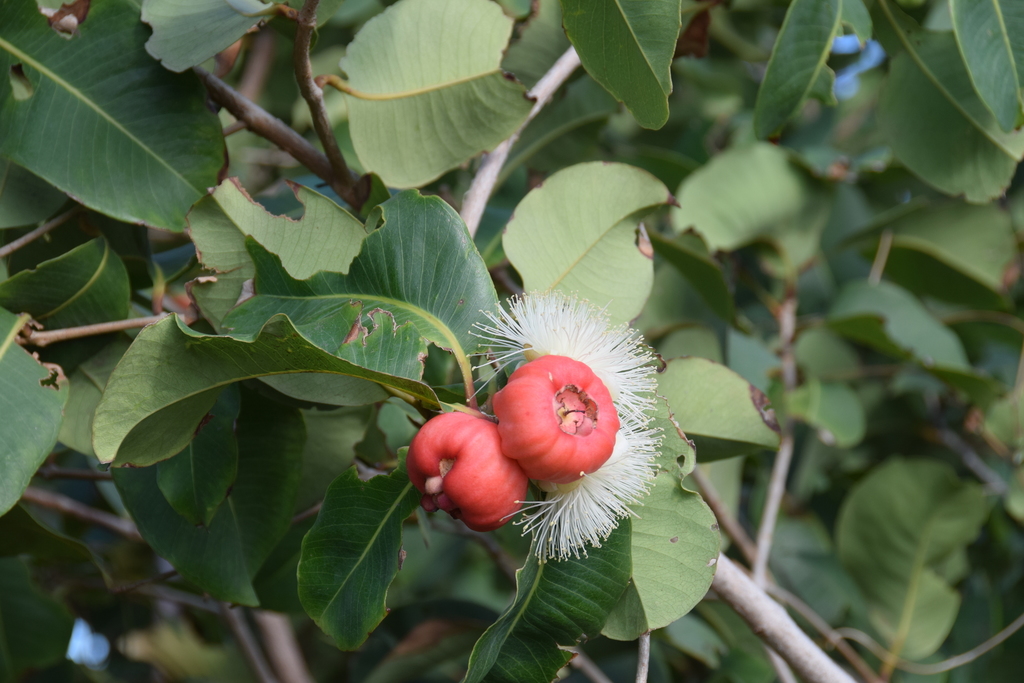
red bush apple
Syzygium suborbiculare
Syzygium suborbiculare, the red bush apple or lady apple, is a shrub or small understorey tree native to northern Australia (the Northern Territory, Queensland, and northern Western Australia) and New Guinea.
From the article Syzygium suborbiculare on Wikipedia (CC BY-SA), quoted section by section
Description
This tree or shrub typically grows to a height of 4 to 20 metres (13 to 66 ft). It blooms between June and November producing white flowers. The leaves are smooth, thick, leathery, broad oval 7.2–19 cm long. Flowers are white with numerous stamens. The edible fruit is flattened-globular, fleshy, prominently ribbed, 3–7 cm long, with a large seed.
Range & habitat
It is found in open forests and woodland and on the flood plains and rocky sandstone hills of the Kimberley region of Western Australia where it grows in sandy soils.
Wikipedia: “Habitat”
At the table
The fruit is eaten raw by Aboriginal people. The tree is also used as firewood and as a nectar source for bees. The fruit has been regarded among the Aboriginal people as being particularly medicinally effective against respiratory problems. The juice extracted from the boiled or roasted fruit has been used to clear chest congestion or as a cough remedy; the fire-heated leaves were used to heal wounds; the pulp of a cooked fruit has been used to treat a sore ear; chewed fruit or seeds have been used as a remedy against toothache or mouth sores.
== References ==
Wikipedia: “Uses”
Where it lives
Recorded sightings
—
geo-referenced records in GBIF, from museums, herbaria and field observers.
Drag the globe to turn it. Dots are where records exist, not a range map; darker means more records.
In the stacks
Searching the stacks…
Every page naming Syzygium suborbiculare in the Biodiversity Heritage Library →
This page is assembled live from iNaturalist, GBIF, Wikipedia, the Source Library and the Internet Archive. It is not yet part of the hand-edited codex. iNaturalist taxon 431665.