- Plants
- ›Vascular Plants
- ›flowering plants
- ›Dicots
- ›Mints, Plantains, Olives, and Allies
- ›Acanthus Family
- ›Acanthoideae
- ›Ruellieae
- ›Trichantherinae
- ›Trichanthera
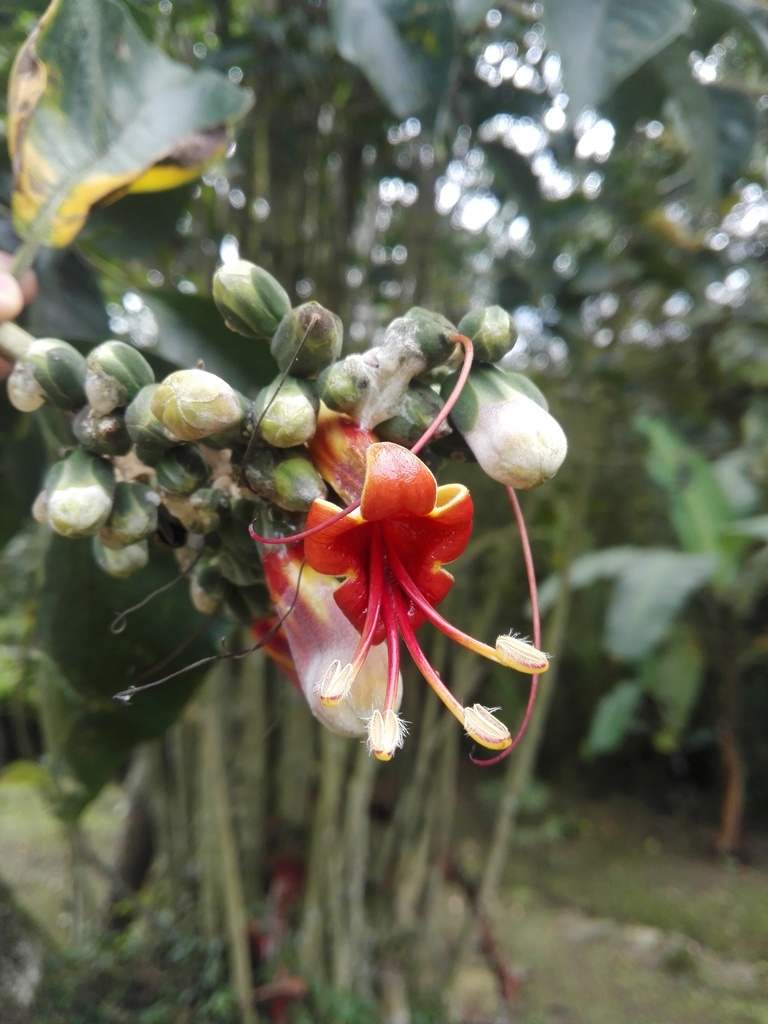
Trichanthera gigantea
Trichanthera is a monotypic genus of flowering plants in the acanthus family containing the single species Trichanthera gigantea, which is known by many common names, including madre de agua, suiban, cenicero, tuno, naranjillo, and palo de agua. It is native to Central America and northern South America. It has also been introduced to other tropical regions such as Vietnam, Cambodia, and the Philippines.
From the article Trichanthera gigantea on Wikipedia (CC BY-SA), quoted section by section
Description
Trichanthera gigantea grows as a shrub or tree up to 5 meters tall, though a 15-meter specimen was reported once. It often produces aerial roots. The oval or oblong leaves are up to 26 centimeters long by 14 wide and are borne on short petioles. The flower is maroon with a yellow throat. It is bell-shaped and the throat measures up to 2.5 centimeters long. The plant blooms in the afternoon and the flowers fall away during the night. The flowers are pollinated by bats. The bat Glossophaga soricina has been seen at the flowers of this species.
At the table
This plant is cultivated as an animal fodder and fed to ducks, pigs, and rabbits. Its leaves are relatively rich in protein. It has veterinary uses in Colombia, where it has been used to treat horse colic and retained placenta in cows. This plant also has many uses for humans. It has uses in human medicine, including as a supplement to increase lactation in nursing mothers. It is used as a living fence and a shade tree.
== References ==
Wikipedia: “Uses”
Where it lives
Recorded sightings
—
geo-referenced records in GBIF, from museums, herbaria and field observers.
Drag the globe to turn it. Dots are where records exist, not a range map; darker means more records.
In the stacks
Searching the stacks…
Every page naming Trichanthera gigantea in the Biodiversity Heritage Library →
This page is assembled live from iNaturalist, GBIF, Wikipedia, the Source Library and the Internet Archive. It is not yet part of the hand-edited codex. iNaturalist taxon 431693.