- Animals
- ›Chordates
- ›Vertebrates
- ›Birds
- ›Cranes, Rails, and Allies
- ›Rails, Gallinules, and Coots
- ›Gallirallus
On eBird ↗
Guam Rail
Live sightings near you, the range map, bar charts of when it is seen, and Macaulay Library photos and recordings.
Guam Rail
Gallirallus owstoni
The Guam rail (Gallirallus owstoni), known locally and in Chamorro as ko'ko', is a small, terrestrial bird endemic to Guam in the Rallidae family. They are one of the island's few remaining endemic bird species. The species became extinct in the wild in the early 1980s when biologists captured the remaining wild population to establish a breeding program. They have since been successfully introduced to the nearby Rota and Cocos islands. In 2019, they became the second bird species to be reclassified by the International Union for the Conservation of Nature from Extinct in the Wild to Critically Endangered.
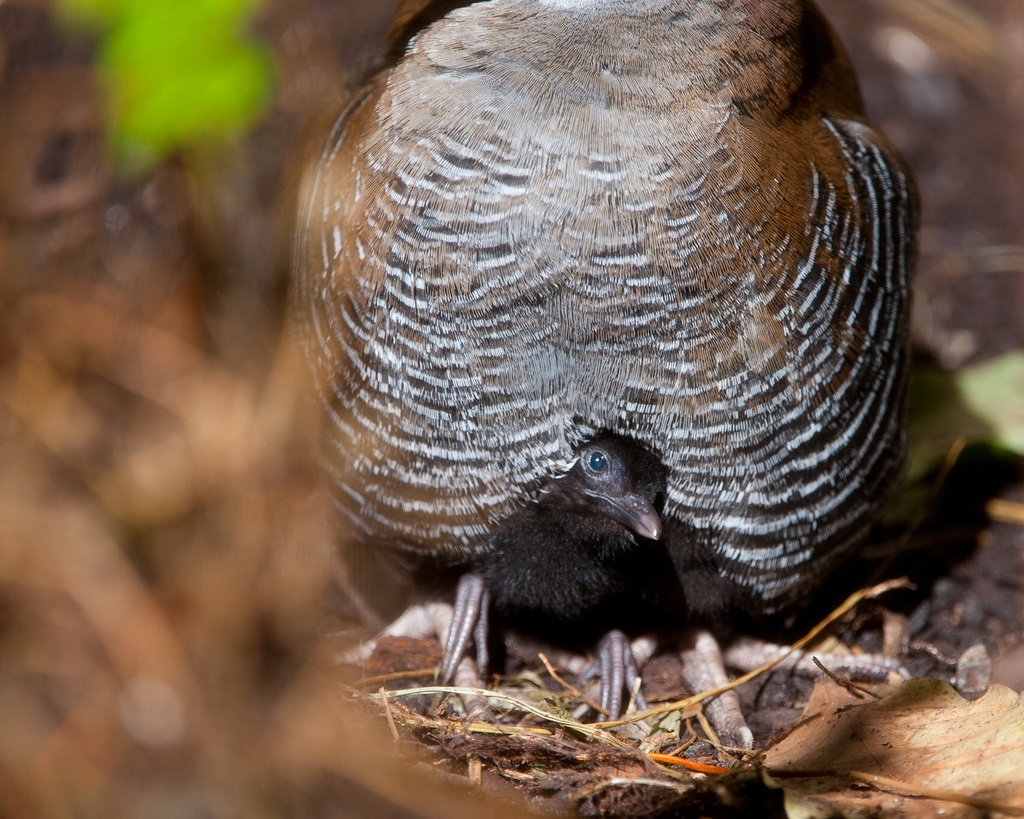
Adult male and female plumage is primarily brown with barred black-and-white plumage on their underside. Their heads are brown with a grey stripe running above the eye and a medium-length grey bill. They have strong legs with long toes that help them walk over marshy ground. Their most common vocalizations are short "kip" notes, but also screeches during the breeding season.
From the article Guam rail on Wikipedia (CC BY-SA), quoted section by section
Description
Guam rails are a medium-sized rail species, growing to about 11 inches (28 cm) in total length. Adults will weigh around 7 to 12 ounces (200 to 350 grams). They have an elongated body, with small wings and medium-length legs. Guam rails have underdeveloped wing muscles and are considered flightless, though they can fly about 3 to 10 feet (1 to 3 meters) at once. Their strong leg muscles make them fast runners instead. Adult Guam rails are monomorphic, meaning males and females have the same plumage and characteristics. They are primarily brown, with a grey bill and tan-colored legs. The head and back are brown. It has a grey eye stripe and throat, a dark blackish breast with white barring, and the legs and beak are dark brown.
Range & habitat
Historically, the rail was found only on Guam. The island covers about 132,230 acres. According to a 2013 survey, about 53% of the island is forested. Rails were once distributed widely across most habitats on the island, including mixed forest, savanna, grasslands, fern thickets, and agricultural areas. Individuals observed by the Guam Division of Aquatic and Wildlife Resources were noted as preferring edge habitats that provided good cover. Today, the rail is still found on Guam, though in captivity, with wild populations introduced on Rota and Cocos Islands. Since 1985, the rails have only lived in captivity on Guam, located at the Guam Department of Agriculture.
Wikipedia: “Distribution and habitat”
What it does
Guam rails are secretive, fast birds. Though they are capable of a short bursts of flight, they seldom fly. It was found more frequently in savannas and scrubby mixed forest than in uniform tracts of mature forest. It was usually found in dense vegetation but it was also observed bathing or feeding along roadsides or forest edges. Its call is a loud, piercing whistle or series of whistles, usually given by two or more birds in response to a loud noise, the call of another rail, or other disturbances. Though individuals will respond almost invariably to the call of another rail, the species is generally silent.
Breeding. It is a year-round ground nester and lays 2–4 eggs per clutch, and both parents share in the construction of a shallow nest of leaves and grass. They mature at six months of age, and have been known to produce up to 10 clutches per year in captivity. Their nesting habits make them highly susceptible to predators, such as the native Mariana monitor and the invasive feral pig, feral cat, feral dog, mangrove monitor, brown tree snake, black rat, and Norway rat.
Food and feeding. Guam rails are omnivorous foragers known to consume gastropods, insects, geckos, seeds, and vegetable matter. A large part of their diet consists of giant African snails, which were introduced to Guam around 1945 and became an easy food source for the birds. …
Wikipedia: “Ecology and behavior”
In human culture
The Guam rail was first described as Hypotaenidia owstoni in 1895 by Lord Walter Rothschild. Rothschild announced the specific name owstoni was "in honour of Mr. Alan Owston, of Yokohama, whose men have collected for me on the Marianne Islands." The generic name, Hypotaenidia, comes from the Ancient Greek hypo meaning "under" and tainia meaning "stripe" or "band." This refers to the banded feathers seen on their underside and wings, typically found across rail species. The Guam rail is now placed in the genus Gallirallus that was introduced in 1841 by Frédéric de Lafresnaye.
Wikipedia: “Taxonomy and etymology”
Listen
Looking for field recordings…
Where it lives
Recorded sightings
—
geo-referenced records in GBIF, from museums, herbaria and field observers.
Drag the globe to turn it. Dots are where records exist, not a range map; darker means more records.
In the stacks
Searching the stacks…
Every page naming Gallirallus owstoni in the Biodiversity Heritage Library →
This page is assembled live from iNaturalist, GBIF, Wikipedia, the Source Library and the Internet Archive. It is not yet part of the hand-edited codex. iNaturalist taxon 435.