- Plants
- ›Vascular Plants
- ›flowering plants
- ›monocots
- ›Agaves, Orchids, Irises, and Allies
- ›Aloe family
- ›Aloes and allies
- ›Aloe
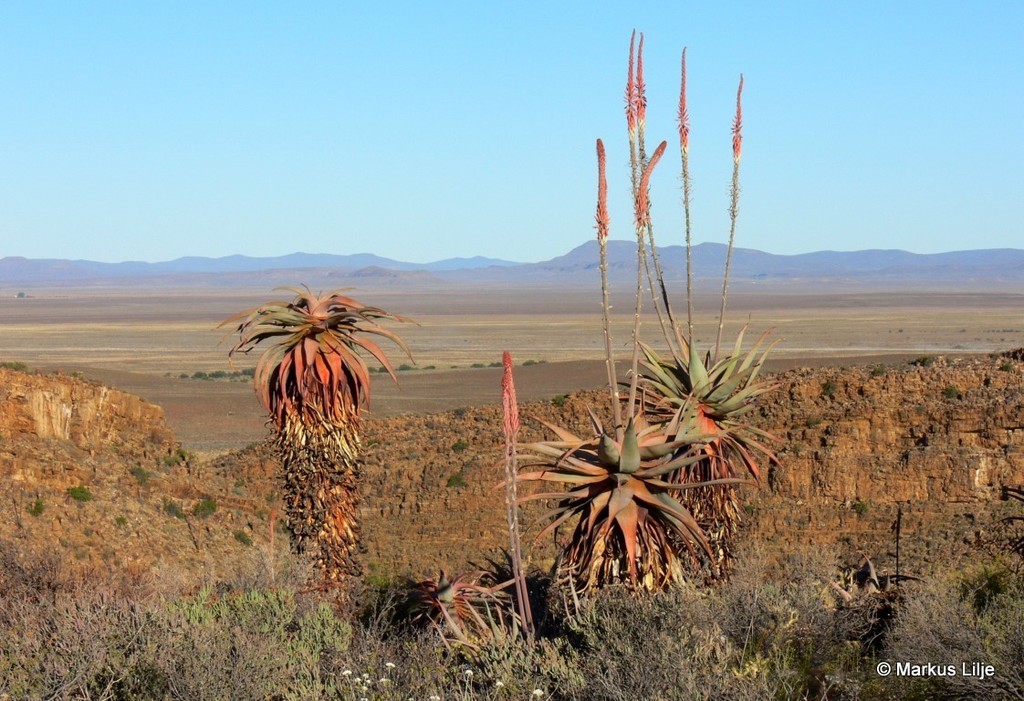
Clanwilliam aloe
Aloe comosa
Aloe comosa is a species of flowering plant in the Asphodelaceae family. It is commonly called Clanwilliam aloe and is endemic to South Africa.
From the article Aloe comosa on Wikipedia (CC BY-SA), quoted section by section
Description
Typically, Aloe comosa has thick, succulent leaf blades approximately 2 feet (0.6 metres) long. The leaves are lanceolate with a glabrous surface. The edges of the leaves are entire, curved upwards (involute) and lined with spiny, tooth-like, brown-red thorns. The fleshy blades have a whorled leaf insertion as they emerge from the rosette which is at the end of an erect stem. Aloe comosa is considered a tree aloe, having a single, unbranched stem which may attain heights of approximately 3 m (9.8 ft). As it matures and grows in height, it retains its dry, dead leaves which form a tangled mass resembling a skirt or a beard. Tree aloe bark differs from woody dicot bark in that it does not have a phellogen, which is the meristematic tissue that differentiates into bark. In essence, aloe bark is actually overlapping, irregular layers of incomplete bark tissues. A study in 1983 considered the purpose of retaining dead leaves by several species of tree aloe. Previous ideas were that dead-leaf retention protected bare bark from the sun during the day and the cold at night or that the thorny mass of leaves could deter unwanted wild life in search for water, nectar, or seeds. It was proposed that dead-leaf retention was selected to provide thick, fire resistant bark in a fire-prone habitat.
Reproduction. Naturally, Aloe comosa follows the typical angiosperm life cycle. …
Range & habitat
Aloe comosa inhabits a very small region within the Western Cape province of South Africa. It was discovered in the Olifants River Valley in 1905, north of the town Clanwilliam (hence its common name).
Wikipedia: “Distribution”
At the table
The genus Aloe currently consists of over 650 species. A few species of aloe are used to treat minor thermal burns, itching, and sunburn by applying the thick, mucilaginous gel to the skin, but Aloe comosa is not one of those species. Its only apparent uses are a decorative house plant and collector's item. Even though Aloe comosa is indigenous to the Western Cape of South Africa, it is possible for experienced collectors and horticulturalists to maintain their plants outdoors, in Arizona and California for instance, or in a desert climate greenhouse.
== References ==
Wikipedia: “Uses”
Where it lives
Recorded sightings
—
geo-referenced records in GBIF, from museums, herbaria and field observers.
Drag the globe to turn it. Dots are where records exist, not a range map; darker means more records.
In the stacks
Searching the stacks…
Every page naming Aloe comosa in the Biodiversity Heritage Library →
This page is assembled live from iNaturalist, GBIF, Wikipedia, the Source Library and the Internet Archive. It is not yet part of the hand-edited codex. iNaturalist taxon 435488.