- Plants
- ›Vascular Plants
- ›flowering plants
- ›monocots
- ›Agaves, Orchids, Irises, and Allies
- ›iris family
- ›Iridoideae
- ›Irideae
- ›Iris
- ›Iris
- ›Iris
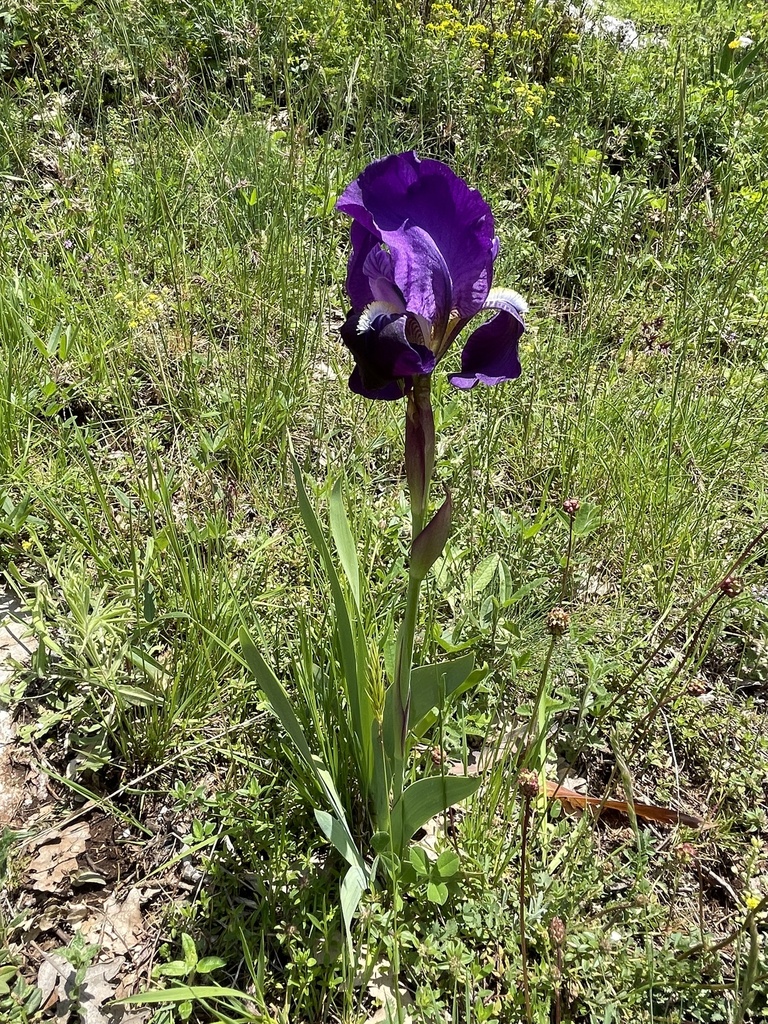
Iris marsica
Iris marsica is a plant species in the genus Iris, it is also in the subgenus Iris. It is a rhizomatous perennial, from the Apennine Mountains, in Italy. It has glaucous, sickle-shaped or curved, light green leaves, slender stem with 2 branches, and 3 violet, light blue violet, dark violet, and dark purple flowers. It was only found and described since 1973, and is not yet in general cultivation. It was once thought to be a form of Iris germanica, but has different morphological characteristics and different chromosomal differences.
From the article Iris marsica on Wikipedia (CC BY-SA), quoted section by section
Description
It is similar in form to Iris germanica, but it has more curved leaves (or sickle-shaped,) greener, and longer leaves, the stem is less glaucous, and it has less scarious (membranous) spathes. It has a thick rhizome, with many stoloniferous and fibrous branches. The rhizomes grow at ground level. It has herbaceous, (or deciduous), falcate (sickle-shaped), light green and slightly glaucous leaves. They can grow up to 30 cm (12 in) long. They often have 2–3 basal (rising from the rhizome) leaves, with one sheathing the stem. It has a flattened stem, or peduncle, that can grow up to between 30–65 cm (12–26 in) tall. It has 2 short branches, (or pedicels), the lowest branch is similar in length to the bract. The other branch, appears from the midpoint on the stem. The stem has 2–3 green, marked with purple, slightly inflated, rounded, spathes (leaves of the flower bud). They are scarious (along the top part of the leaf), at blooming time. The stem (and the branches) hold up to 3 flowers, in early season, in April, May, or between May and June. The slightly fragrant, flowers come in shades of violet, light blue violet, dark violet, and dark purple. It sometimes has bi-toned flowers. Like other irises, it has 2 pairs of petals, 3 large sepals (outer petals), known as the 'falls' and 3 inner, smaller petals (or tepals), known as the 'standards'. …
Range & habitat
It is endemic to Italy, within the regions of Umbria, Marche, Lazio, Molise and Abruzzo. It has geographic range of 4,083 km2 (1,576 sq mi), which includes the Apennine Mountains, Monti Simbruini (with Iris sambucina (a synonym of Iris germanica L.) and Iris chameiris (a synonym of Iris lutescens Lam.)), and The Abruzzo National Park. It is listed in a checklist of Vascular Flora in Italy, with Iris albicans, Iris bicapitata, Iris foetidissima, Iris germanica, Iris marsica, Iris pallida, Iris planifolia, Iris pseudacorus, Iris pseudopumila, Iris relicta, Iris revoluta Iris setina, Iris sibirica and Iris xiphium. It is also listed as endemic species of the Apennines with Aquilegia magellensis, Centaurea scannensis, Jonopsidium savianum, Goniolimon italicum, Astragalus aquilanus and Achillea luncana.
Wikipedia: “Range”
Toxicity
Like many other irises, most parts of the plant are poisonous (rhizome and leaves), and if mistakenly ingested can cause stomach pains and vomiting. Handling the plant may cause skin irritation or an allergic reaction.
How it is grown
It is hardy. It prefers situations in well-drained soils in full sun. It can be grown on slopes, and can be grown in similar situations as other bearded irises. It is not regularly available for sale, but only cultivated by iris collectors. Specimens can be seen in 'Michele Tenore Majella Botanical Garden', (also known as 'Giardino Botanico della Majella') situated within the scree slopes section of the garden.
Propagation. Irises can generally be propagated by division, or by seed growing.
Wikipedia: “Cultivation”
Where it lives
Recorded sightings
—
geo-referenced records in GBIF, from museums, herbaria and field observers.
Drag the globe to turn it. Dots are where records exist, not a range map; darker means more records.
In the stacks
Searching the stacks…
Every page naming Iris marsica in the Biodiversity Heritage Library →
This page is assembled live from iNaturalist, GBIF, Wikipedia, the Source Library and the Internet Archive. It is not yet part of the hand-edited codex. iNaturalist taxon 436585.