- Plants
- ›Vascular Plants
- ›flowering plants
- ›monocots
- ›Agaves, Orchids, Irises, and Allies
- ›iris family
- ›Iridoideae
- ›Irideae
- ›Iris
- ›Iris
- ›Iris
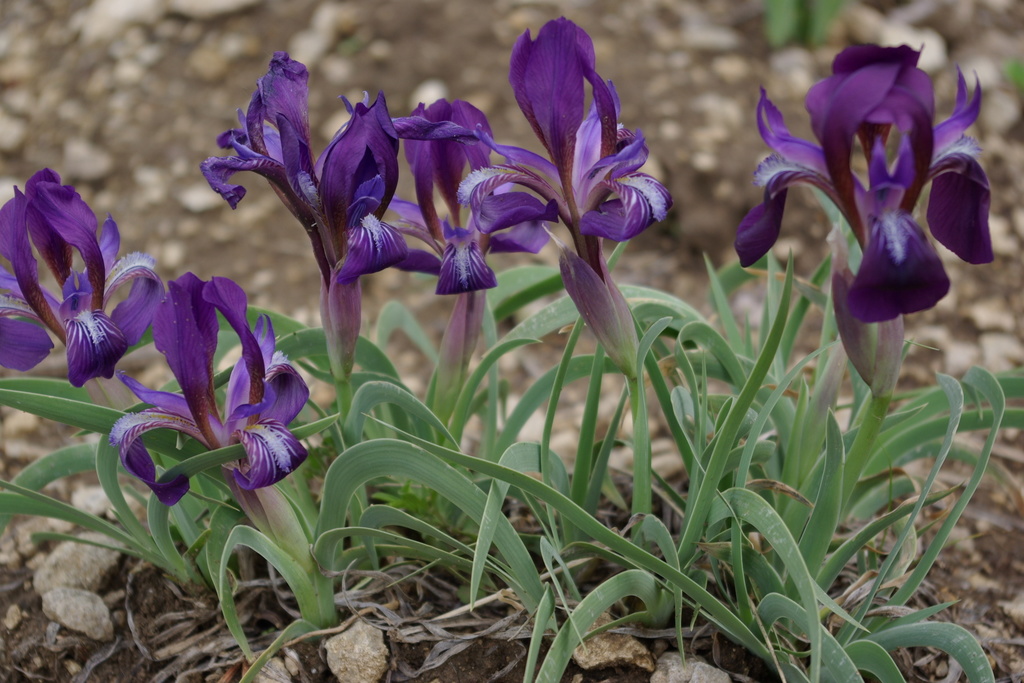
Iris timofejewii
Iris timofejewii is a species of flowering plant in the genus Iris, and also in the subgenus Iris. It is a rhizomatous perennial, from the mountain slopes of the Caucasus and Dagestan. It has narrow, evergreen, falcate (sickle-shaped), grey-green (glaucous) leaves, and a short flowering stem just taller than the leaves. Each stem has 1–2 flowers in shades of violet, with white beards that have purple tips. It is cultivated as an ornamental plant in temperate regions.
From the article Iris timofejewii on Wikipedia (CC BY-SA), quoted section by section
Description
Iris timofejewii is close in form to Iris scariosa, or Iris pumila. It has a slender stem or peduncle, that can grow up to between 10–25 cm (4–10 in) tall. The stem is normally taller than the foliage. The stem has two acute, carinate (keeled), spathes (leaves of the flower bud). It holds between 1, and 2 terminal (top of stem) flowers, in late spring and early summer, in June. It has evergreen, grey-green, or blue-green, or glaucous leaves. They are falcate, or recurved. The narrow leaves, can grow up to between 12–25 cm (5–10 in) long, and between 5 -6mm wide. The flowers are very similar to aril iris species flowers. The flowers are 4–6 cm (2–2 in) in diameter, come in shades of violet, from reddish-violet, reddish brown, to blue-violet, dark violet, to purple. They are similar in form to Iris germanica, or Iris section Regalia flowers. Like other irises, it has 2 pairs of petals, 3 large sepals (outer petals), known as the 'falls' and 3 inner, smaller petals (or tepals), known as the 'standards'. The narrow, and tucked, falls are obovate. In the middle of the falls, is a row of short hairs called the 'beard', which is white, or yellow, with purple tips. The standards are oblanceolate-oblong, with round tips. It has style branches that are a similar length to the falls and a perianth tube which is 4–5 times as longer than the ovary. …
Range & habitat
Iris timofejewii is native to temperate regions of Asia, specifically the Eastern Caucasus, and is endemic to Dagestan, (including the districts of Akhvakhskiy, Akhtynskiy Botlikhskiy, Gumbetovskiy, Gunibskiy, Karabudakhkentskiy, Levashinskiy, Shamilskiy, Tsumadisnkiy, and Untsukulskiy,) a republic of Russia. They can be found at an altitude of 500–1,500 m (1,600–4,900 ft) above sea level, growing on the dry, rocky mountain, slopes, (normally made of limestone,) or scrubland steppes.
Wikipedia: “Distribution and habitat”
Toxicity
Like many other irises, most parts of the plant are poisonous (rhizome and leaves), and if mistakenly ingested can cause stomach pains and vomiting. Handling the plant may cause skin irritation or an allergic reaction.
How it is grown
Iris timofejewii prefers to grow in scree-like soils, in full sun, with low humidity (or in dry soils). It can be grown within garden rockeries. It needs a dry and warm summer to rest and to re-flower the next season. The species was tested for hardiness in the Russian botanical gardens of Alma-Ata, Baku, Bakuriani, Tallinn and Tbilisi. An attempt was tried to grow the iris in West Germany and the US (near New York City), but they were unsuccessful, due to high humidity conditions. It can normally only be found for cultivation in specialised iris nurseries. Irises can generally be propagated by division, or by seed growing. Seeds can be distributed around by ants and birds, which take between 2–3 years to germinate. Like other irises, it can be damaged by slugs and snails.
Wikipedia: “Cultivation”
Where it lives
Recorded sightings
—
geo-referenced records in GBIF, from museums, herbaria and field observers.
Drag the globe to turn it. Dots are where records exist, not a range map; darker means more records.
In the stacks
Searching the stacks…
Every page naming Iris timofejewii in the Biodiversity Heritage Library →
This page is assembled live from iNaturalist, GBIF, Wikipedia, the Source Library and the Internet Archive. It is not yet part of the hand-edited codex. iNaturalist taxon 436586.