- Animals
- ›Arthropods
- ›Crustaceans
- ›Typical Crustaceans
- ›Malacostracans
- ›Decapods, Isopods, and allies
- ›Decapods and Krill
- ›Decapods
- ›Crabs, Lobsters, Shrimps, and Allies
- ›Caridean Shrimps
- ›Pandaloidea
- ›Pandalid Shrimp
- ›Pandalus
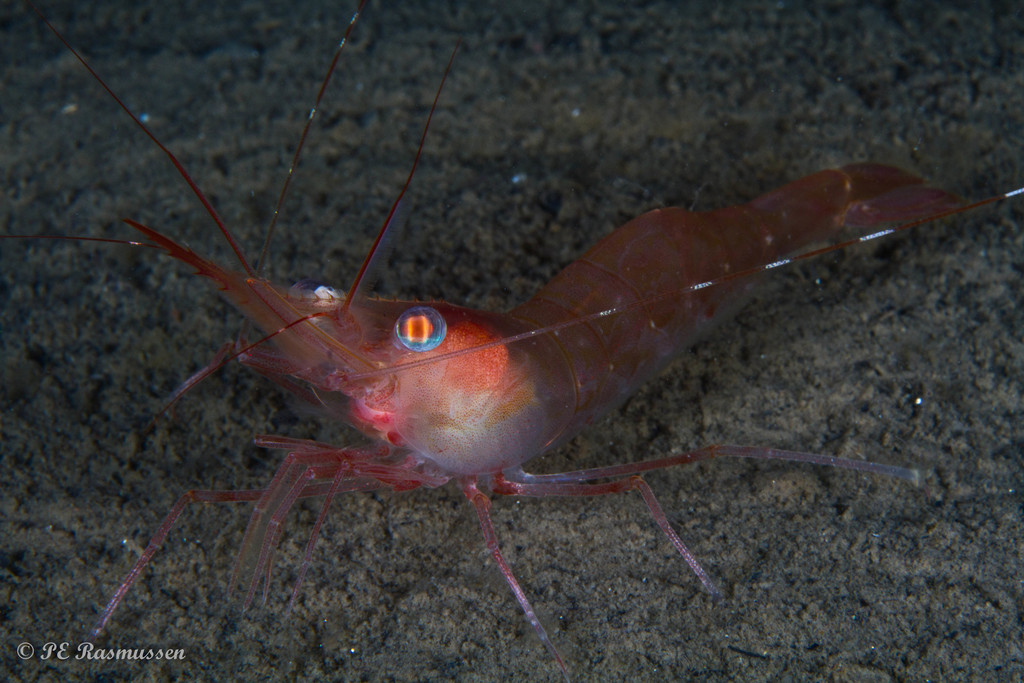
Northern Shrimp
Pandalus borealis
Pandalus borealis is a species of caridean shrimp found in cold parts of the northern Atlantic and northern Pacific Oceans, although the latter population now often is regarded as a separate species, P. eous. The Food and Agriculture Organization refers to them as the northern prawn. Other common names include pink shrimp, deepwater prawn, deep-sea prawn, Nordic shrimp, great northern prawn, northern shrimp, coldwater prawn and Maine shrimp.
From the article Pandalus borealis on Wikipedia (CC BY-SA), quoted section by section
Range & habitat
Pandalus borealis usually lives on a soft muddy bottoms at depths of 20 to 1,330 m (66–4,364 ft), in waters with a temperature of 0 to 8 °C (32–46 °F), although it has been recorded from 9 to 1,450 m (30–4,757 ft) and −2 to 12 °C (28–54 °F). P. borealis thrives in waters where the salinity ranges between 32 and 35 ppt, depending on where the shrimp are at in their life cycle. The distribution of the North Atlantic nominate subspecies P. b. borealis ranges from New England in the United States, Canada's eastern seaboard (off Newfoundland and Labrador and eastern Baffin Island in Nunavut), southern and eastern Greenland, Iceland, Svalbard, Norway and the North Sea as far south as the English Channel. The North Pacific P. b. eous is found from Japan and Korea, through the Sea of Okhotsk, across the Bering Strait, and as far south as the U.S. state of California. Instead of regarding it as a subspecies, the North Pacific population is often recognized as a separate species, P. eous.
Wikipedia: “Distribution”
What it does
Trophic DNA metabarcoding studies show that Pandalus borealis plays a key role in Arctic food webs, by feeding on a diverse array of prey, including gelatinous zooplankton and chaetognaths. High diversity of fish DNA can also be detected in their stomachs, probably as a result of their role as generalized scavengers. This has led some authors to propose Pandalus borealis as an efficient natural sampler for assessing molecular fish diversity in Arctic marine ecosystems.
Wikipedia: “Ecology”
At the table
Beyond human consumption, shrimp alkaline phosphatase (SAP), an enzyme used in molecular biology, is obtained from Pandalus borealis, and the species' carapace is a source of chitosan, a versatile chemical used for such different applications as treating bleeding wounds, filtering wine or improving the soil in organic farming.
Wikipedia: “Uses”
Where it lives
Recorded sightings
—
geo-referenced records in GBIF, from museums, herbaria and field observers.
Drag the globe to turn it. Dots are where records exist, not a range map; darker means more records.
In the stacks
Searching the stacks…
Every page naming Pandalus borealis in the Biodiversity Heritage Library →
This page is assembled live from iNaturalist, GBIF, Wikipedia, the Source Library and the Internet Archive. It is not yet part of the hand-edited codex. iNaturalist taxon 437504.